


























Views
Downloads

Grade 2 Earth's Water Worksheet | Essential Science
Paste this activity's link or code into your existing LMS (Google Classroom, Canvas, Teams, Schoology, Moodle, etc.).
Students can open and work on the activity right away, with no student login required.
You'll still be able to track student progress and results from your teacher account.
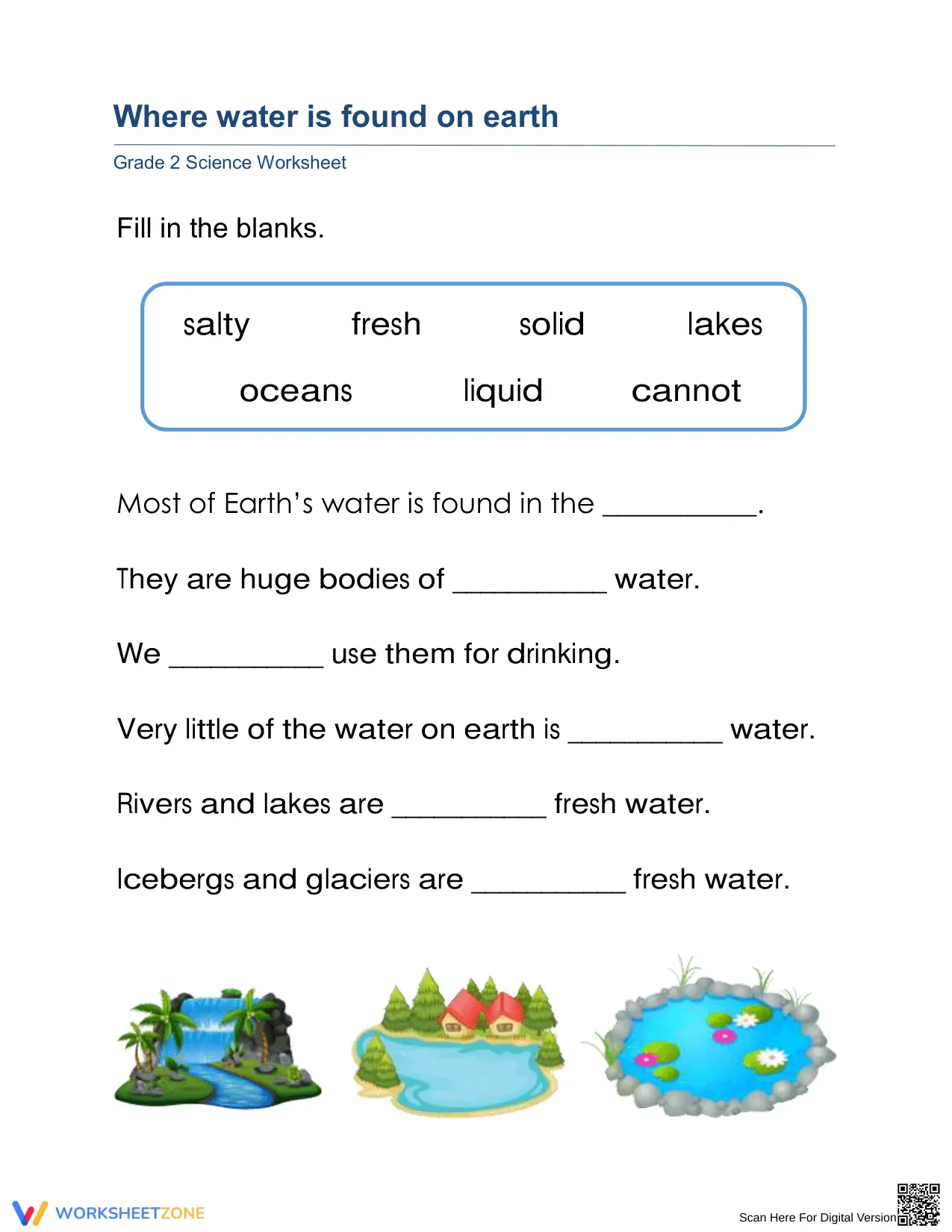
This Grade 2 science worksheet helps students identify the distribution and properties of water across the planet. By completing structured fill-in-the-blank sentences, learners distinguish between saltwater and freshwater sources while recognizing the physical states of water in different environments. It provides a clear framework for understanding Earth's hydrosphere through simple, observable facts.
At a Glance
- Grade: 2 · Subject: Science
- Standard:
2-ESS2-3— Identify where water is found on Earth and its physical states- Skill Focus: Earth's water distribution and properties
- Format: 2 pages · 6 problems · Answer key included · PDF
- Best For: Independent practice or quick formative assessment
- Time: 10–15 minutes
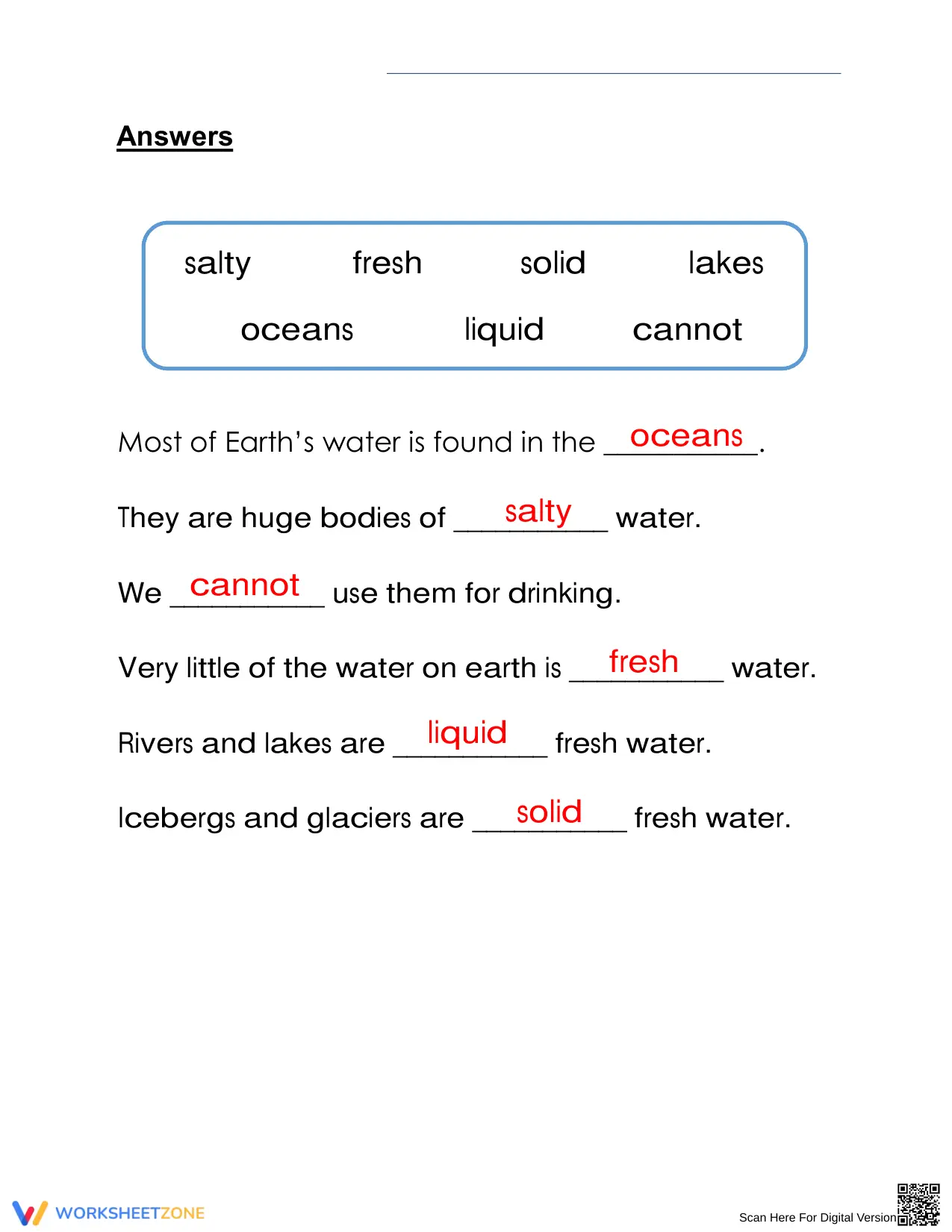
The resource features a single-page student activity accompanied by a full-page answer key for rapid grading. Students utilize a word bank containing seven key terms—including salty, fresh, solid, and liquid—to complete six descriptive sentences about oceans, rivers, and glaciers. The layout includes supportive illustrations of water bodies to provide visual context for early readers.
The zero-prep workflow is designed for maximum efficiency. First, print the single-page PDF in under 30 seconds. Second, distribute the sheets to students for independent work or as part of a guided science center. Third, use the provided answer key to review responses as a whole group or for individual grading in less than 2 minutes. This makes it an ideal resource for emergency sub plans or last-minute lesson additions.
This activity is aligned to 2-ESS2-3, which requires students to obtain information to identify where water is found on Earth and that it can be solid or liquid. It specifically addresses the distinction between the vast salt water of the oceans and the limited fresh water found in lakes and ice. Both standard codes can be copied directly into lesson plans, IEP goals, or district curriculum mapping tools.
Use this worksheet as a formative check for understanding after a direct instruction lesson on Earth's resources. Alternatively, assign it as a morning work task to activate prior knowledge before starting a unit on the water cycle. Teachers should observe if students can correctly categorize icebergs as "solid" to assess their grasp of physical states in nature. Expected completion time is approximately 12 minutes.
This resource is designed for second-grade students but serves as an excellent scaffold for English Language Learners (ELLs) or third graders needing a review of basic Earth science concepts. It pairs naturally with a classroom globe or a physical map of the world to help students visualize the oceans and lakes mentioned in the text.
Effective science instruction in early elementary grades relies on the integration of literacy and content-area knowledge. According to the RAND AIRS 2024 report, using structured text-based activities like fill-in-the-blank exercises helps young learners internalize domain-specific vocabulary while building reading comprehension. This worksheet targets the 2-ESS2-3 standard by requiring students to process information about Earth’s water distribution and its physical states. Research from Fisher & Frey (2014) emphasizes that providing a word bank serves as a critical scaffold for Tier 2 and Tier 3 vocabulary acquisition, ensuring that students focus on the scientific concepts rather than the mechanics of spelling. By identifying that most of Earth's water is salty and that glaciers represent solid fresh water, students build the foundational schema necessary for more complex hydrological studies in later grades. This resource provides a measurable way to track student progress toward NGSS mastery in a concise, accessible format.


