


























Views
Downloads

Proper Nouns Capitalization Worksheet | Grade 1 Printable
Paste this activity's link or code into your existing LMS (Google Classroom, Canvas, Teams, Schoology, Moodle, etc.).
Students can open and work on the activity right away, with no student login required.
You'll still be able to track student progress and results from your teacher account.
Help your young writers master essential English mechanics with this focused proper nouns and capitalization worksheet. Students will practice identifying specific names of people, places, and times that require a capital letter, moving from error correction to independent production. This resource ensures that Grade 1 learners understand when to use uppercase letters to distinguish unique identities from common objects.
At a Glance
- Grade: 1 · Subject: English Language Arts (ELA)
- Standard:
CCSS.ELA-LITERACY.L.1.2.A— Capitalize the names of people, specific places, days of the week, and months- Skill Focus: Proper Noun Identification and Capitalization
- Format: 3 pages · 21 problems · Answer key included · PDF
- Best For: Grammar centers and independent practice
- Time: 15–20 minutes
What's Inside
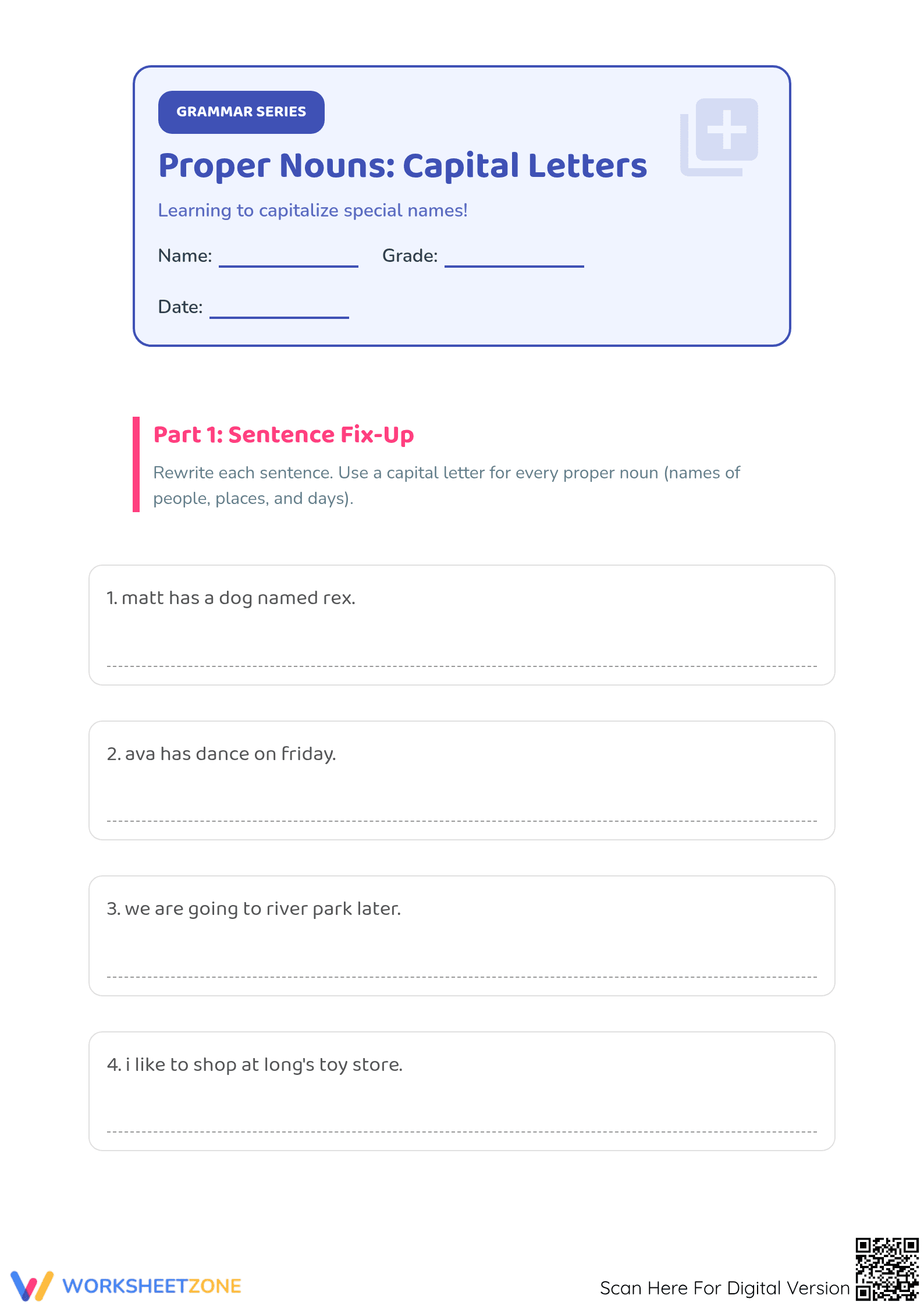
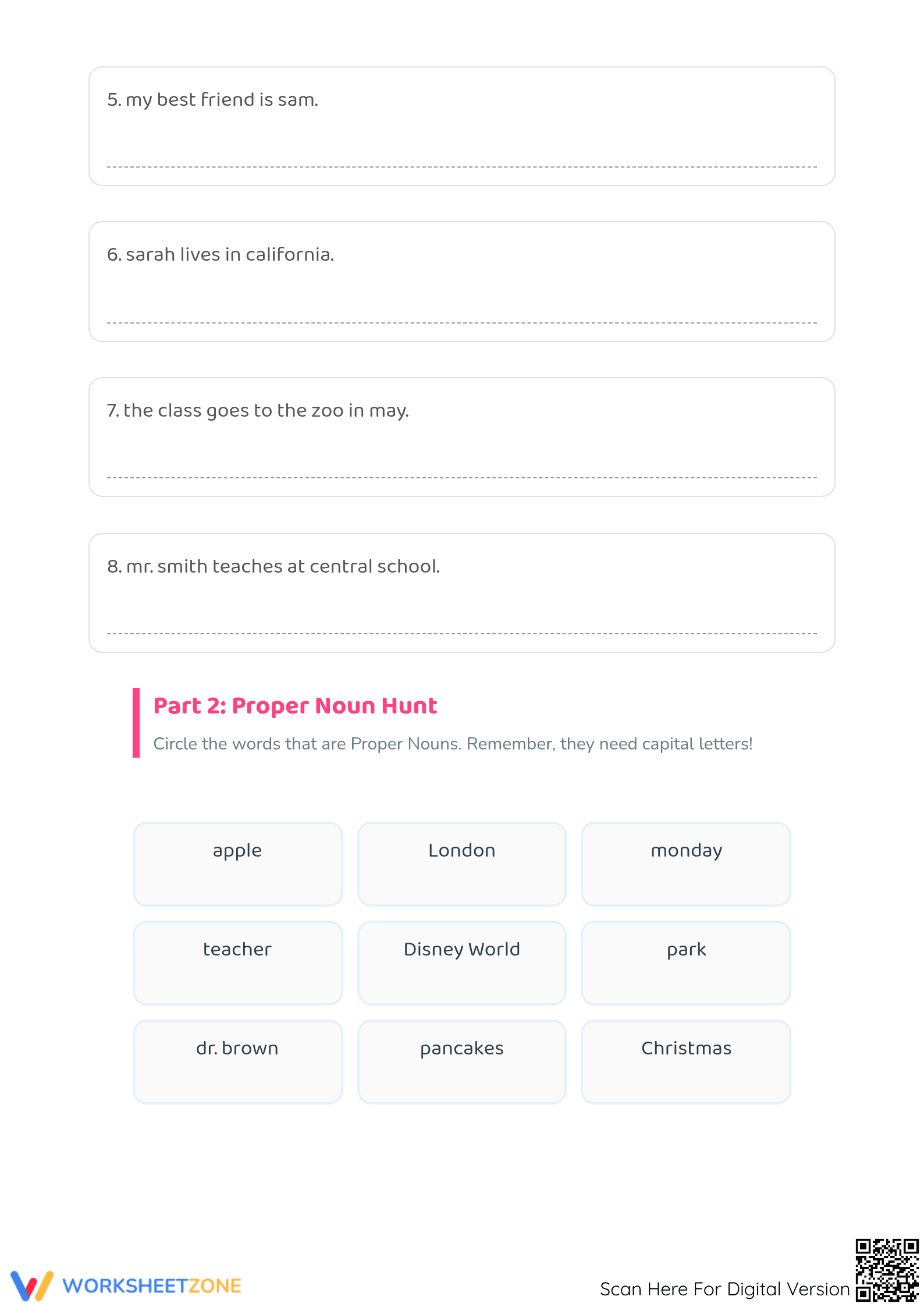
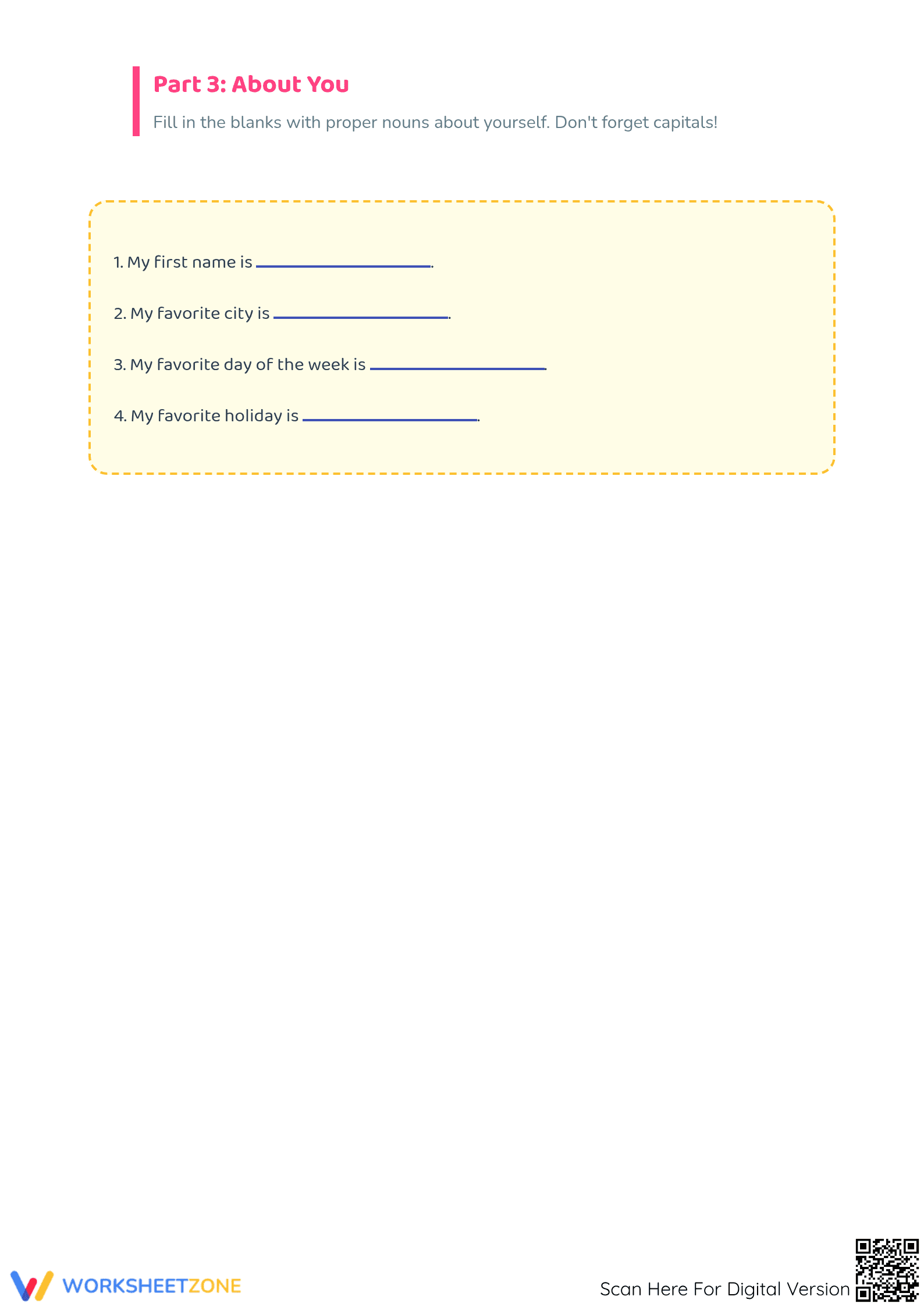
This comprehensive three-page PDF features a structured approach to mechanics. Part 1 provides eight "Sentence Fix-Up" tasks where students rewrite sentences to correct lowercase proper nouns like names and states. Part 2, the "Proper Noun Hunt," asks students to discriminate between nine common and proper nouns in a grid. Finally, Part 4 invites personal application through four fill-in-the-blank questions about the student's own life. A full answer key is included for quick grading or self-check.
Skill Progression
- Guided Practice: The Sentence Fix-Up section uses eight scaffolded sentences to help students identify errors in context, focusing on names like "Matt" and places like "River Park."
- Supported Practice: The Proper Noun Hunt provides nine isolated lexical items, challenging students to recognize the inherent "specialness" of words like "London" versus "apple."
- Independent Practice: The final section requires students to generate four original proper nouns from memory, applying capitalization rules to their own name, city, and favorite holiday.
This sequence follows the "I Do, We Do, You Do" model, ensuring students build confidence before working entirely on their own.
Standards Alignment
This resource is specifically designed to meet CCSS.ELA-LITERACY.L.1.2.A: "Capitalize dates and names of people." It also touches upon the broader language convention of capitalizing important words in names and places, which is foundational for Grade 1 writing standards. Both standard codes can be copied directly into lesson plans, IEP goals, or district curriculum mapping tools.
How to Use It
Use this worksheet as a follow-up to a direct instruction lesson on proper nouns. It works exceptionally well as a morning work assignment or a literacy center rotation. For a formative assessment, observe students during the "Proper Noun Hunt" to see if they can distinguish between specific names and general categories. The expected completion time for all three pages is approximately 20 minutes for a typical first grader.
Who It's For
This printable is ideal for Grade 1 students, but it also serves as an excellent remedial tool for Grade 2 students who need to reinforce capitalization habits. It is highly effective for ESL/ELL learners who are navigating the specific capitalization rules of English. Pair this with a proper noun anchor chart or a shared reading passage to maximize student engagement and mastery.
Grammar and mechanics instruction in primary grades requires a balance between explicit rule-following and meaningful application. This worksheet leverages the research-based gradual release model, as described by Fisher & Frey (2014), to move students from identifying errors to producing their own proper nouns. According to CCSS.ELA-LITERACY.L.1.2.A, Grade 1 students must master the capitalization of dates and names of people, a foundational skill that signals an understanding of the distinction between common and specific lexical categories. By practicing with 21 distinct items, students build orthographic mapping necessary for automaticity. The inclusion of personal facts in the final section ensures proper noun capitalization is not merely an abstract exercise but a tool for expressing identity and location. This instructional design supports long-term retention essential for early literacy and writing success.


