


























Views
Plays

Essential Pronunciation: -s and -es Ending Sounds
Paste this activity's link or code into your existing LMS (Google Classroom, Canvas, Teams, Schoology, Moodle, etc.).
Students can open and work on the activity right away, with no student login required.
You'll still be able to track student progress and results from your teacher account.
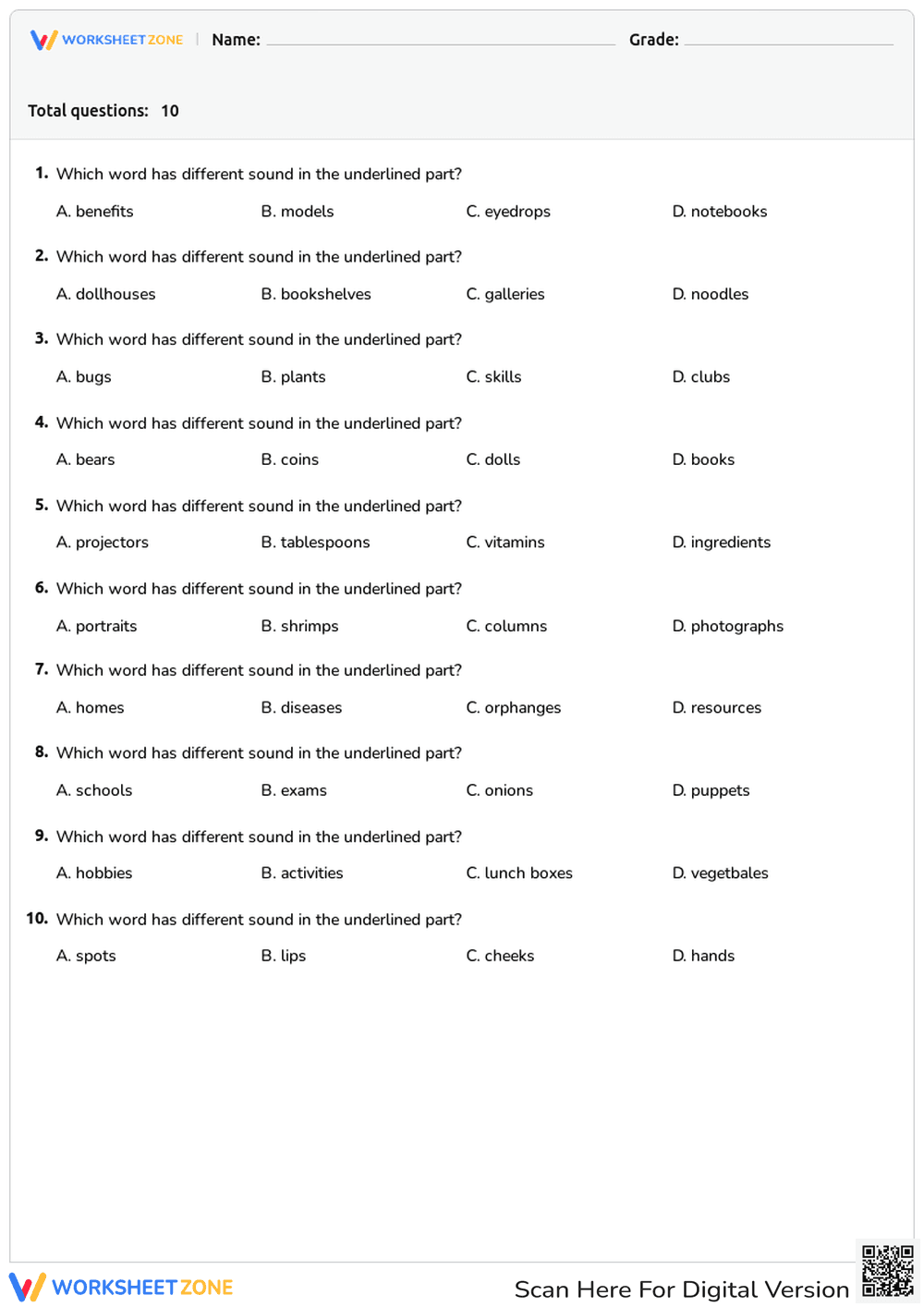
This Grade 1 and 2 phonics worksheet targets the auditory discrimination of final -s and -es sounds. Students analyze ten sets of words to identify the outlier pronunciation among /s/, /z/, and /ɪz/ endings. It provides immediate practice in recognizing how plural and verb inflections change based on phonetic context.
At a Glance
- Grade: 1-2 · Subject: ELA Phonics
- Standard:
CCSS.ELA-LITERACY.RF.1.3.F— Read words with inflectional endings to distinguish different sounds- Skill Focus: Final -s and -es pronunciation
- Format: 1 page · 10 problems · Answer key included · PDF
- Best For: Phonics centers and quick assessments
- Time: 10–15 minutes
The resource contains a single-page assessment featuring 10 multiple-choice questions. Each question presents four words with underlined final endings, such as "benefits," "models," "eyedrops," and "notebooks." A clear header tracks the total question count, and the layout is optimized for high-contrast printing and easy student navigation.
Skill Progression
- Guided practice: The first three questions use common high-frequency nouns to establish the pattern of voiced versus unvoiced endings in a controlled format.
- Supported practice: Questions 4-7 introduce multi-syllabic words like "projectors" and "ingredients" to test sound retention across longer phonetic strings.
- Independent practice: The final three questions require students to distinguish the /ɪz/ sound in words like "hobbies" and "lunch boxes" without external scaffolding.
This progression ensures students move from basic auditory recognition to complex phonetic analysis using the gradual release of responsibility model.
This resource aligns with `CCSS.ELA-LITERACY.RF.1.3.F`, which requires students to read words with inflectional endings. By focusing on the specific sounds produced by -s and -es, it also supports `CCSS.ELA-LITERACY.L.1.1.C` regarding singular and plural nouns with matching verbs. Both standard codes can be copied directly into lesson plans, IEP goals, or district curriculum mapping tools.
Use this worksheet as a formative assessment after a direct instruction lesson on voiced and unvoiced consonants. It is particularly effective during small-group literacy rotations where a teacher can listen to students pronounce the words aloud to check for mastery. Expect students to complete the 10 items in approximately 12 minutes.
This is designed for first and second-grade students, as well as English Language Learners (ELL) who struggle with the nuances of English pluralization. It pairs naturally with a phonics anchor chart illustrating the "Snake /s/" and "Bee /z/" sounds for visual reinforcement during the activity.
Research by Fisher & Frey (2014) emphasizes that phonological awareness, specifically the ability to distinguish subtle inflectional endings, is a critical precursor to reading fluency. This worksheet addresses the phonetic complexity of the English plural system, where the same grapheme represents three distinct phonemes. By isolating the final -s and -es sounds in 10 targeted tasks, the resource provides the repetitive exposure necessary for students to internalize the rules of voicing. Aligned to CCSS.ELA-LITERACY.RF.1.3.F, it supports the development of decoding skills by requiring students to look beyond the letter to the sound it produces in context. Such targeted practice is essential for Grade 1 and 2 learners to bridge the gap between spelling and speech, ensuring they can accurately decode and pronounce common inflectional endings in diverse texts.


