


























Views
Downloads

Printable Pronouns Worksheet | Grade 1 English Language Arts
Paste this activity's link or code into your existing LMS (Google Classroom, Canvas, Teams, Schoology, Moodle, etc.).
Students can open and work on the activity right away, with no student login required.
You'll still be able to track student progress and results from your teacher account.
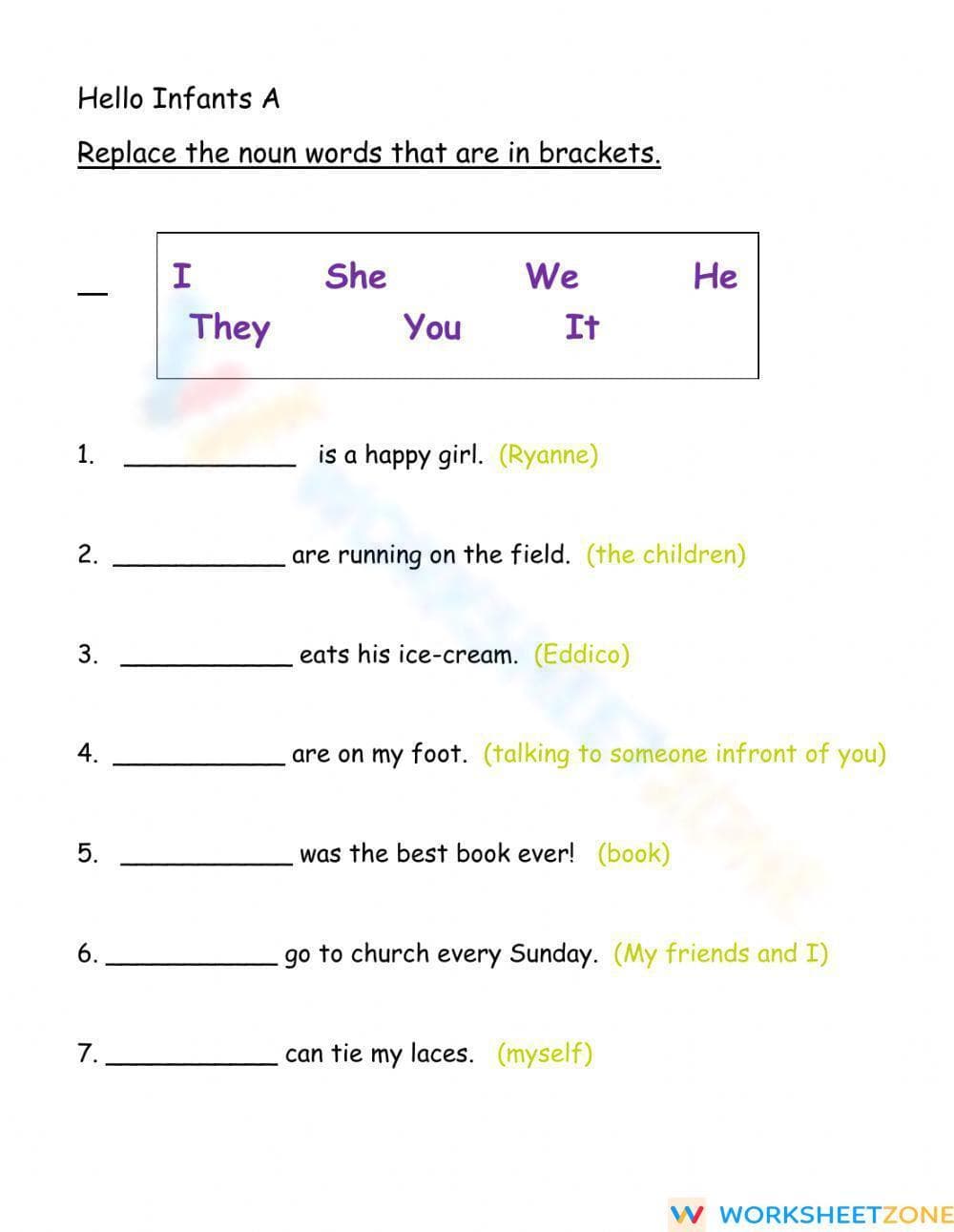
This printable pronouns worksheet provides Grade 1 students with focused practice in applying subjective personal pronouns. By replacing nouns with appropriate pronouns like "he," "she," and "it," learners build foundational grammar skills necessary for clear writing. This resource ensures instructional mastery and student success in early language arts.
At a Glance
- Grade: 1 · Subject: English Language Arts
- Standard:
CCSS.ELA-LITERACY.L.1.1.D— Use personal, possessive, and indefinite pronouns in speaking and writing- Skill Focus: Personal Pronoun Replacement
- Format: 1 page · 7 problems · Answer key included · PDF
- Best For: Grammar warm-ups and quick assessments
- Time: 10–15 minutes
What's Inside
The worksheet features a student-friendly layout designed for early primary learners. It includes a clear word bank containing seven essential pronouns: I, She, We, He, They, You, and It. Students complete seven fill-in-the-blank sentences by substituting nouns provided in brackets with the correct pronoun. The single-page format is perfect for keeping young learners focused and engaged without overwhelming them.
Zero-Prep Workflow
The zero-prep workflow follows three simple steps. First, Print the single-page PDF (30 seconds). Second, Distribute it to your class or small group (1 minute), as the word bank provides scaffolds for independent work. Finally, Review the answers using the included key (5 minutes) for immediate feedback. This makes it an ideal sub-plan, morning work activity, or quick check for understanding during a grammar unit.
Standards Alignment
Aligned to CCSS.ELA-LITERACY.L.1.1.D, this resource helps students use personal, possessive, and indefinite pronouns correctly. By practicing substitution in controlled sentences, students develop the syntactic awareness needed for more complex literacy tasks. Both standard codes can be copied directly into lesson plans, IEP goals, or district curriculum mapping tools to ensure instructional compliance and easy progress tracking.
How to Use It
Use this worksheet as a formative assessment after teaching personal pronouns. As students work, circulate and observe if they correctly match gendered pronouns or pluralities. A helpful tip is to watch for students who hesitate on the "My friends and I" prompt, which may indicate a need for collective pronoun instruction. Expect completion in 12 minutes, making it an excellent transition or bell-ringer activity.
Who It's For
Designed for Grade 1 and 2 students, this worksheet also supports Kindergarteners or English Language Learners needing basic pronoun practice. It pairs naturally with pronoun anchor charts or reading passages where students highlight pronouns they find in the text. The clear word bank specifically supports learners who are still developing their spelling and reading fluency in a structured environment.
The RAND AIRS 2024 study on primary literacy scaffolds indicates that explicit word banks and substitution tasks enhance a student's ability to internalize grammar rules without cognitive overload. This worksheet targets CCSS.ELA-LITERACY.L.1.1.D by requiring students to evaluate the relationship between nouns and their substitutes, a critical step in developing syntactic maturity. Research from Fisher & Frey (2014) emphasizes that "gradual release of responsibility" starts with high-support tasks, allowing students to practice specific skills before applying them to open-ended writing. By isolating personal pronouns within seven structured problems, this resource provides the repetition necessary for long-term retention. Such targeted interventions are essential for closing achievement gaps in early childhood education, ensuring all learners grasp the functional parts of speech before moving into complex composition and higher-order tasks.


