


























Views
Downloads


Essential Personal Pronouns Worksheet | Grade 2-3 ELA
Paste this activity's link or code into your existing LMS (Google Classroom, Canvas, Teams, Schoology, Moodle, etc.).
Students can open and work on the activity right away, with no student login required.
You'll still be able to track student progress and results from your teacher account.
Mastering personal pronouns is a foundational step in developing clear and concise writing for young learners. This comprehensive worksheet helps Grade 2 and Grade 3 students identify and apply pronouns like he, she, it, and they to avoid repetitive noun usage. By completing these exercises, students gain the confidence to structure sentences effectively in their daily writing.
At a Glance
- Grade: 2-3 · Subject: English Language Arts
- Standard:
CCSS.ELA-LITERACY.L.2.1— Use pronouns to replace nouns and complete sentences accurately.- Skill Focus: Personal Pronoun Identification and Application
- Format: 2 pages · 30 problems · Answer key included · PDF
- Best For: Grammar centers and independent practice
- Time: 20–30 minutes
What's Inside
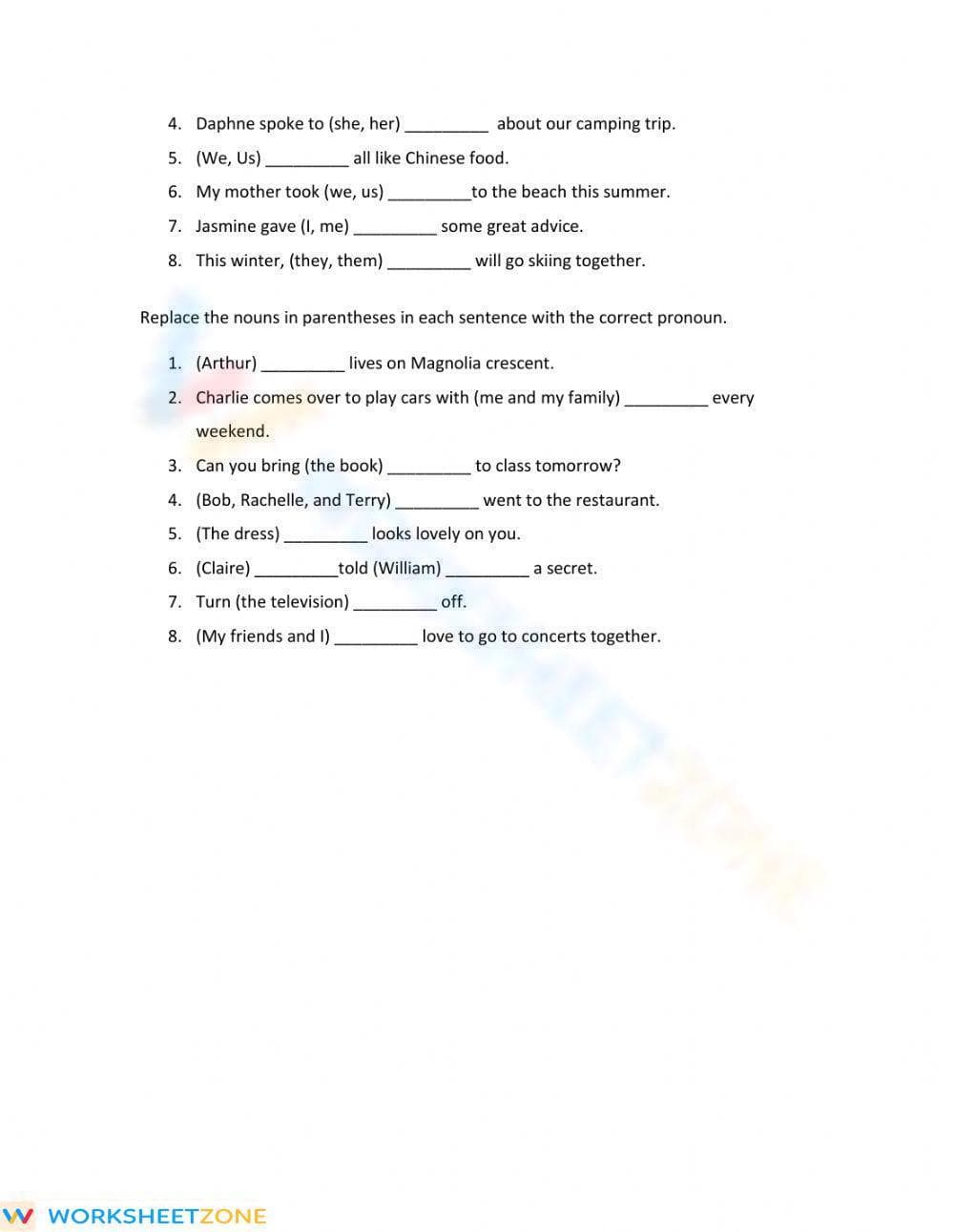
This two-page resource features 30 practice problems to reinforce pronoun usage. It includes four exercises: sentence rewriting, fill-in-the-blank, matching nouns to pronouns, and multiple-choice circling tasks. The structured layout and clear examples allow for independent work, and the full answer key ensures quick and easy grading for teachers or parents during the school day.
Skill Progression
- Guided Practice: Students rewrite five sentences using a provided pronoun bank to model correct noun-to-pronoun substitution, ensuring a successful start to the lesson.
- Supported Practice: Fifteen tasks involving matching and fill-in-the-blank exercises require students to analyze sentence context for number and gender agreement.
- Independent Practice: Ten multiple-choice sentences challenge students to select the correct pronoun, demonstrating mastery of the skill.
This progression follows the gradual-release model of instruction to build student confidence through increasing complexity.
Standards Alignment
This worksheet is primarily aligned to CCSS.ELA-LITERACY.L.2.1, which requires students to demonstrate command of the conventions of standard English grammar and usage. Specifically, it focuses on the correct application of personal pronouns to ensure sentence variety and clarity. Both standard codes can be copied directly into lesson plans, IEP goals, or district curriculum mapping tools.
How to Use It
Use this resource for independent practice or as a follow-up to a direct grammar lesson. The matching section serves as a great formative assessment tool to check student understanding of pronoun-antecedent agreement. Most students will complete the worksheet in 25 minutes, making it a perfect addition to a rotation block or a quick sub plan.
Who It's For
Designed for Grade 2 and Grade 3 students, this worksheet is also an excellent tool for English Language Learners (ELL) who are navigating the complexities of English pronoun-antecedent agreement. It pairs naturally with a classroom anchor chart displaying pronoun categories or a short reading passage where students can highlight pronouns in action during guided reading groups.
Research by Fisher & Frey (2014) emphasizes the importance of the gradual release of responsibility model in developing literacy skills, particularly within grammar and mechanics. By providing structured scaffolds—such as the pronoun banks and noun-replacement tasks found in this resource—educators enable students to move from rote identification to functional application. According to the RAND AIRS 2024 report, high-quality printable resources that offer targeted, repetitive practice on discrete skills like CCSS.ELA-LITERACY.L.2.1 are essential for closing achievement gaps in early elementary writing. This personal pronouns worksheet provides exactly that type of rigorous, focused practice, ensuring that 2nd and 3rd-grade students build the linguistic stamina needed for more complex narrative and informational writing. The 30 tasks included here are calibrated to build mastery through progressive difficulty, making this an evidence-based addition to any grammar curriculum or intervention block.


