




























Views
Downloads

Printable Winter Clothes Word Search | Grades 2–3 ELA

Paste this activity's link or code into your existing LMS (Google Classroom, Canvas, Teams, Schoology, Moodle, etc.).
Students can open and work on the activity right away, with no student login required.
You'll still be able to track student progress and results from your teacher account.
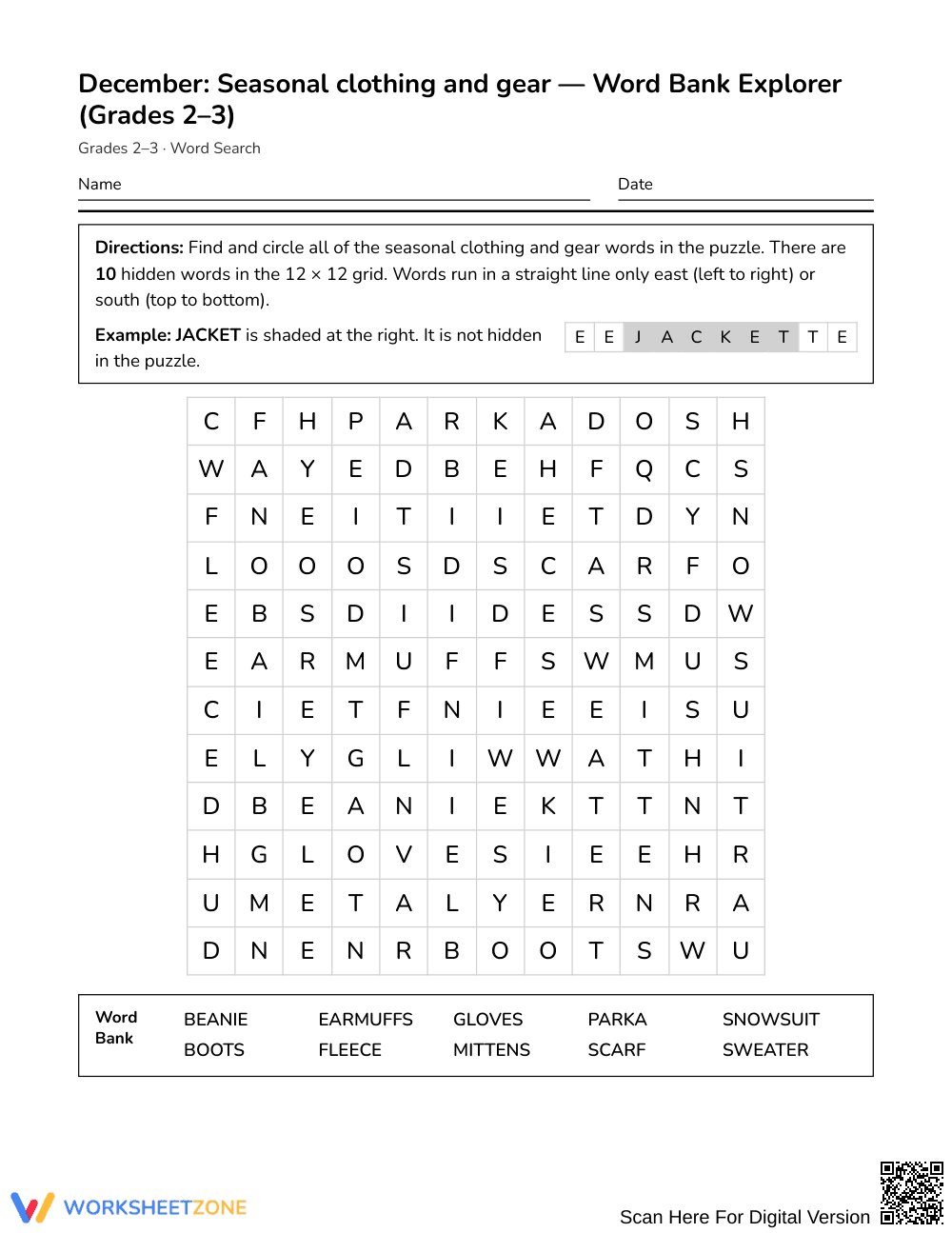
This printable word search introduces primary learners to essential seasonal clothing and gear terms through engaging vocabulary exploration. Students search for ten key cold-weather words while reading clear definitions that reinforce contextual meaning. Designed for efficient classroom delivery, it strengthens recognition, orthographic mapping, and seasonal language retention with zero teacher prep required.
At a Glance
- Grade: Grades 2–3 · Subject: English Language Arts
- Standard: Not standards-assessed — vocabulary enrichment
- Skill Focus: Seasonal clothing and gear vocabulary
- Format: 1 page · 10 words · Answer key included · PDF
- Best For: Morning work, literacy centers, fast finishers
- Time: 15–20 minutes
What's Inside: The single-page student activity features a 10-word bank arranged alphabetically alongside student-friendly definitions. Hidden vocabulary includes everyday winter staples such as beanie, fleece, mittens, and snowsuit. A three-page answer key provides clear solution maps for rapid teacher verification or structured student self-checking.
Puzzle Structure and Mechanics
The activity is built specifically for emerging readers in primary grades. Words are concealed within a clean 12 × 12 letter grid running exclusively in two accessible directions: left-to-right (East) and top-to-bottom (South). Eliminating diagonal and backward placements ensures that young learners focus on letter sequences without frustration. Students read the alphabetical word bank and accompanying clues, locate each term in the grid, and circle the correct letter strings.
Curriculum Alignment
This resource serves as targeted vocabulary enrichment rather than formal assessment and is not tied to a specific state or national standard. It supports foundational literacy by reinforcing high-utility thematic words, building semantic associations, and encouraging close letter inspection during word hunting.
How to Use It
Distribute this activity as a warm-up transition during December literacy blocks or place it in independent morning stations after whole-group seasonal read-alouds. During independent work time, observe whether students cross-reference the descriptive clues to confirm word meanings or simply scan for beginning letters. Learners typically complete the full 10-word search within 15 to 20 minutes.
Who It's For
This activity is designed for second- and third-grade learners developing seasonal vocabulary and spelling accuracy. It offers gentle scaffolding for English language learners through pairing concrete definitions with target words. Pair this puzzle with an informational winter clothing anchor chart or a seasonal read-aloud text about cold climates.
Thematic word searches support orthographic learning and vocabulary acquisition by prompting students to analyze letter patterns repeatedly. According to Fisher & Frey (2014), intentional exposure to domain-specific terminology across engaging, low-stakes formats deepens lexical storage and aids reading comprehension in developing readers. By pairing targeted word finding with explicit definitions, this resource encourages primary learners to connect pronunciation, spelling patterns, and real-world semantic context. Emerging decoders benefit from searching along predictable left-to-right and top-to-bottom axes, which mirrors standard reading orientation and reinforces print conventions without extraneous cognitive strain. As an independent or paired literacy routine, this focused exercise delivers meaningful seasonal language enrichment while providing teachers with an immediate, self-explanatory vocabulary review tool that supports fluent word recognition and sustained classroom engagement.


