


























Views
Downloads

Printable Touch Dot Addition Worksheet | Grade 1 Math
Paste this activity's link or code into your existing LMS (Google Classroom, Canvas, Teams, Schoology, Moodle, etc.).
Students can open and work on the activity right away, with no student login required.
You'll still be able to track student progress and results from your teacher account.
This focused addition worksheet helps first-grade students master counting on and crossing ten using the touch dot strategy. By providing visual cues directly on the numbers, students can confidently calculate sums from 11 to 18, building essential foundational fluency for more advanced arithmetic operations.
At a Glance
- Grade: 1 · Subject: Math
- Standard:
CCSS.MATH.CONTENT.1.OA.C.6— Add and subtract within 20 using counting on strategies- Skill Focus: Touch dot addition (sums 11-18)
- Format: 3 pages · 20 problems · Answer key included · PDF
- Best For: Independent practice and math centers
- Time: 15–20 minutes
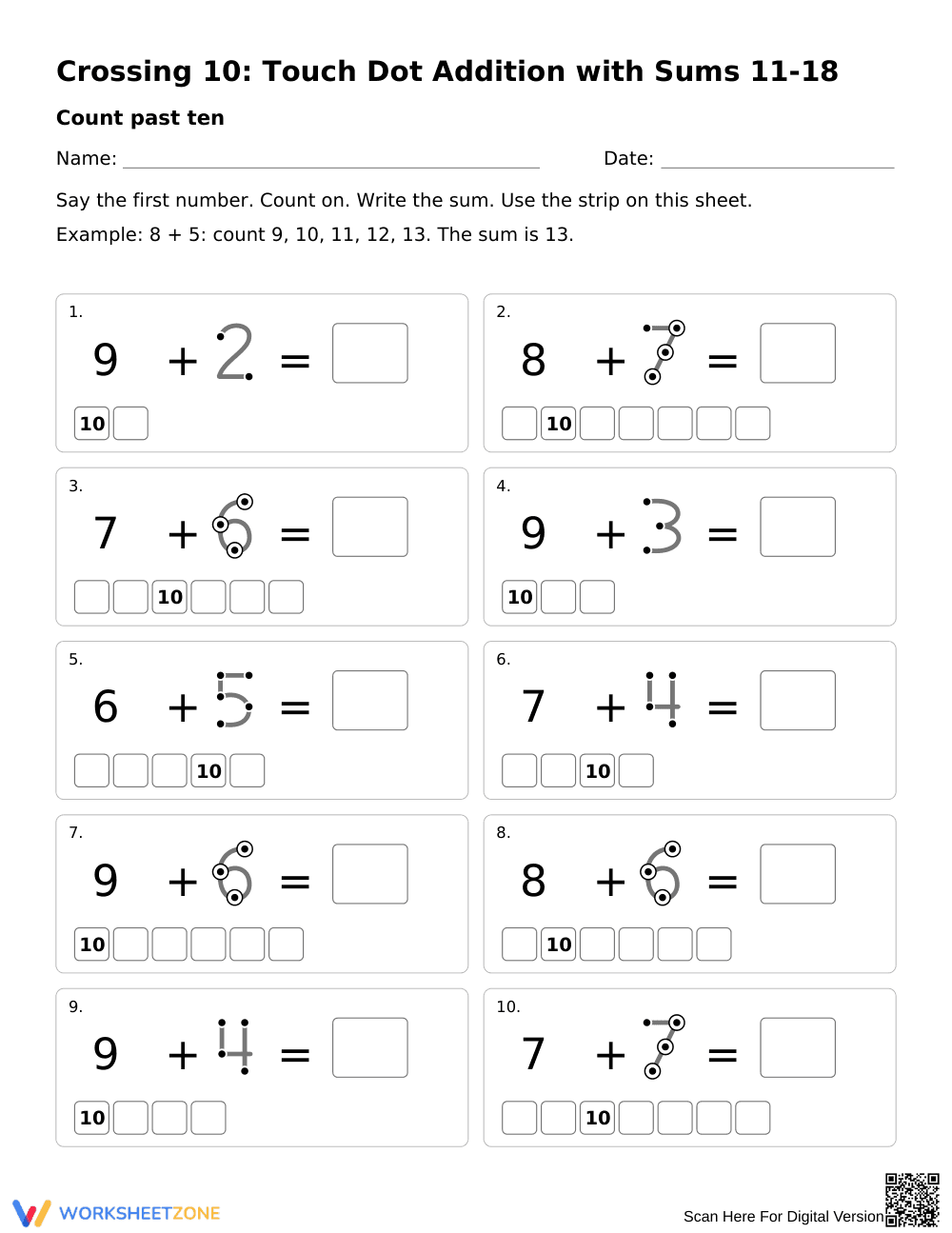
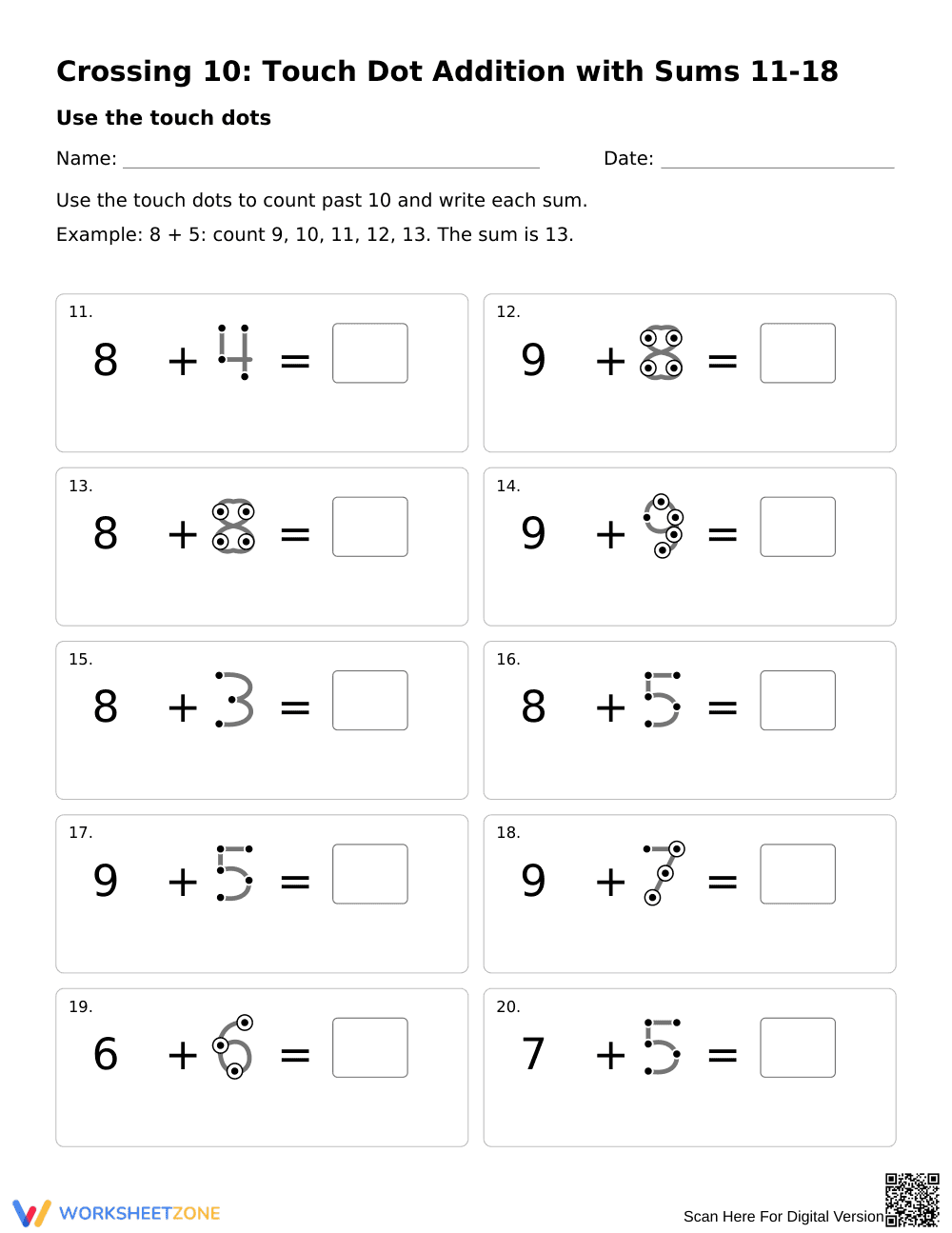
This resource includes two pages of targeted student practice featuring 20 total addition problems. The first page provides explicit scaffolding with write-in boxes for the count-on sequence, helping students visually track their counting past ten. The second page removes the sequence boxes, requiring students to use the touch dots to find the final sum independently. A complete, one-page answer key is provided, detailing both the final sums and the expected count-on sequences for the first ten problems.
- Guided practice: The first few problems include an example showing exactly how to say the first number and count on using the dots.
- Supported practice: Problems 1 through 10 feature sequence boxes, prompting students to write each number as they count up from ten to the final sum.
- Independent practice: Problems 11 through 20 present the equations with touch dots but without the sequence boxes, encouraging mental tracking.
This gradual-release approach ensures students internalize the counting-on strategy before moving to independent execution.
This worksheet is aligned to primary standard CCSS.MATH.CONTENT.1.OA.C.6: Add and subtract within 20, demonstrating fluency for addition and subtraction within 10, using strategies such as counting on and making ten. It specifically targets the transition from single-digit addition to sums between 11 and 18. Both standard codes can be copied directly into lesson plans, IEP goals, or district curriculum mapping tools.
Deploy this worksheet during math centers after introducing the touch dot strategy in whole-group instruction. It serves as an excellent follow-up activity to solidify the concept of counting on from the larger addend. As a formative assessment tip, observe students as they complete the first page; ensure they are physically tapping the dots and writing the correct sequential numbers in the provided boxes. Expected completion time is 15 to 20 minutes.
This resource is designed for first-grade students developing addition fluency, but it is also highly effective for second graders needing intervention or special education students who benefit from multisensory math strategies. The visual scaffolds make it accessible for diverse learners. Pair this worksheet with a classroom anchor chart demonstrating where touch dots are placed on digits 1 through 9 for maximum impact.
Developing early arithmetic fluency requires strategic scaffolding that bridges concrete counting and abstract recall. Standard CCSS.MATH.CONTENT.1.OA.C.6 emphasizes the ability to add and subtract within 20 using counting on strategies. Visual aids, such as touch dots, provide a critical intermediate step for students who struggle with mental math. According to a 2024 report by EdReports, instructional materials that incorporate explicit, visual counting strategies significantly improve computational accuracy and confidence in early elementary learners. By embedding these visual cues directly into the equations, students can physically interact with the numbers, reinforcing the one-to-one correspondence required for accurate counting on. This multisensory approach not only supports immediate task completion but also builds the cognitive pathways necessary for long-term mathematical automaticity and success in subsequent grade levels.


