




























Views
Downloads



Printable Shape-Shifter Word Search | Grades 4–5 ELA

Paste this activity's link or code into your existing LMS (Google Classroom, Canvas, Teams, Schoology, Moodle, etc.).
Students can open and work on the activity right away, with no student login required.
You'll still be able to track student progress and results from your teacher account.
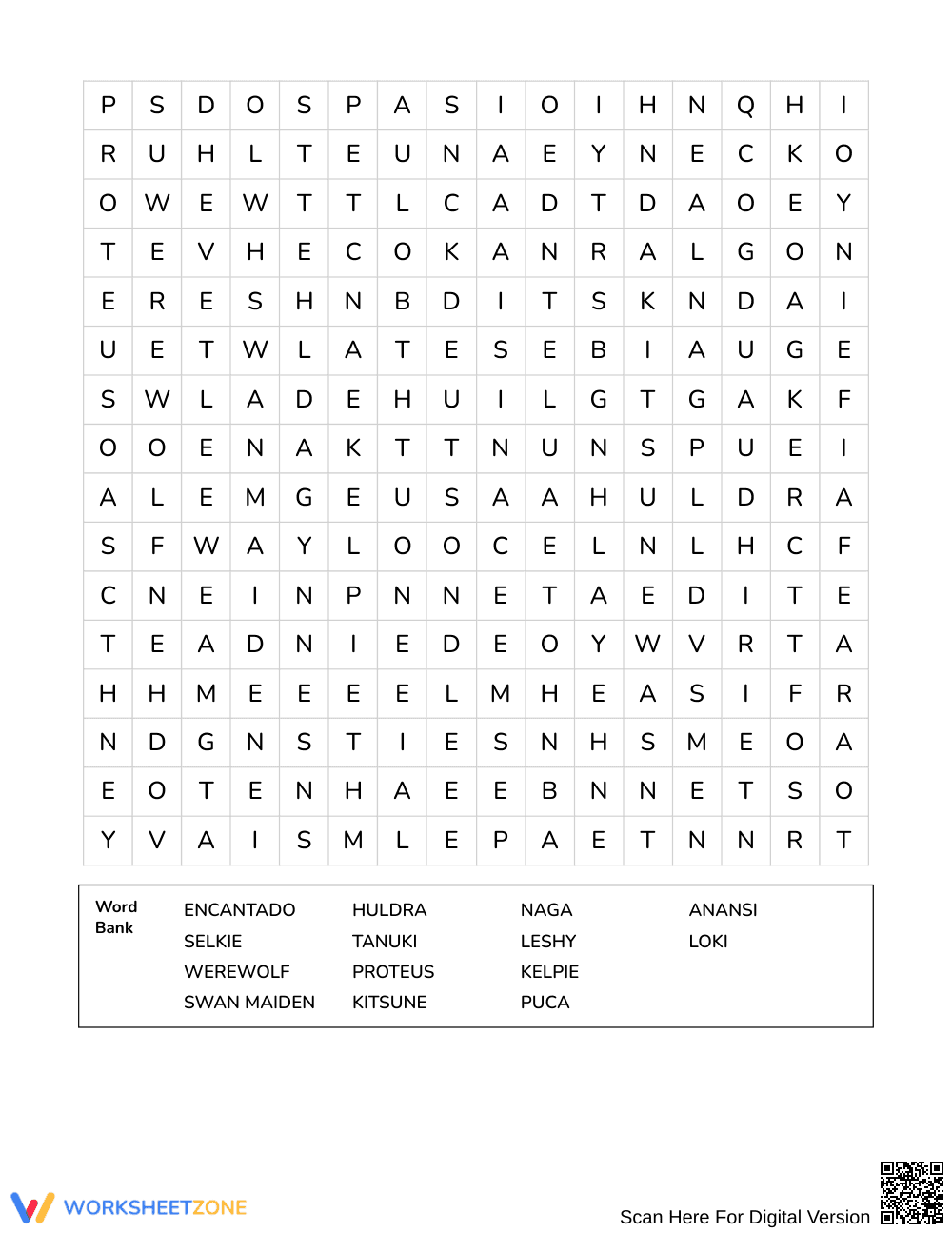
Engage upper elementary learners in cross-cultural mythology with this clue-based word search. Designed for Grades 4–5 ELA classrooms, this 3-page activity challenges students to read descriptive context clues, deduce 14 legendary shape-shifting entities from global folklore, and locate each term within the letter grid. The activity reinforces critical reading comprehension alongside cultural vocabulary acquisition.
At a Glance
- Grade: Grades 4–5 · Subject: English Language Arts (ELA)
- Standard: Not standards-assessed — vocabulary enrichment across global folklore traditions
- Skill Focus: Shape-shifting beings in selected global myth traditions
- Format: 3 pages · 14 words · Full 3-page answer key included · Printable PDF
- Best For: Myth unit vocabulary enrichment, sub plans, and fast finishers
- Time: 20–30 minutes of focused puzzle work
What's Inside
This 3-page print-and-go PDF provides an enriching vocabulary experience centered on world folklore. Students receive a 16 by 16 letter grid, a shuffled word bank containing 14 mythical names, and a detailed clue detective section featuring cultural background notes for every creature. A complete 3-page answer key outlines word coordinates and highlights puzzle solutions clearly for rapid verification.
Puzzle Mechanics and Structure
The puzzle operates on a clean 16 by 16 grid designed to offer accessible yet stimulating search patterns. Hidden terms run across four distinct directions: northeast (NE), east (E), southeast (SE), and south (S). Students do not simply scan for spelling; they read narrative clues defining beings such as the Celtic Selkie, Japanese Tanuki, and West African Anansi. The shuffled word bank ensures learners actively connect definitions to names before circling terms.
Standards Alignment
This activity functions strictly as supplemental vocabulary enrichment and is not aligned to a formal state standard. It enhances contextual reading fluency and world literature appreciation, allowing educators to expand multicultural background knowledge during myth and folklore units without the constraints of standardized scoring rubrics.
How to Use It
Deploy this word search during an introductory unit on world folklore or as an independent literacy station. Before direct instruction, assign the clues as an inquiry warm-up where students predict each creature's cultural origins. During independent seatwork, observe whether students deduce names directly from the folklore clues or rely primarily on letter scanning, noting who needs support deciphering contextual definitions. Students typically finish the puzzle within 20 to 30 minutes.
Who It's For
This resource serves Grades 4–5 reading classes, gifted enrichment clusters, and English language learners benefiting from embedded context clues. Pair this activity directly with a shared reading of global trickster tales or an anchor chart tracking supernatural archetypes across world cultures.
According to research highlighted in the RAND AIRS 2024 report, integrating contextual vocabulary enrichment into thematic units significantly bolsters upper elementary reading engagement and domain-specific background knowledge. Word puzzles that pair textual clues with lexical search tasks require active cognitive processing, bridging surface-level word recognition and deep semantic comprehension. When students in Grades 4–5 analyze brief folklore descriptions to identify shape-shifting entities from Celtic, West African, Slavic, and Indigenous Amazonian traditions, they exercise inferential deduction while cementing cross-cultural literary concepts. Rather than completing rote memorization drills, learners synthesize textual details—such as geographical origins, supernatural disguises, and narrative roles—to solve each clue detective challenge. This balanced blend of cultural storytelling and structured puzzle mechanics supports long-term memory consolidation, making targeted vocabulary puzzles an effective instructional supplement for upper elementary literacy classrooms exploring diverse mythologies.


