


























Views
Downloads




Printable Oxygen-Limited Cells Worksheet | Grade 10 Biology
Paste this activity's link or code into your existing LMS (Google Classroom, Canvas, Teams, Schoology, Moodle, etc.).
Students can open and work on the activity right away, with no student login required.
You'll still be able to track student progress and results from your teacher account.
This Grade 10 biology worksheet guides high school students through the bioenergetic constraints of oxygen deprivation. Students evaluate quantitative laboratory case studies, calculate metabolic stoichiometric ratios, and assess how mammalian muscle tissue and plant root cells maintain redox homeostasis when electron transport chains stall under hypoxic and anoxic conditions.
At a Glance
- Grade: 10 · Subject: Biology
- Standard: Cellular Energetics — Model cellular respiration and fermentation under limiting oxygen conditions
- Skill Focus: Analyzing oxygen-limited cellular respiration and redox balance
- Format: 5 pages · 10 problems · Answer key included · PDF
- Best For: AP or Honors Biology case analysis
- Time: 45–60 minutes
What's Inside
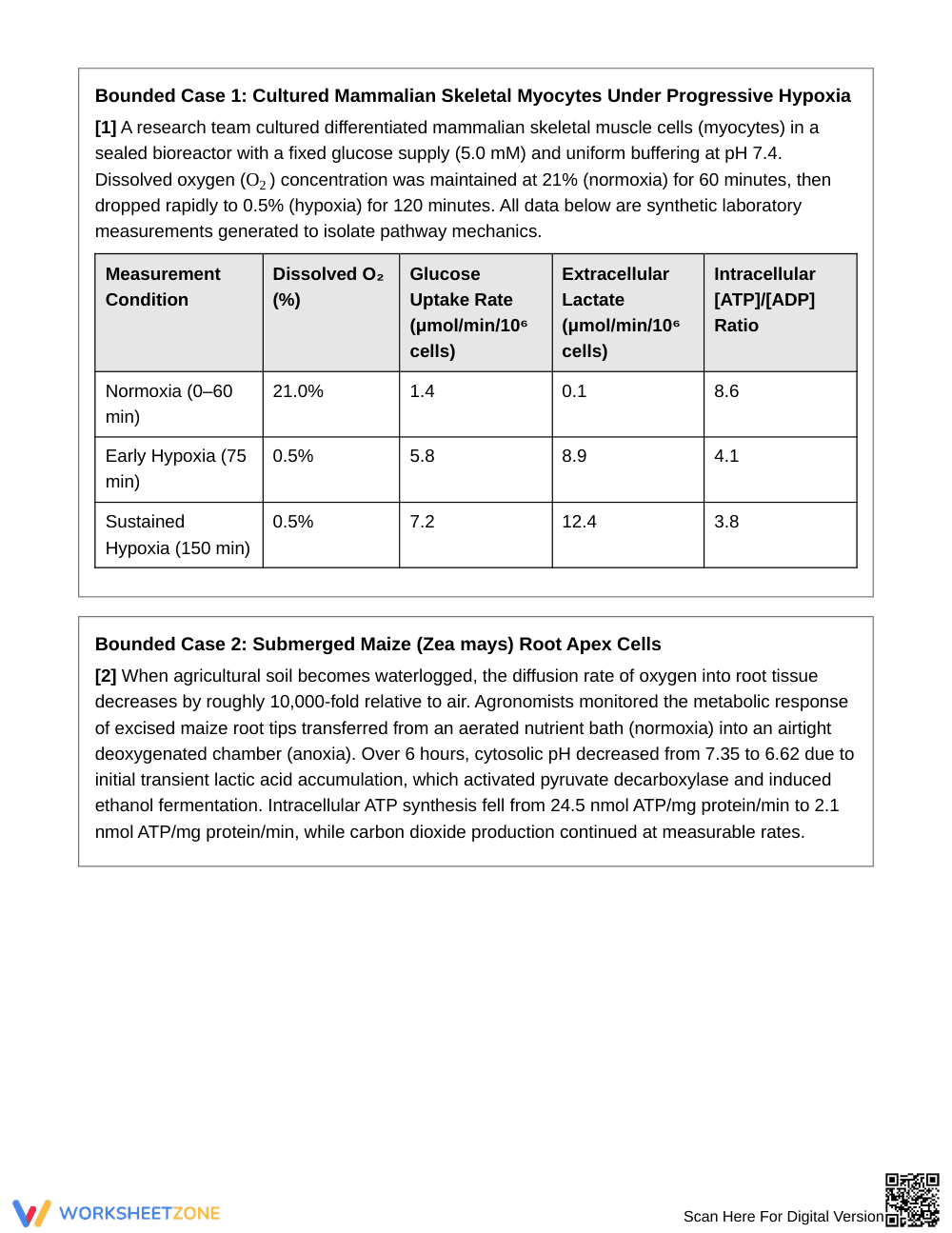
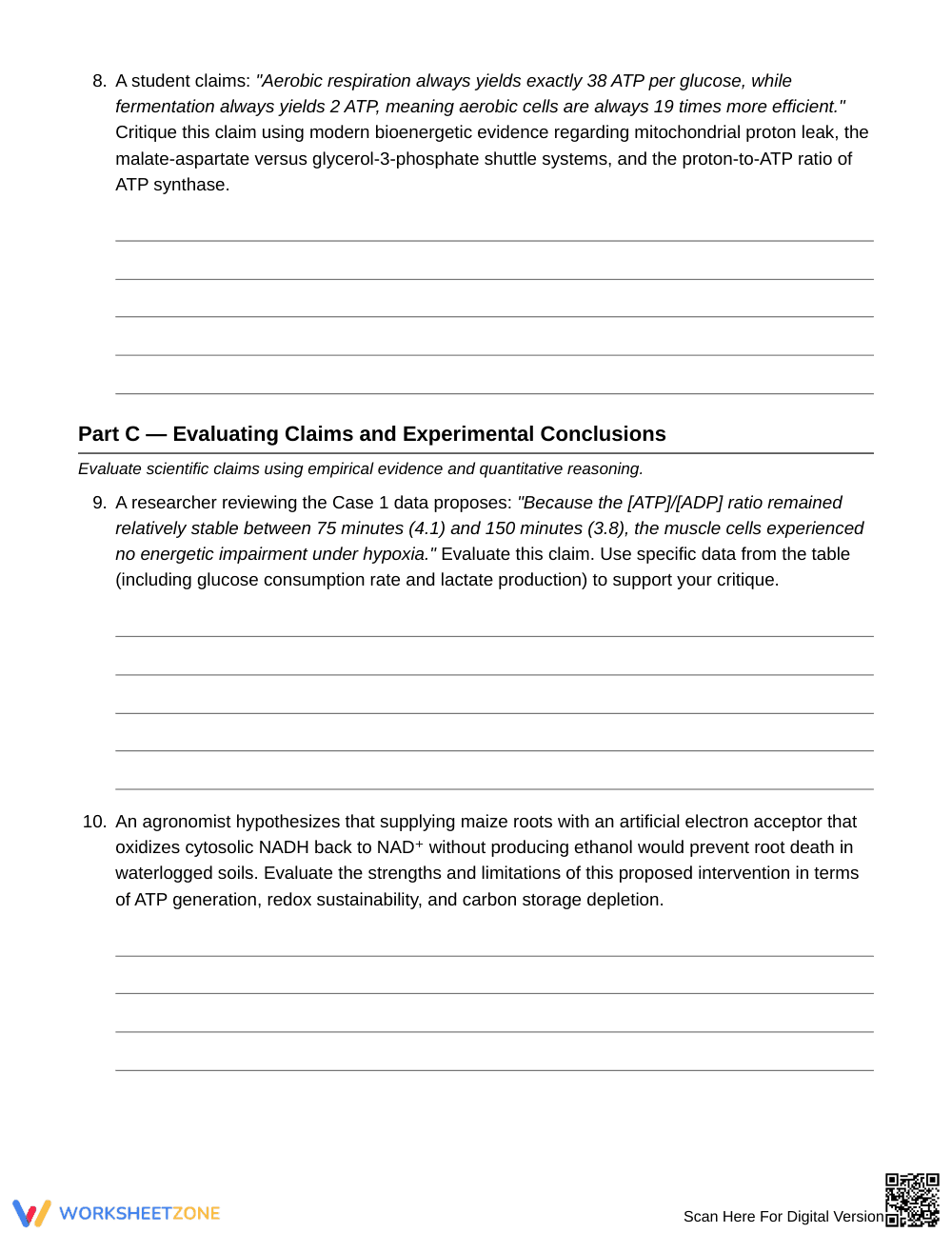
This 5-page printable resource delivers two bounded experimental scenarios: cultured mammalian skeletal myocytes experiencing progressive hypoxia and waterlogged maize root apex cells undergoing ethanolic fermentation. Across 10 rigorous analytical tasks, students engage with biochemical data tables, reaction pathway equations, multiple-choice mechanism evaluation, and extended claim critique. A comprehensive 3-page teacher answer key provides full chemical explanations and quantitative calculations.
Skill Progression
- Guided practice (Tasks 1–2): Students identify immediate biochemical constraints, diagnosing how oxygen loss collapses mitochondrial proton-motive force and halts the Krebs cycle.
- Supported practice (Tasks 3–8): Students apply core energetic mechanisms to calculate lactate-to-glucose ratios, analyze allosteric enzyme regulation, and contrast mammalian and plant fermentation pathways.
- Independent practice (Tasks 9–10): Students synthesize bioenergetic principles to evaluate complex experimental claims regarding metabolic stability and proposed agronomic redox interventions.
This sequence implements a gradual-release instructional model, shifting students from direct constraint identification to independent scientific critique.
Standards Alignment
This resource aligns with high school life science standards addressing cellular energy synthesis, carbon cycling, and matter transformation. Students construct evidence-based explanations for how cellular respiration and fermentation convert stored chemical energy into usable ATP during aerobic and anaerobic conditions. These conceptual links can be copied directly into lesson plans, IEP goals, or district curriculum mapping tools.
How to Use It
Deploy this worksheet after direct instruction on the electron transport chain and glycolysis to solidify students' grasp of redox coupling. Alternatively, assign it as a small-group collaborative inquiry where student pairs interpret the myocyte data table. During completion, check whether students recognize that fermentation functions primarily to regenerate oxidized NAD⁺ rather than directly synthesize ATP. Expected completion time is 45 to 60 minutes.
Who It's For
Designed for Grade 10 general, honors, and introductory Advanced Placement biology students, this activity provides high-level bioenergetic challenge. Visual data tables support developing learners, while multi-step stoichiometric prompts stretch advanced thinkers. Pair this worksheet with a dynamic mitochondrial electron transport chain diagram or an enzyme regulation anchor chart.
According to Fisher & Frey (2014), structured case-based scientific analysis accelerates conceptual mastery by embedding complex biochemical mechanisms within authentic experimental contexts. This 10-task cellular energetics worksheet operationalizes that research by requiring Grade 10 biology students to analyze oxygen-limited cellular respiration across mammalian and plant physiological models. Working through guided prompts, students examine quantitative hypoxic laboratory datasets, calculate molar stoichiometric ratios, and explain why regenerating oxidized nicotinamide adenine dinucleotide (NAD⁺) is vital for sustaining substrate-level phosphorylation when mitochondrial electron transport halts. By systematically transitioning learners from foundational constraint identification to sophisticated evaluation of experimental claims, the resource reinforces rigorous biochemical reasoning, allosteric enzyme regulation concepts, and quantitative data literacy. The 5-page structured progression ensures high school learners master thermodynamic and redox principles essential for advanced achievement in biological sciences, preparing them thoroughly for standard assessments and laboratory inquiries.


