


























Views
Downloads
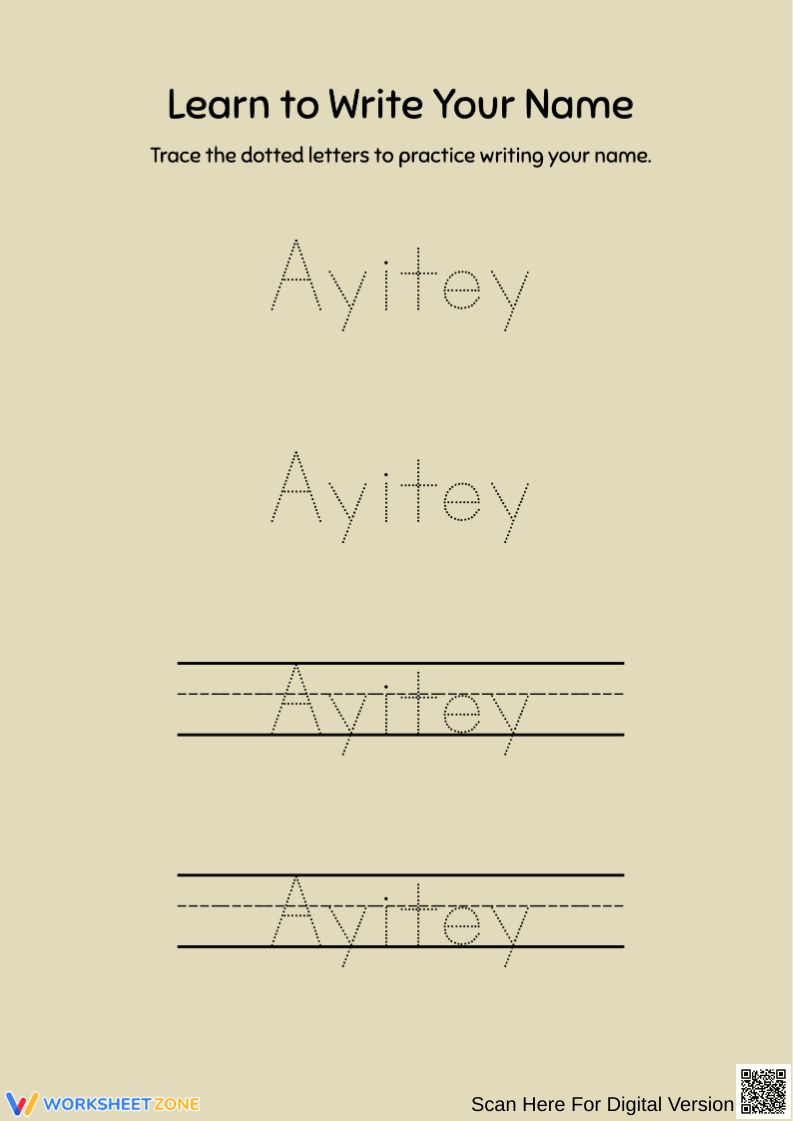

Printable Name Writing Practice | Kindergarten Ready
Paste this activity's link or code into your existing LMS (Google Classroom, Canvas, Teams, Schoology, Moodle, etc.).
Students can open and work on the activity right away, with no student login required.
You'll still be able to track student progress and results from your teacher account.
This Kindergarten name writing worksheet helps young learners master the essential skill of writing their own names through repetitive tracing. By focusing on specific letter formation and spatial awareness, students develop the fine motor control necessary for legible handwriting. This resource provides a structured path from basic tracing to lined-paper alignment.
At a Glance
- Grade: Kindergarten · Subject: Handwriting
- Standard:
CCSS.ELA-LITERACY.L.K.1.A— Print many upper- and lowercase letters correctly during writing tasks- Skill Focus: Name tracing and letter formation
- Format: 1 page · 4 problems · No answer key needed · PDF
- Best For: Morning work and literacy centers
- Time: 5–10 minutes
This single-page PDF features four distinct tracing opportunities designed to build muscle memory. The first two instances allow for large-scale tracing in open space, while the final two tasks are set on primary handwriting lines featuring a top line, dashed middle line, and baseline. This layout helps students understand how letters sit on a line, improving overall legibility and consistency.
Teachers can implement this resource in under 2 minutes. First, print the required number of copies for your roster (30 seconds). Second, distribute the sheets during morning arrival or as a transition activity (1 minute). Finally, provide immediate verbal feedback as students complete the 4 tracing tasks (30 seconds). It is an ideal resource for busy classrooms or substitute folders.
The primary focus is `CCSS.ELA-LITERACY.L.K.1.A`, which requires students to print many upper- and lowercase letters. By practicing their specific name, students engage with a high-frequency set of characters that hold personal significance. This standard code can be copied directly into lesson plans, IEP goals, or district curriculum mapping tools.
Use this worksheet as a daily bell-ringer to settle students as they enter the classroom. It serves as an excellent formative assessment tool; observe the student's grip and stroke direction during the 10-minute activity. For students struggling with fine motor skills, consider having them trace with a highlighter first before using a pencil to complete the tasks.
This resource is designed for Preschool, Kindergarten, and early First Grade students. It is particularly effective for English Language Learners (ELLs) who are familiarizing themselves with the Roman alphabet. Pair this worksheet with a name-tag anchor chart or a tactile salt-tray writing activity for a multi-sensory learning experience that reinforces letter shapes.
Research from Fisher & Frey (2014) emphasizes the importance of scaffolded practice in early literacy development, particularly through the gradual release of responsibility. Handwriting, specifically name writing, is a foundational skill that serves as a significant predictor of later reading and writing success. According to the NAEP, early mastery of letter formation allows cognitive resources to shift from the mechanics of writing to higher-level composition and expression. This worksheet provides the necessary repetition to move letter production from a conscious effort to an automatic motor program. By utilizing both unlined and lined tracing, the resource addresses the developmental progression of spatial awareness in young children. Consistent use of such structured tracing tools in Kindergarten has been shown to improve fine motor precision and letter recognition, creating a solid base for the primary grade curriculum.


