




























Views
Downloads



Printable Mitosis Chromosomes Worksheet | Grade 9 Biology

Paste this activity's link or code into your existing LMS (Google Classroom, Canvas, Teams, Schoology, Moodle, etc.).
Students can open and work on the activity right away, with no student login required.
You'll still be able to track student progress and results from your teacher account.
This worksheet helps Grade 9 Biology students explain how chromosomes are copied and distributed during mitosis. Students track chromosome and DNA counts through the cell cycle, interpret onion root tip data, and predict what happens when division goes wrong, so each daughter cell's full chromosome set makes sense.
At a Glance
- Grade: 9 · Subject: Biology
- Standard: Cell cycle and mitosis — explain how replication and separation give each daughter cell a full chromosome set
- Skill Focus: Explaining chromosome distribution in mitosis
- Format: 5 pages · 12 problems · Answer key included · PDF
- Best For: Reinforcing mitosis after direct instruction
- Time: 35–45 minutes
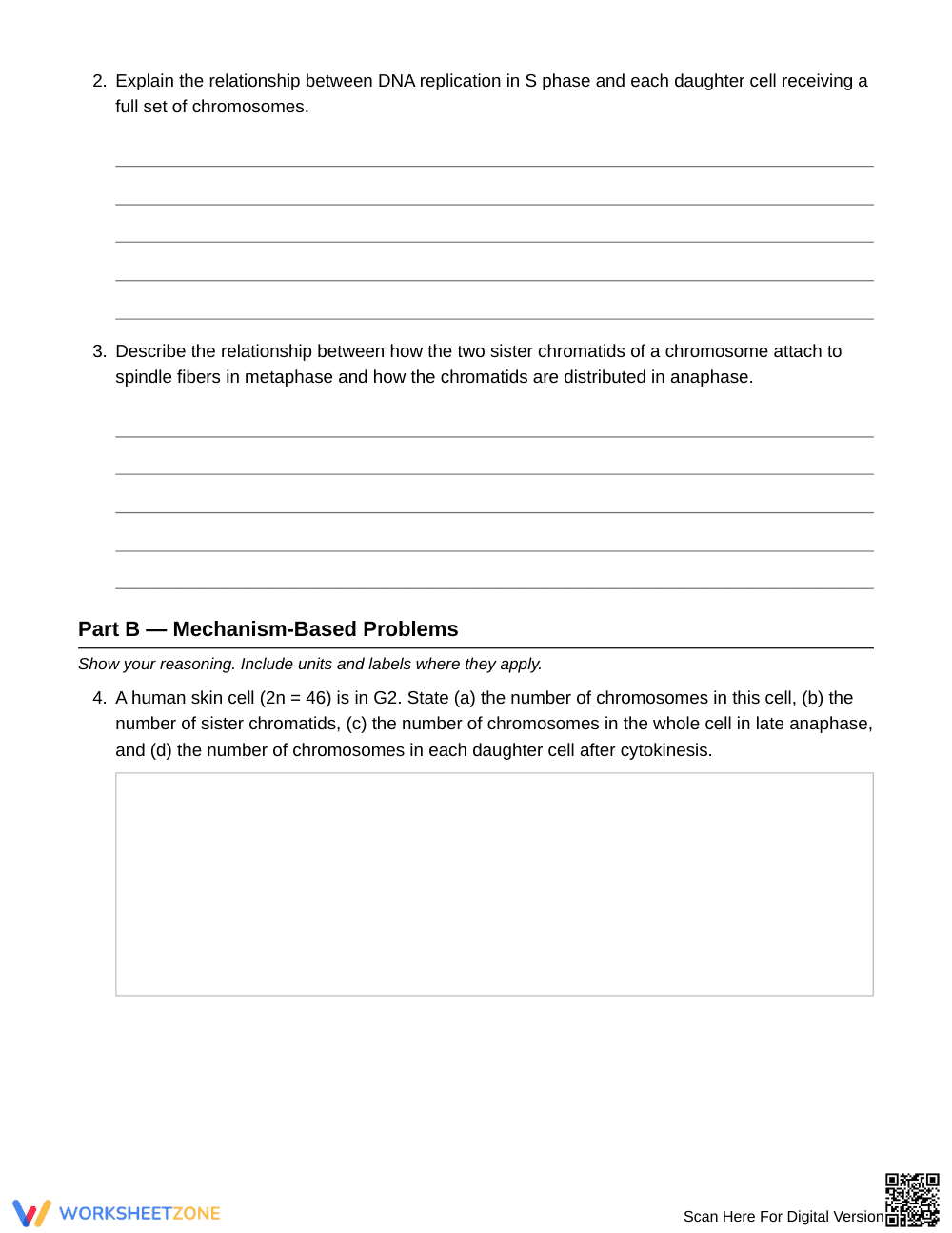
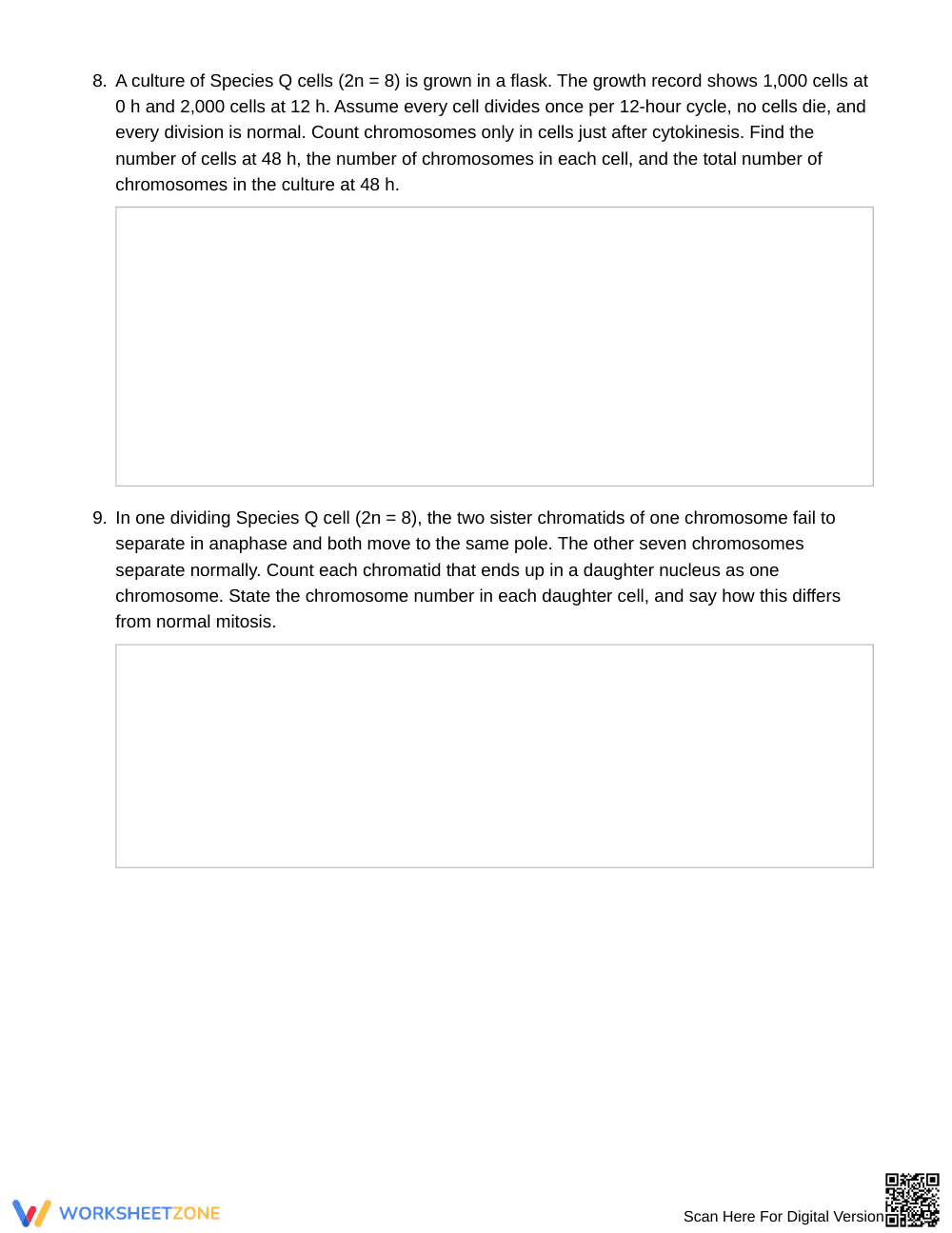
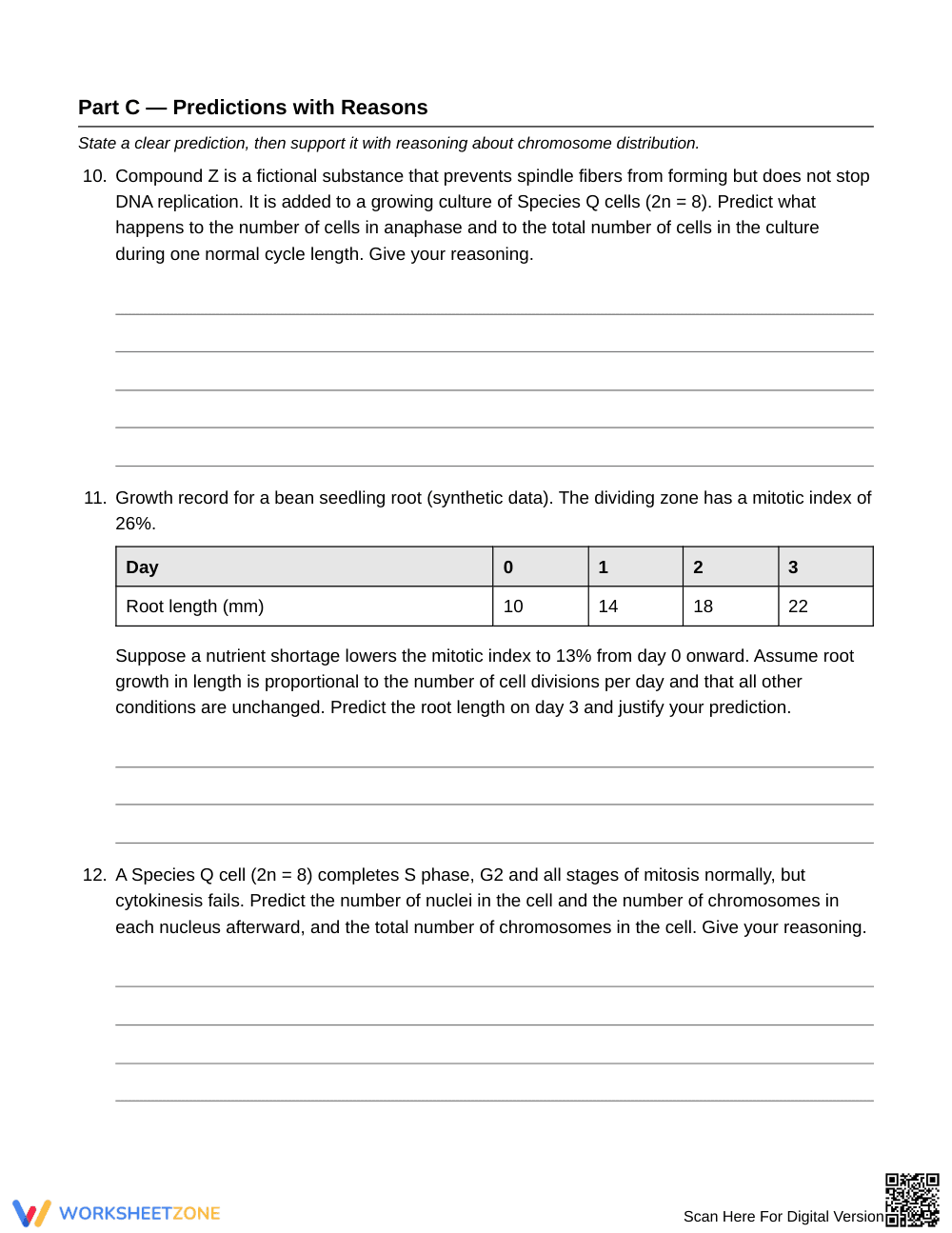
What's Inside. The worksheet has 5 pages with 12 tasks in three parts: a stage-by-stage counting table and two explanation items, six mechanism-based problems, and three prediction items. A reminder box defines chromosome and DNA counting conventions. Two synthetic data sets (onion root tip cell counts and bean root growth) support calculations. A 3-page answer key is included.
Skill Progression
- Guided practice (3 tasks): Part A uses the reminder box, a fill-in table, and short explanations.
- Supported practice (6 tasks): Part B asks for calculations, mitotic index, timing, and a chromatid-separation error, with data provided.
- Independent practice (3 tasks): Part C asks for predictions backed by reasoning about chromosome distribution.
The sequence follows gradual release: I Do, We Do, You Do.
Standards Alignment
No standard code was supplied for this worksheet. The content aligns with high school biology expectations that students model how mitosis produces genetically identical daughter cells, each with a complete chromosome set. Add your district's code when mapping it to lesson plans, IEP goals, or curriculum tools.
How to Use It
Assign Part A during instruction as a check on counting conventions, then Parts B and C after direct instruction as practice or homework. While students work, watch whether they count chromosomes or chromatids in late anaphase; that is the most common error. Expect 35–45 minutes for the full set.
Who It's For
Grade 9 Biology students in a first mitosis unit. Students who need support can stay with Part A and use the reminder box. Pair it with a labeled mitosis diagram or an onion root tip slide lab.
This Grade 9 Biology worksheet teaches students to explain chromosome distribution in mitosis by tracking chromosome and DNA counts from G1 through cytokinesis. Twelve tasks across five pages require students to distinguish chromosomes from sister chromatids, calculate mitotic index from onion root tip data, and predict outcomes when spindle formation, chromatid separation, or cytokinesis fails. Because S phase gives each chromosome two sister chromatids and anaphase separates them, each daughter cell receives a full set; a cell with 2n = 8 holds 16 chromosomes in late anaphase but 8 in each daughter. Fisher & Frey (2014) describe gradual release of responsibility, moving from modeled to guided to independent work, and this three-part structure follows that model. A 3-page answer key supports quick checking.


