


























Views
Downloads


Printable Matter Balance vs Energy Transfer Worksheet
Paste this activity's link or code into your existing LMS (Google Classroom, Canvas, Teams, Schoology, Moodle, etc.).
Students can open and work on the activity right away, with no student login required.
You'll still be able to track student progress and results from your teacher account.
This Grade 10 Biology worksheet builds students' ability to distinguish mass conservation from free-energy transfer in cellular respiration, challenging them to calculate ATP capture efficiency, evaluate competing biochemical models, and write a defended synthesis that goes far beyond balanced equations.
At a Glance
- Grade: 10 · Subject: Biology
- Standard: Cellular Energy & ATP — Explain why matter balance alone does not describe energy transfer
- Skill Focus: Thermodynamic reasoning, ATP efficiency calculations, mechanism-based critique
- Format: 5 pages · 6 problems · Answer key included · PDF
- Best For: Post-instruction practice and formative assessment
- Time: 40–55 minutes
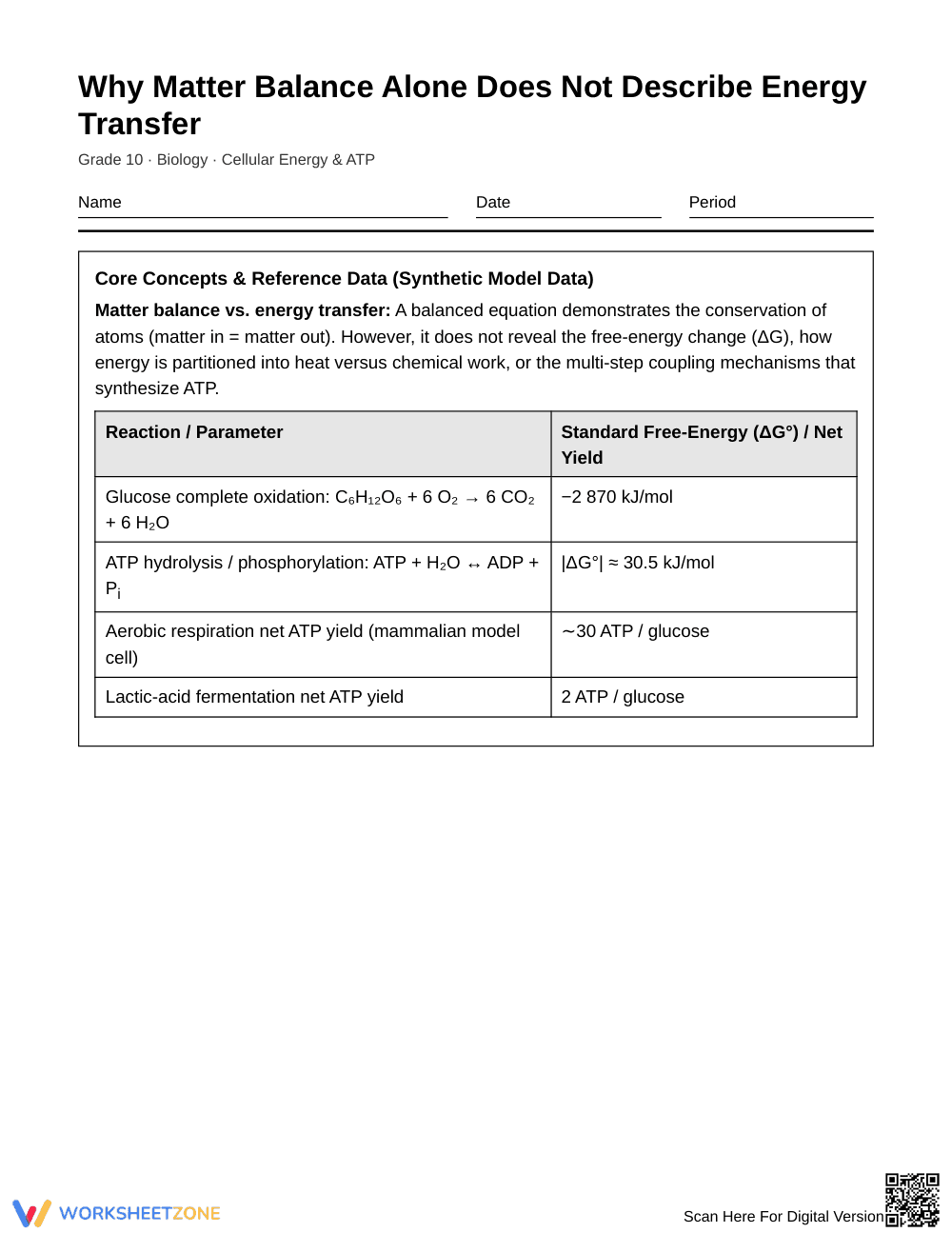
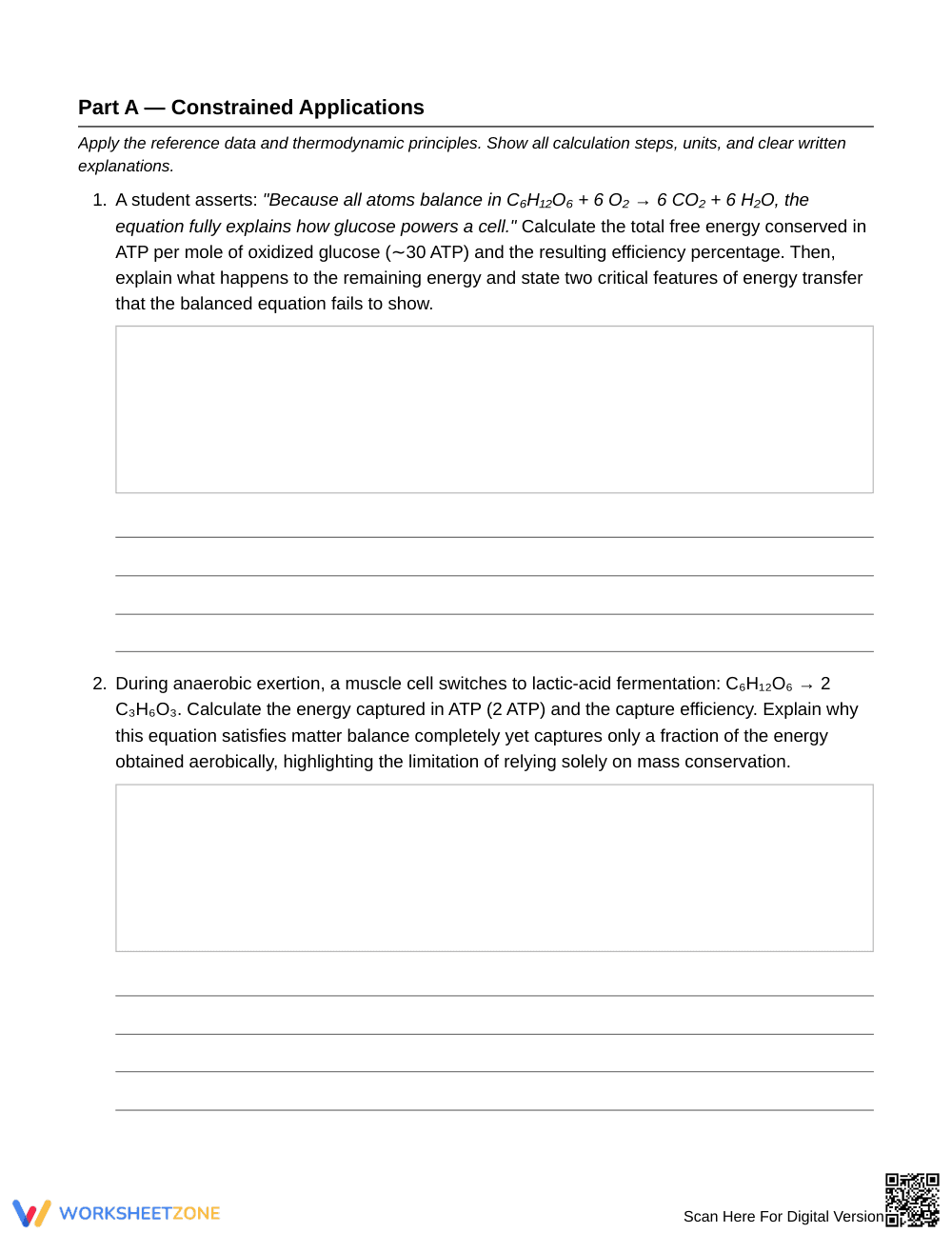
The worksheet spans 5 pages and 6 structured tasks organized across three parts. Part A presents two application problems requiring students to calculate free-energy capture (using ΔG° = −30.5 kJ/mol per ATP) and efficiency percentages for both aerobic respiration (~30 ATP) and lactic-acid fermentation (2 ATP). Part B contains three competing-model problems, including analysis of a synthetic bacterial strain producing only 16 ATP and an evaluation of the photosynthesis-as-reverse-respiration claim. Part C asks students to write a defended critique of a curriculum reviewer's assertion. A reference data table with standard free-energy values and net ATP yields is provided on the first page.
Skill Progression
- Guided practice (Part A, 2 problems): Students apply reference data directly, with calculation scaffolds and explicit prompts for written explanation, easing into thermodynamic reasoning.
- Supported practice (Part B, 3 problems): Students evaluate competing models and non-standard systems, requiring mechanism-based reasoning without step-by-step scaffolds.
- Independent practice (Part C, 1 extended problem): Students synthesize conceptual threads into a defended written critique, demonstrating mastery without prompts. This gradual-release structure moves students from structured calculation toward autonomous argumentation.
Standards Alignment
This worksheet targets the Cellular Energy & ATP objective: explain why matter balance alone does not describe energy transfer, including free-energy change (ΔG), heat versus chemical work partitioning, and ATP coupling mechanisms. Supporting concepts include conservation of matter and the thermodynamics of coupled reactions.
How to Use It
Assign Parts A and B the day after direct instruction on cellular respiration and ATP synthesis to consolidate calculation skills before moving to metabolic comparisons. Use Part C as an end-of-unit formative assessment: circulate during writing and note whether students reference ΔG values and coupling mechanisms unprompted. Students typically complete the full worksheet in 40–55 minutes; Parts A and B alone take approximately 25 minutes for a shorter session.
Who It's For
Designed for Grade 10 Biology students in standard or honors tracks who have completed initial instruction on cellular respiration. Students who need additional support benefit from the reference data table and calculation prompts in Part A, while advanced learners are extended by the synthetic-strain analysis and photosynthesis-reversal evaluation in Part B.
Research consistently shows that students who practice distinguishing stoichiometric balance from thermodynamic efficiency develop stronger mechanistic reasoning in biology. Fisher & Frey (2014) found that gradual-release frameworks — moving from guided to independent practice — significantly improve transfer of complex science concepts. This worksheet applies that structure across three escalating parts, targeting the critical misconception that a balanced chemical equation fully describes cellular energy transfer. Students calculate that aerobic respiration captures approximately 30 × 30.5 kJ/mol = 915 kJ of the 2,870 kJ released per mole of glucose, yielding roughly 32% efficiency, and must account for the remaining ~68% lost as heat — information entirely absent from the balanced equation. By requiring efficiency comparisons, model critiques, and defended written synthesis, the worksheet builds layered conceptual understanding that addresses a persistent gap in high school life science performance.


