




























Views
Downloads




Printable Layer Properties Worksheet | Grade 8 Science

Paste this activity's link or code into your existing LMS (Google Classroom, Canvas, Teams, Schoology, Moodle, etc.).
Students can open and work on the activity right away, with no student login required.
You'll still be able to track student progress and results from your teacher account.
This Grade 8 Earth science worksheet teaches students to infer the properties of Earth's layers from evidence. Learners read density values and seismic wave data, apply science rules, and justify which layer the evidence points to with numbers instead of memorized facts.
At a Glance
- Grade: 8 · Subject: Science
- Standard: Unit objective — Use density and wave data to infer layer properties
- Skill Focus: Infer layer properties from density and seismic evidence
- Format: 5 pages · 10 problems · Answer key included · PDF
- Best For: Mid-unit practice on Earth's interior layers
- Time: 35–45 minutes
What's Inside
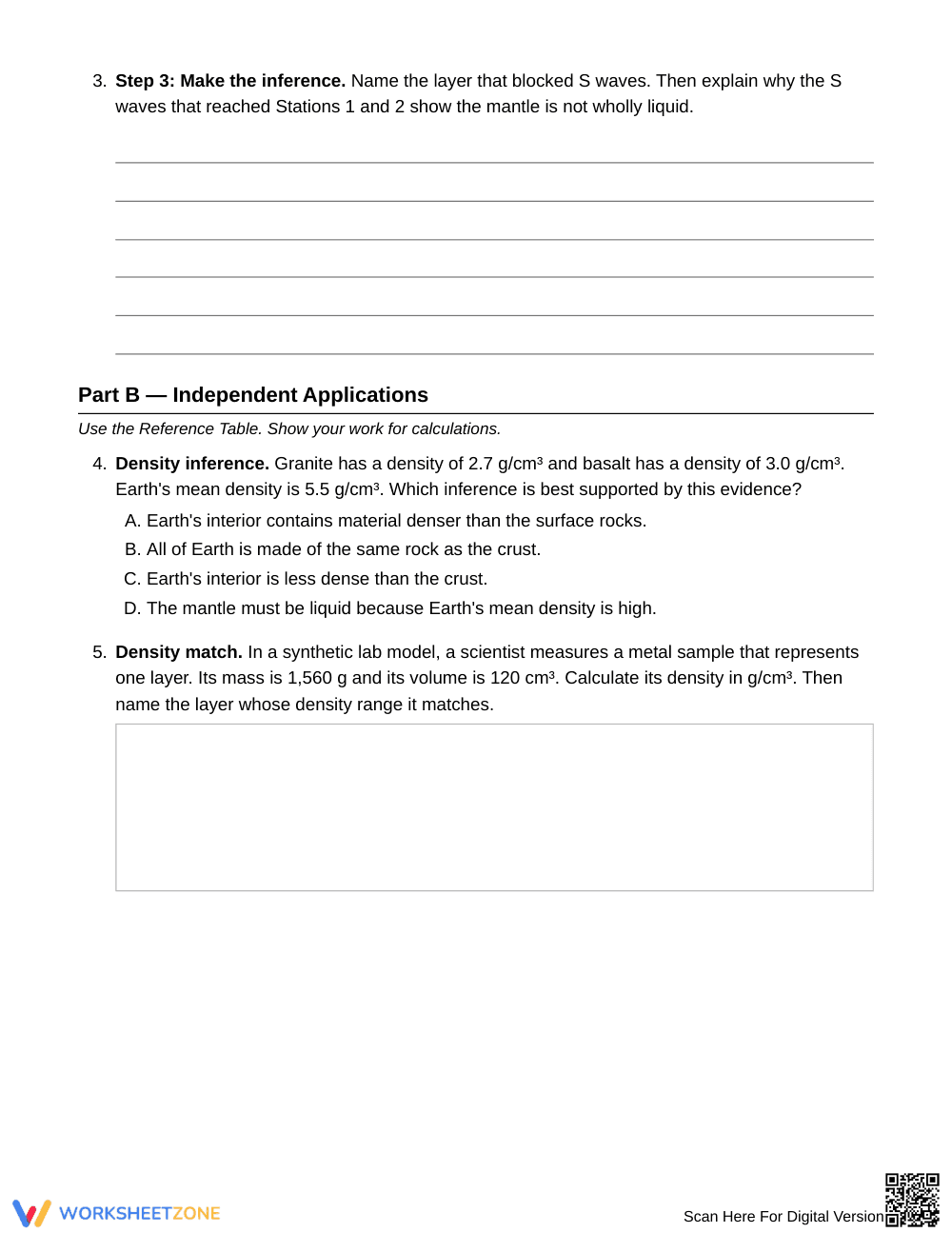
A reference table of depth, state, density, and P- and S-wave speeds anchors every task. Two worked examples model the evidence, reasoning, inference pattern. Students then complete guided steps, multiple-choice items, density and speed calculations, a layer-sorting table, and written explanations. A 2-page answer key is included.
Skill Progression
- Guided practice (Items 1–3): Step-by-step reading of synthetic seismic records with sentence completion.
- Supported practice (Items 4–8): Calculations, sorting, and boundary questions using the reference table.
- Independent practice (Items 9–10): Students evaluate a claim and explain overlapping layer names in complete sentences.
The sequence follows gradual release: I do, we do, you do.
Standards Alignment
No standard code was supplied for this worksheet, so it is aligned to the unit objective: use density and seismic wave evidence to infer the properties of Earth's layers. Add your state or district code when copying it into lesson plans, IEP goals, or curriculum mapping tools.
How to Use It
- During instruction: Work the two examples together, then have pairs complete Part A.
- After instruction: Assign Parts B and C as independent practice or a check for understanding.
While students work, watch whether they cite specific data in Item 9. Plan for 35–45 minutes.
Who It's For
Grade 8 science students in an Earth's layers unit. The reference table and worked examples support students who need scaffolds, and Part C stretches confident writers. Pair it with a seismic wave diagram or an anchor chart on composition versus mechanical layers.
The Grade 8 worksheet “Earth's Layers: Infer Layer Properties from Evidence” teaches students to reason from data to conclusions about Earth's interior. Across 10 tasks and 5 pages, students compare surface rock density with Earth's mean density of 5.5 g/cm³, calculate density and wave speed, and interpret seismic records in which S waves fail to reach distant stations. From this evidence they conclude that the outer core is liquid and that the core is denser than the crust. They also separate composition layers from mechanical layers such as the lithosphere and asthenosphere. Explicit evidence-reasoning-inference modeling reflects the gradual-release approach described by Fisher & Frey (2014), in which teachers model thinking, guide practice, and then release students to work independently. An answer key is included, so teachers can check both calculations and written explanations quickly.


