


























Views
Downloads


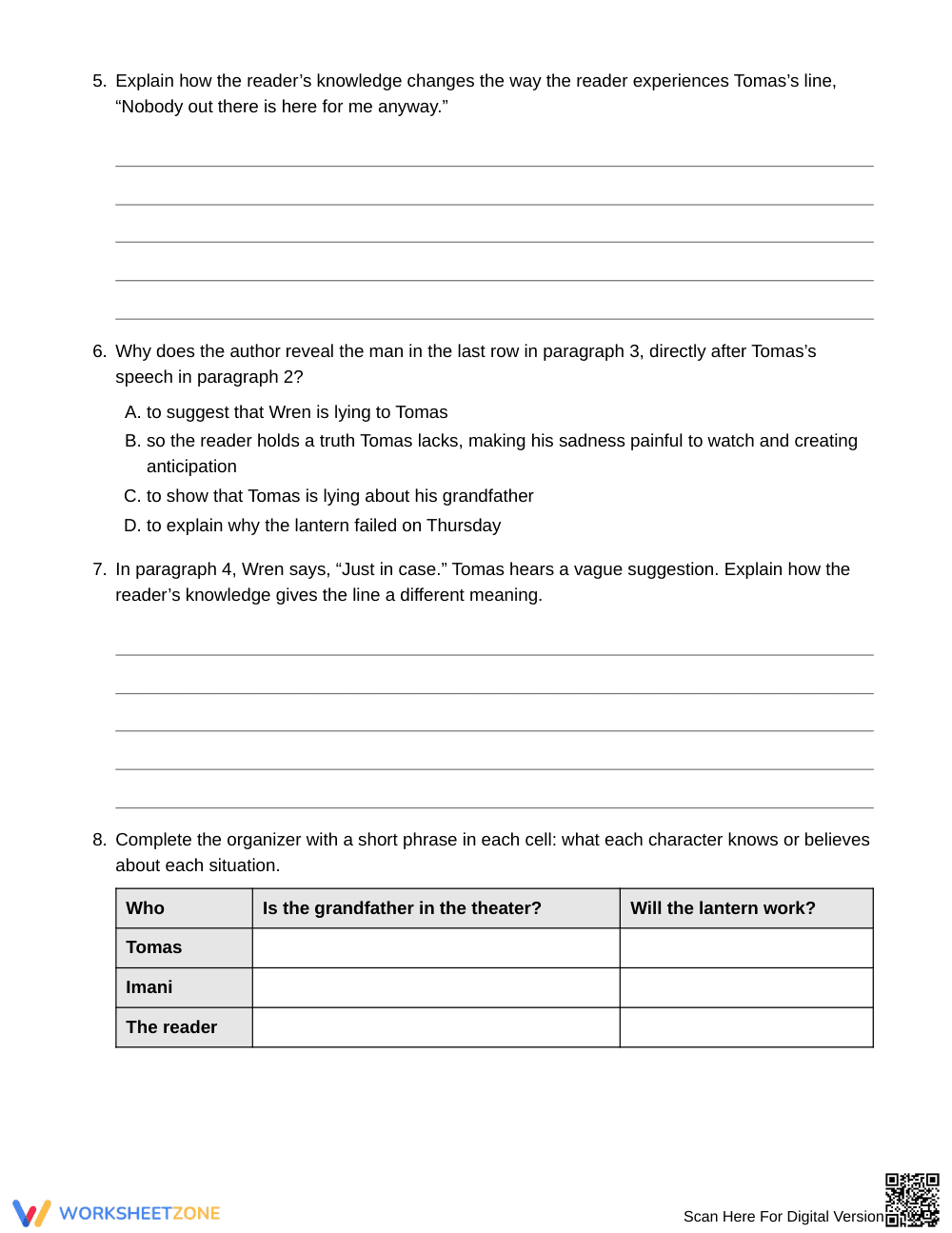


Printable Dramatic Irony Worksheet | Grade 8 ELA
Paste this activity's link or code into your existing LMS (Google Classroom, Canvas, Teams, Schoology, Moodle, etc.).
Students can open and work on the activity right away, with no student login required.
You'll still be able to track student progress and results from your teacher account.
This Grade 8 ELA worksheet teaches students to explain dramatic irony and how the gap between reader and character knowledge creates suspense, humor, and sympathy. Students read a backstage story, “Places, Please,” then move from locating details to defending claims with exact textual evidence.
At a Glance
- Grade: 8 · Subject: ELA
- Standard:
RL.8.6— Explain how reader and character knowledge differ to create suspense or humor.- Skill Focus: Explaining dramatic irony and its effects using textual evidence
- Format: 6 pages · 12 problems · Answer key included · PDF
- Best For: Dramatic irony practice after direct instruction
- Time: 40–50 minutes
What's Inside
A reminder box defines dramatic irony and strongest evidence, followed by an eight-paragraph numbered story. Paragraph numbers let students cite evidence precisely. Twelve tasks include four multiple-choice items, four short responses, one knowledge organizer, and three paragraph-length defenses. The 6-page PDF includes a 3-page answer key.
Skill Progression
- Guided practice (3 problems, Part A): Students locate key details with two multiple-choice items and one exact-quotation task.
- Supported practice (6 problems, Part B): Answer choices, a knowledge organizer, and short explanations help students compare what Tomas, Imani, and the reader know.
- Independent practice (3 problems, Part C): Students write claim-and-evidence paragraphs and address a competing view.
The sequence follows gradual release: I Do, We Do, You Do.
Standards Alignment
RL.8.6 — Analyze how differences in the points of view of the characters and the audience or reader (e.g., created through the use of dramatic irony) create such effects as suspense or humor. This standard code can be copied directly into lesson plans, IEP goals, or district curriculum mapping tools.
How to Use It
- After direct instruction: Assign the full worksheet as independent practice once students can define dramatic irony.
- During instruction: Work Part A together, then release students to Parts B and C.
Formative tip: as students answer, check whether they cite the detail that most directly proves their claim rather than one that is merely related. Expect 40–50 minutes for all 12 tasks.
Who It's For
Built for Grade 8 ELA students studying point of view, suspense, and irony. Students who need support can start with Part A and the organizer; students ready for more can focus on the counterclaims in Part C. Pair it with a dramatic irony anchor chart or a read-aloud of a short story.
This Grade 8 ELA worksheet addresses RL.8.6, which asks students to explain how differences between what characters know and what the reader knows create effects such as suspense or humor. Twelve tasks use one story, “Places, Please,” in which the reader learns that a grandfather is secretly in the audience and that a stage lantern will work, while Tomas does not know the first and doubts the second. Students locate exact details, compare what Tomas, Imani, and the reader know, and defend interpretations in paragraphs with textual evidence. The sequence follows the gradual release of responsibility model described by Fisher & Frey (2014), moving from guided to supported to independent work. The 6-page printable suits Grade 8 point of view units and shows whether students connect reader knowledge to suspense, humor, and sympathy.


