




























Views
Downloads
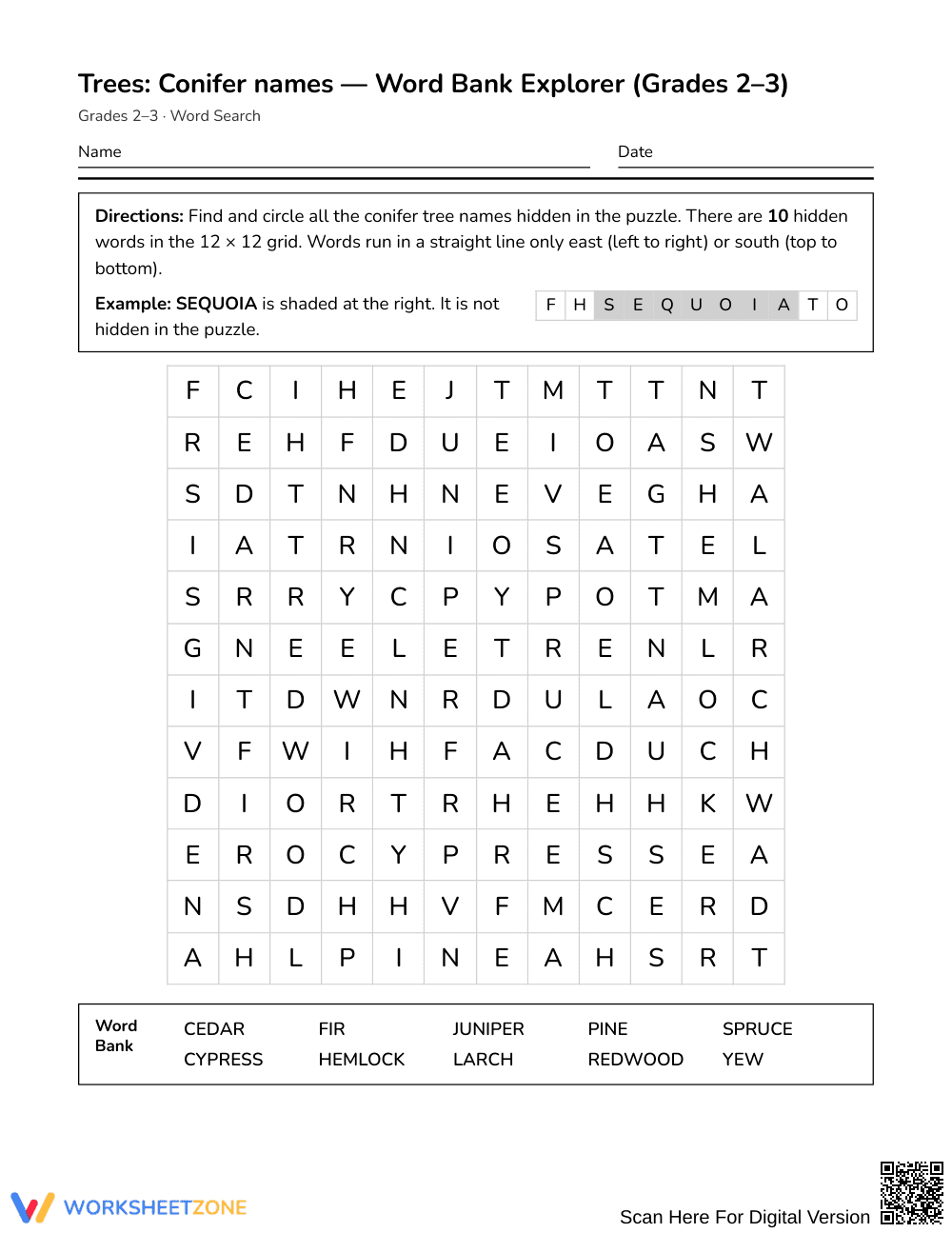

Printable Conifer Names Word Search | Grades 2–3 Science

Paste this activity's link or code into your existing LMS (Google Classroom, Canvas, Teams, Schoology, Moodle, etc.).
Students can open and work on the activity right away, with no student login required.
You'll still be able to track student progress and results from your teacher account.
This conifer names word search introduces young botanists to cone-bearing trees through targeted vocabulary identification. Designed for Grades 2–3 science units, this printable puzzle helps students recognize ten distinctive evergreen species while reinforcing spelling, visual scanning, and plant classification concepts during foundational life science study.
At a Glance
- Grade: Grades 2–3 · Subject: Science (Life Science)
- Standard: Not standards-assessed — vocabulary enrichment
- Skill Focus: Conifer tree names and botanical vocabulary
- Format: 1 student activity page · 10 hidden words · Complete answer key included · PDF
- Best For: Independent science vocabulary practice, review centers, and early finishers
- Time: 15–20 instructional minutes
This single-page science word search features an accessible 12-by-12 letter grid alongside an alphabetical word bank containing ten conifer tree names. Students locate words such as cedar, hemlock, redwood, and spruce without backward or diagonal placements. The resource includes a full answer key that clearly highlights all word locations in the grid.
Puzzle Structure and Mechanics
The activity provides an approachable design tailored to primary learners:
- Grid Dimensions: A 12-by-12 grid keeps letter density accessible for Grades 2–3 visual tracking.
- Word Orientations: Words run solely across (west to east) and down (north to south), eliminating confusing diagonal or reverse text.
- Alphabetical Bank: An alphabetized bank lists all 10 target conifers from cedar to yew, supporting reference skills as students cross off found words.
Standards Alignment
This word search serves strictly as science vocabulary enrichment and is not formally aligned to state or national standards. It supports general life science literacy by introducing essential botanical terminology and tree types during primary plant units.
How to Use It
Deploy this puzzle during or after direct instruction within a plant classification unit. It serves effectively as an independent science center after reading about evergreen trees or as a calm morning work task. During completion, observe whether students scan rows systematically or jump randomly to assess visual tracking strategies. Most students find all 10 words in 15 to 20 minutes.
Who It's For
This activity suits Grades 2–3 general education students, introductory plant units, and English learners acquiring science terms. Provide highlighters for students needing visual isolation support. Pair this puzzle with an illustrated evergreen anchor chart displaying real needle and cone samples.
Vocabulary enrichment activities that focus on specialized domain terms build vital lexical schemas that facilitate long-term scientific comprehension in primary science classrooms. According to Fisher & Frey (2014), intentional word-study tasks strengthen domain-specific academic vocabulary when students repeatedly encounter target terms through engaging, low-stakes practice routines. This single-page science word search provides second and third grade pupils with direct exposure to 10 authentic conifer names, including cedar, redwood, pine, and hemlock, within a structured 12-by-12 puzzle grid. By restricting letter pathways exclusively to horizontal left-to-right and vertical top-to-bottom arrangements, the task reinforces orthographic mapping, letter-sequence recognition, and visual scanning without inducing excessive cognitive load. As students locate each botanical term from the alphabetical list, they consolidate foundational science concepts that prepare them for advanced plant classification and forestry studies across elementary grade levels.


