


























Views
Downloads

Printable Beginning Sounds Hunt Worksheet | Grade K
Paste this activity's link or code into your existing LMS (Google Classroom, Canvas, Teams, Schoology, Moodle, etc.).
Students can open and work on the activity right away, with no student login required.
You'll still be able to track student progress and results from your teacher account.
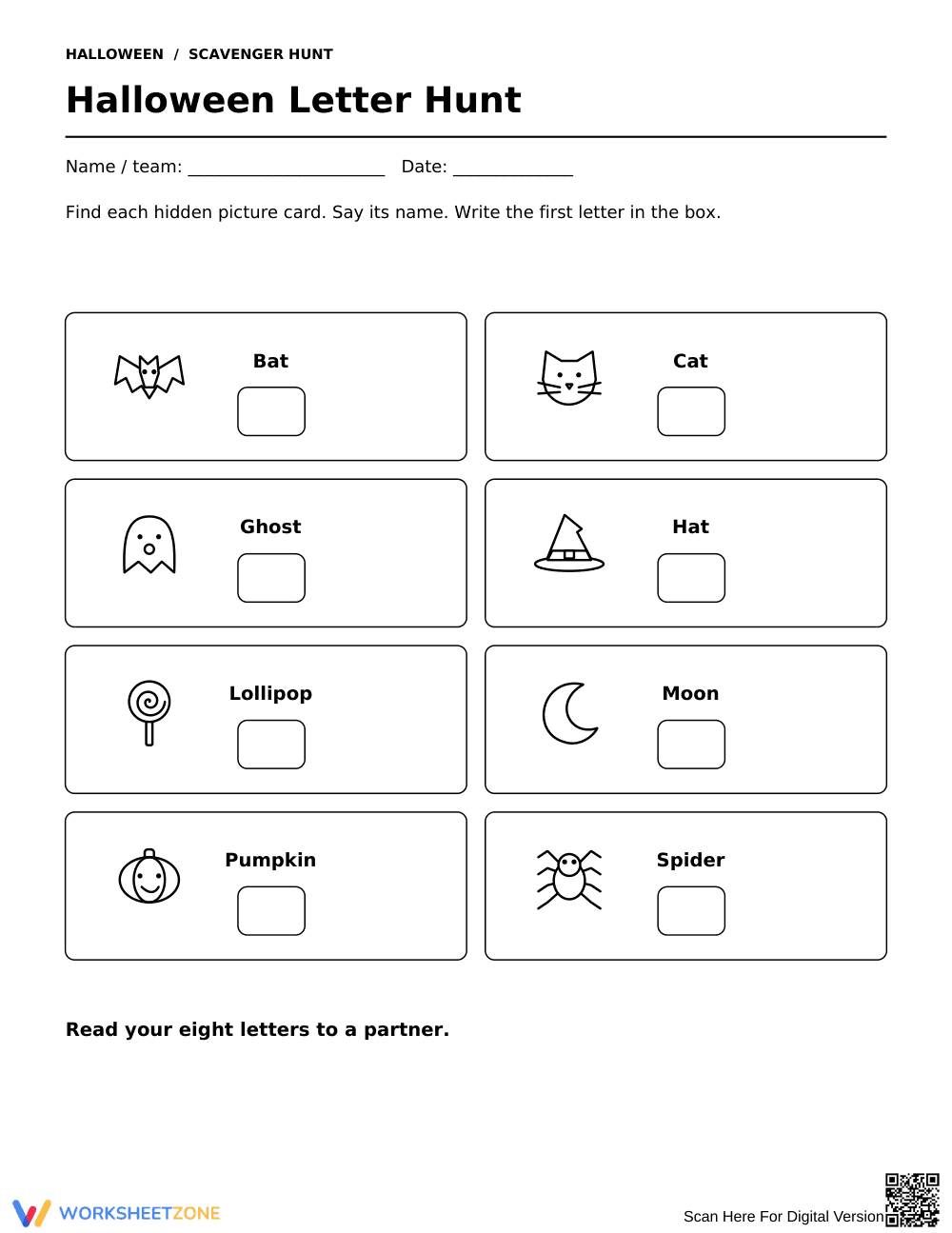
This Halloween letter hunt worksheet builds early phonemic awareness and letter-sound association by prompting learners to identify initial consonant sounds. Students search for themed picture cards, articulate each word aloud, and record the corresponding starting letter in designated answer boxes, reinforcing letter formation and sound-spelling mastery through active movement.
At a Glance
- Grade: K · Subject: ELA / Phonics
- Standard:
CCSS.ELA-LITERACY.RF.K.3.A— Identify and produce the primary sound for common consonant letters- Skill Focus: Initial Consonant Sounds
- Format: 2 pages · 8 problems · Answer key included · PDF
- Best For: Phonics centers and kinesthetic review
- Time: 10–15 minutes
What's Inside
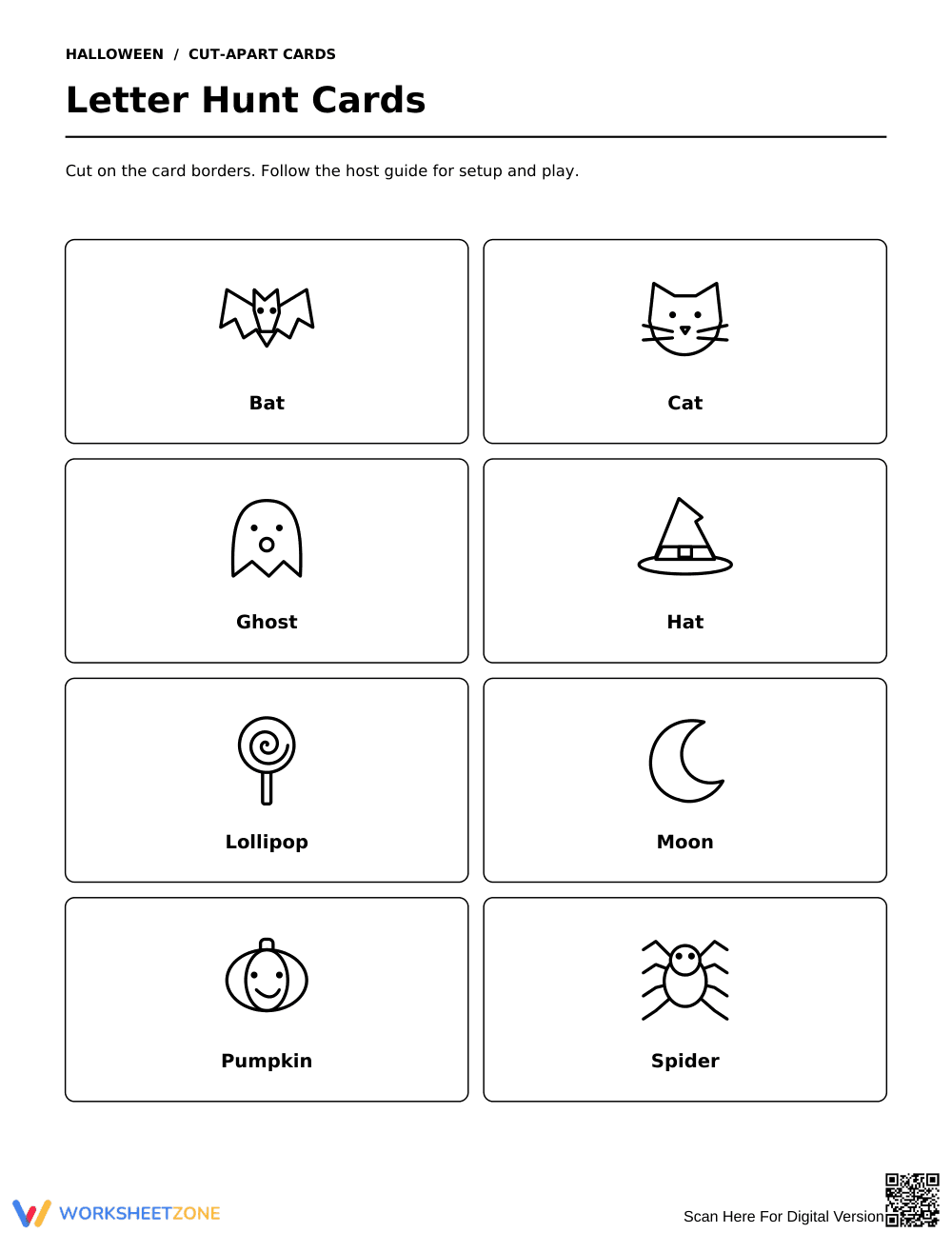
This activity set includes a 1-page student recording sheet with 8 illustrated Halloween vocabulary boxes, 1 page of cut-apart cards, and a 1-page host guide with an answer key. Visual line art and text labels provide supportive scaffolds for early readers.
Skill Progression
- Guided practice (Items 1–2): Students locate familiar words (Bat, Cat) with distinct initial consonants under teacher modeling.
- Supported practice (Items 3–5): Learners work through vocabulary (Ghost, Hat, Lollipop) using partner support to isolate initial phonemes.
- Independent practice (Items 6–8): Students independently identify pictures (Moon, Pumpkin, Spider), determine initial sounds, and write corresponding letters.
This progression follows the gradual release of responsibility model, moving students from guided sound identification to independent phonetic writing.
Standards Alignment
The primary standard addressed is `CCSS.ELA-LITERACY.RF.K.3.A`, requiring students to demonstrate knowledge of letter-sound correspondences by producing primary consonant sounds. The resource also supports `CCSS.ELA-LITERACY.L.K.1.A` through upper- and lowercase letter formation. Both standard codes can be copied directly into lesson plans, IEP goals, or district curriculum mapping tools.
How to Use It
Use this letter hunt during small-group literacy centers after direct phonics instruction on initial consonants. Tape cards around the room for partner hunts, or use it as a focused morning warm-up. Formative assessment tip: Listen as students say words aloud to verify accurate initial sound isolation. Expected completion time is 10 to 15 minutes.
Who It's For
This worksheet is built for kindergarten and early first-grade students developing phonemic awareness. Emergent writers can trace teacher-penciled letters, while advanced learners can cover card labels to identify initial sounds from pictures alone. Pair this activity with an alphabet sound anchor chart or direct phonics mini-lesson.
Phonics instruction that links active letter-sound isolation with immediate written response accelerates early reading acquisition. According to research synthesized by Fisher & Frey (2014), structured physical literacy activities that integrate guided partner discourse significantly improve phonemic retention among primary learners. Aligned with CCSS.ELA-LITERACY.RF.K.3.A, this resource targets the essential early literacy skill of isolating initial consonant sounds and translating auditory phonemes into accurate graphemes. Students explore eight foundational vocabulary words, articulate target sounds aloud, and record matching letters onto a structured response sheet. By combining clear visual picture prompts, kinesthetic card searches, and collaborative partner checks, the activity provides multi-tiered phonological reinforcement for emerging readers. This standards-based practice sheet establishes critical letter-sound fluency required for subsequent decoding success and early word recognition, making it an effective, evidence-based addition to foundational kindergarten and first-grade classroom reading instruction.


