


























Views
Downloads


Printable ATP Cycling & Energy Coupling Worksheet
Paste this activity's link or code into your existing LMS (Google Classroom, Canvas, Teams, Schoology, Moodle, etc.).
Students can open and work on the activity right away, with no student login required.
You'll still be able to track student progress and results from your teacher account.
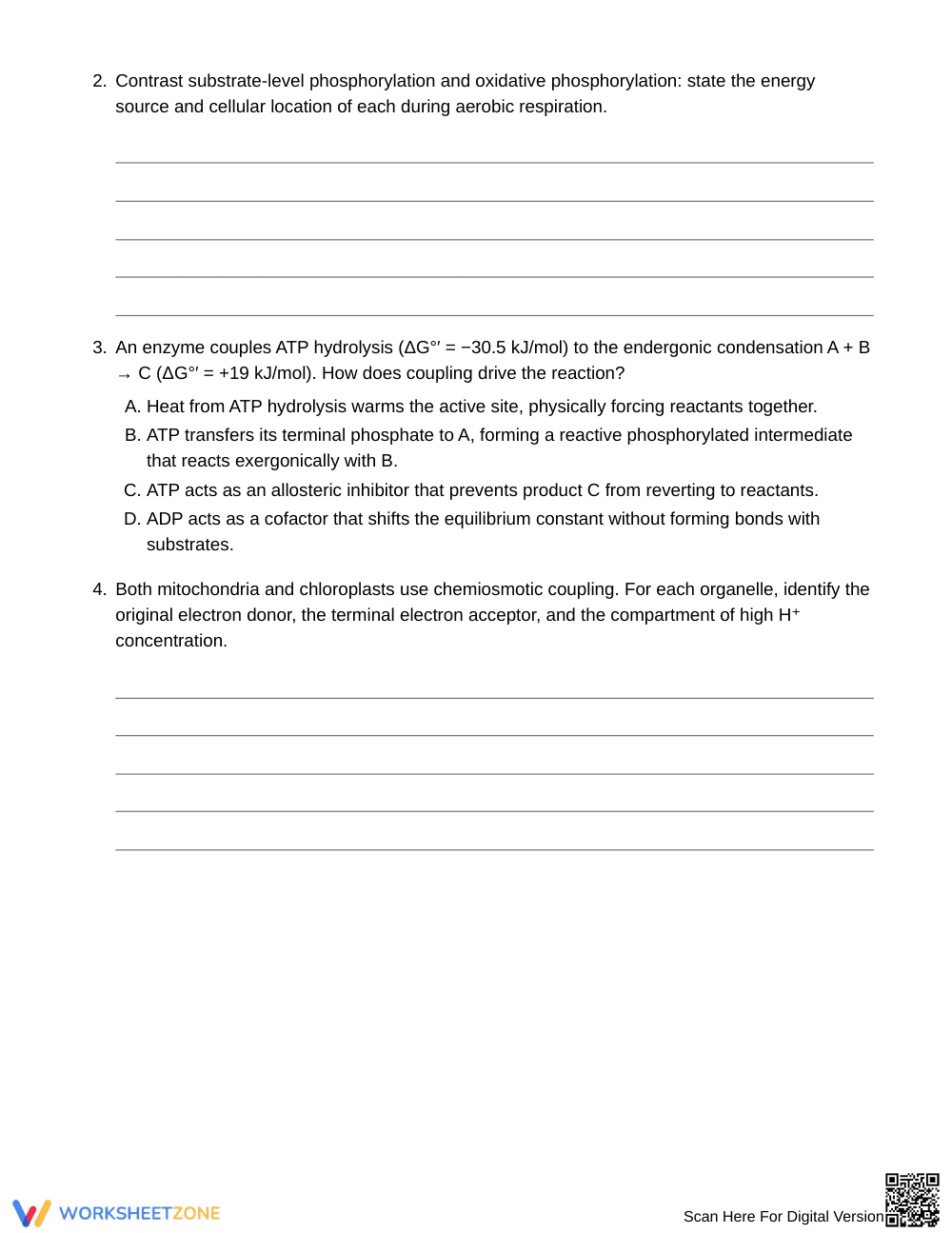
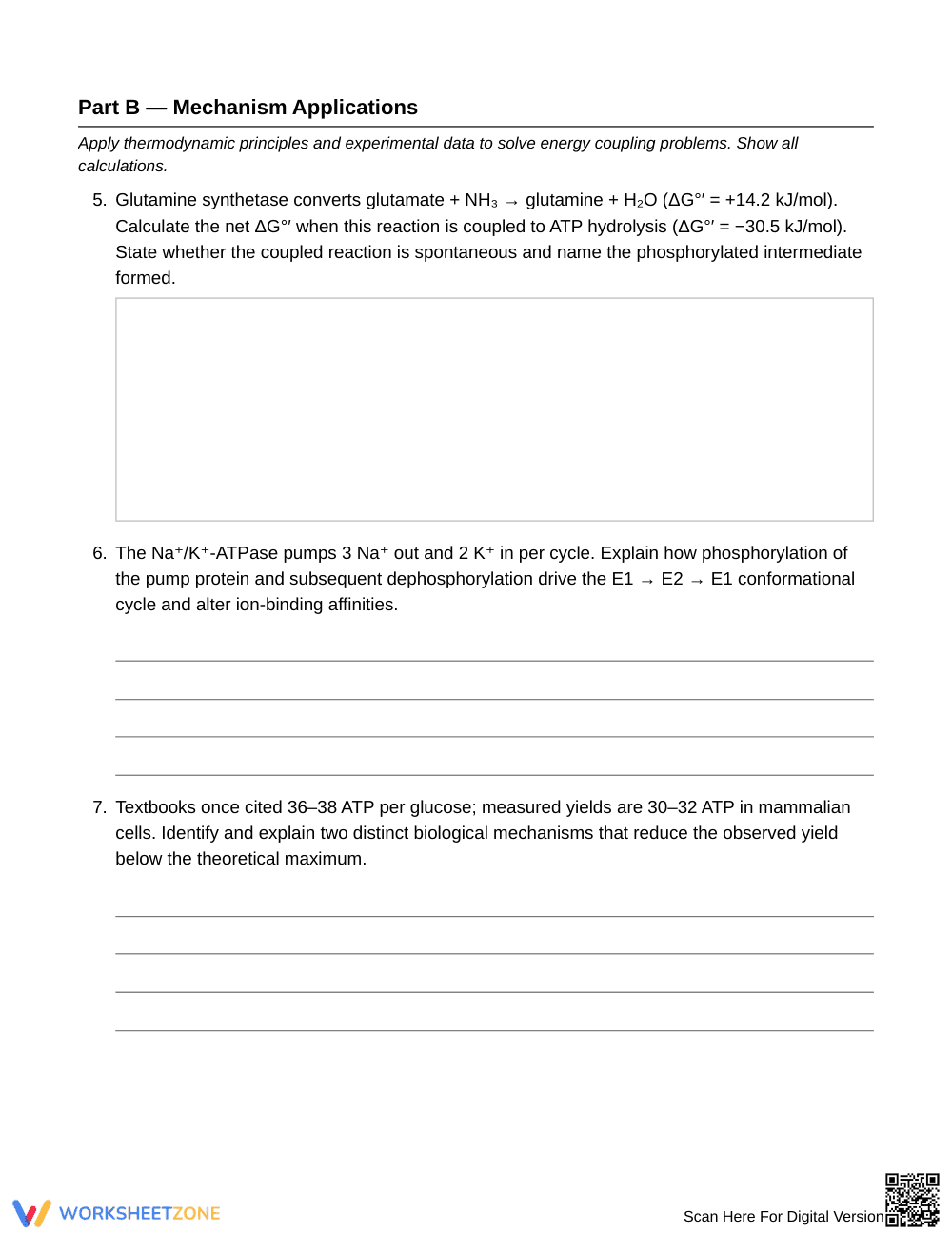
This Grade 10 Biology worksheet builds student mastery of ATP cycling and energy coupling through 12 carefully sequenced problems spanning concept distinctions, mechanism applications, and justified predictions. Students move from identifying why ATP hydrolysis is exergonic to calculating net free energy changes, analyzing experimental mitochondrial data, and predicting metabolic outcomes under novel physiological conditions.
At a Glance
- Grade: 10 · Subject: Biology
- Standard: Cellular Energy & ATP — Explain how ATP hydrolysis and coupling drive endergonic reactions in cells
- Skill Focus: ATP Cycling and Energy Coupling
- Format: 5 pages · 12 problems · Answer key included · PDF
- Best For: Guided practice after direct instruction on cellular respiration
- Time: 40–55 minutes
Skill Progression
- Guided Practice (Part A, 4 problems): A Core Principles box defines ATP hydrolysis thermodynamics, energy coupling, and chemiosmosis. Multiple-choice items address common misconceptions, including the high-energy bond myth.
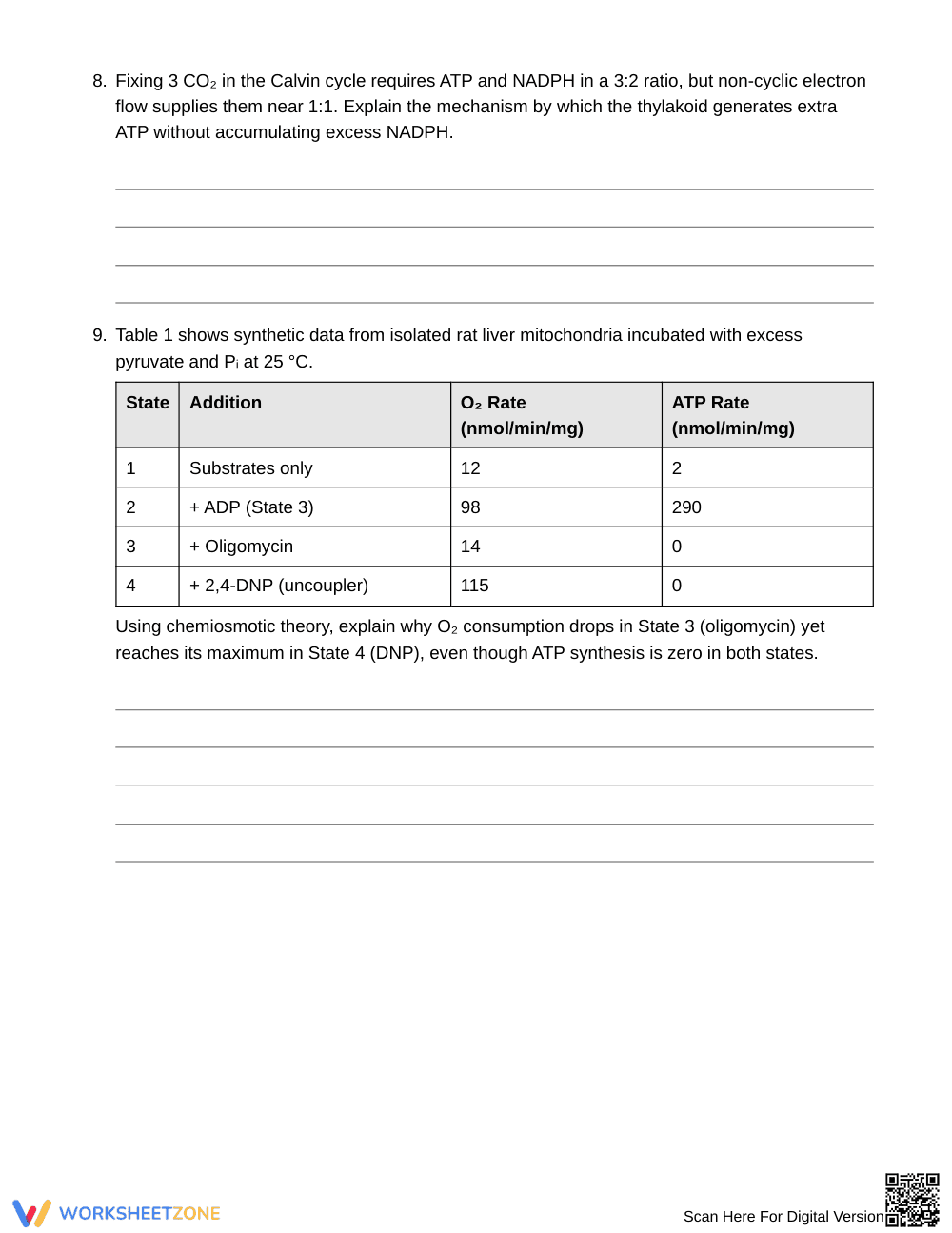
- Supported Practice (Part B, 6 problems): Scaffolding shifts to worked calculations and data analysis. Students calculate net free energy changes, interpret mitochondrial oxygen-consumption data under oligomycin and 2,4-DNP, and explain transport ATPase cycling.
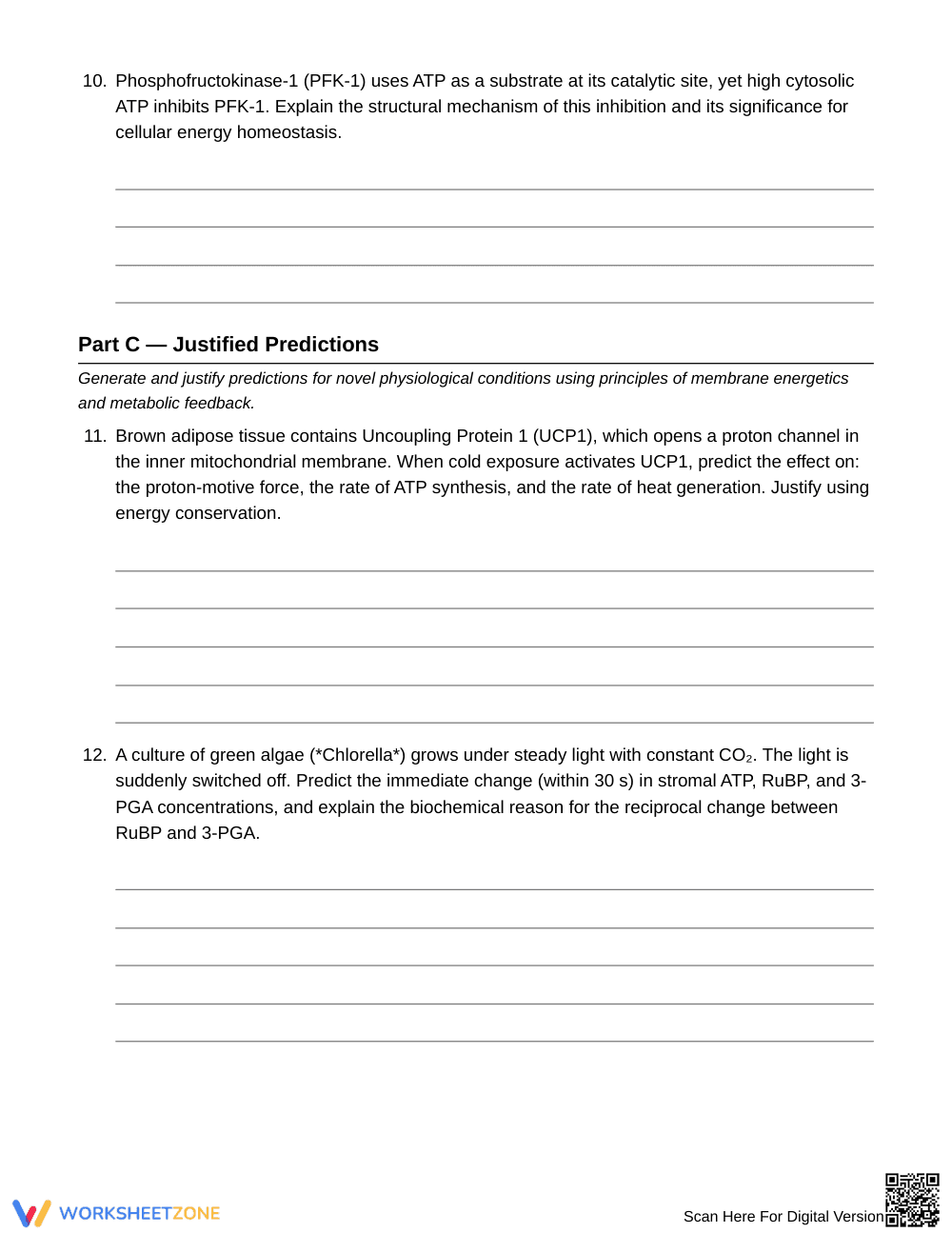
- Independent Practice (Part C, 2 problems): Students apply thermodynamic reasoning to novel contexts without prompts, analyzing brown adipose tissue uncoupling and Calvin cycle responses to darkness.
How to Use It
Assign Part A immediately following direct instruction on ATP structure to check for persistent misconceptions. Parts B and C serve as consolidation tasks at the end of the cellular respiration unit or as exam preparation. Circulating while students complete the mitochondrial data table allows teachers to formatively evaluate whether students understand proton gradient mechanics versus ATP synthase inhibition. Most students finish all 12 problems in 40 to 55 minutes.
Who It's For
This resource is designed for Grade 10 Biology students in general or honors classes studying bioenergetics. Scaffolds support developing learners with reference definitions, while challenging extension questions push advanced students to evaluate multi-variable metabolic feedback loops.
This five-page, 12-problem worksheet targets ATP cycling and energy coupling, the mechanism by which cells use ATP hydrolysis to drive endergonic biosynthetic and transport reactions through shared phosphorylated intermediates. The resource spans concept identification, quantitative free-energy calculations, experimental data interpretation, and open-ended physiological predictions, providing an intentional progression from foundational recall to rigorous scientific analysis. Fisher and Frey (2014) identify gradual-release scaffolding as a primary driver of content retention in secondary science classrooms; this worksheet operationalizes that instructional model across three explicitly structured tiers. A detailed answer key supplies complete worked calculations and model explanations, making the resource exceptionally practical for self-assessment, peer review, or structured teacher-led debrief. The resource is ready to print as a PDF and requires zero additional preparation or lab materials prior to classroom distribution, ensuring immediate instructional implementation across standard and advanced high school biology courses.


