


























Views
Downloads

Printable Alphabet Hunt Worksheet | Grade K ELA
Paste this activity's link or code into your existing LMS (Google Classroom, Canvas, Teams, Schoology, Moodle, etc.).
Students can open and work on the activity right away, with no student login required.
You'll still be able to track student progress and results from your teacher account.
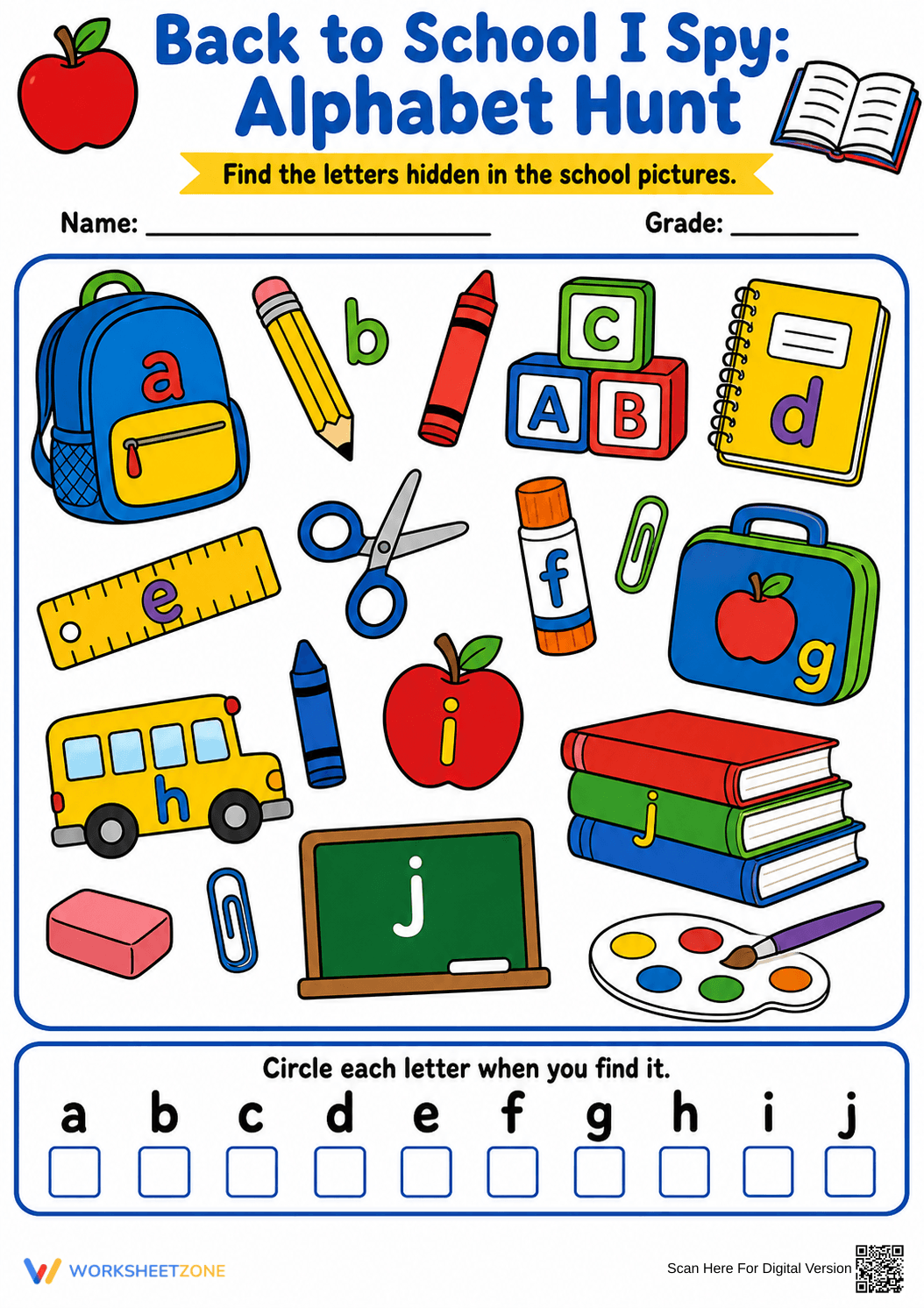
This Back to School I Spy worksheet helps early learners practice lowercase letter recognition through an engaging visual search. Students scan a vibrant classroom scene to locate ten specific letters, reinforcing foundational literacy skills while building focus and visual discrimination. It is a perfect back-to-school activity.
At a Glance
- Grade: K · Subject: ELA
- Standard:
CCSS.ELA-LITERACY.RF.K.1.D— Recognize and name lowercase letters- Skill Focus: Letter recognition
- Format: 1 page · 10 problems · No answer key · PDF
- Best For: Morning work or centers
- Time: 10–15 minutes
Inside this single-page resource, educators will find a brightly illustrated school-themed scene filled with familiar objects like backpacks, school buses, and crayons. Hidden among these items are ten lowercase letters (a through j). The bottom of the page features a clear tracking section with checkboxes, allowing students to mark off each letter as they find it in the picture above.
This resource is designed for a completely zero-prep workflow, making it ideal for busy mornings or unexpected schedule changes.
- Print (1 minute): Simply download the PDF and print the required number of copies. The bold lines and clear graphics print beautifully.
- Distribute (1 minute): Hand out the sheets along with pencils or crayons. The instructions are intuitive enough for young learners to grasp immediately.
- Review (3 minutes): Quickly check student progress by glancing at their completed checkboxes and circled letters.
Total teacher prep time is under two minutes, making it an excellent sub plan addition.
This activity aligns directly with CCSS.ELA-LITERACY.RF.K.1.D: Recognize and name all upper- and lowercase letters of the alphabet. By isolating the first ten letters of the alphabet in a lowercase format, it provides targeted practice for early readers. Both standard codes can be copied directly into lesson plans, IEP goals, or district curriculum mapping tools.
This worksheet serves as excellent morning work during the first weeks of school. As students arrive and settle in, they can immediately begin searching for letters, providing a calm, focused start to the day. Alternatively, use it as an independent literacy center activity while the teacher conducts small group reading instruction. For a quick formative assessment, observe students as they work to see if they can name the letter out loud before checking the corresponding box. Expected completion time is 10 to 15 minutes.
This resource is primarily designed for Kindergarten students who are just beginning to identify lowercase letters. It also works well for pre-K students who need an extra challenge, or first graders requiring a quick back-to-school refresher. To differentiate for students needing more support, provide an alphabet anchor chart they can reference while searching. This worksheet pairs perfectly with a whole-group read-aloud of a school-themed alphabet book.
Developing strong letter recognition skills is a critical first step in early childhood literacy development. According to a recent comprehensive RAND AIRS 2024 report on early reading interventions, students who engage in targeted visual discrimination tasks demonstrate faster acquisition of alphabetic principles. This worksheet supports CCSS.ELA-LITERACY.RF.K.1.D by requiring students to recognize and name lowercase letters within a complex visual field. By integrating this practice into a playful "I Spy" format, educators can reduce affective filters and increase student engagement during foundational skill building. The combination of visual searching and physical tracking via checkboxes reinforces the cognitive connection between the letter's shape and its identity. Utilizing evidence-based formats like this ensures that early learners build the automaticity required for future decoding and reading fluency success.


