




























Views
Downloads
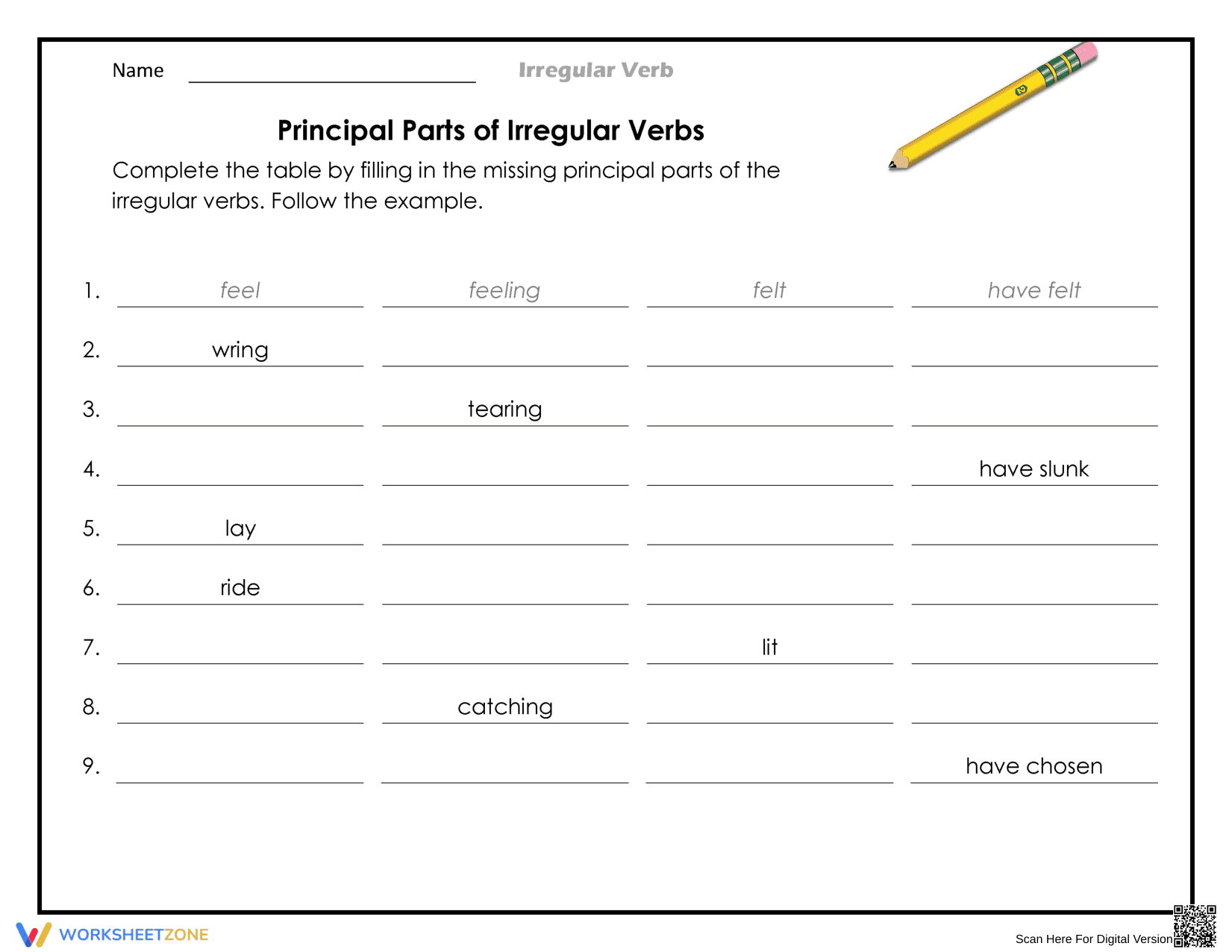

Essential Principal Parts of Irregular Verbs | Grade 4

Paste this activity's link or code into your existing LMS (Google Classroom, Canvas, Teams, Schoology, Moodle, etc.).
Students can open and work on the activity right away, with no student login required.
You'll still be able to track student progress and results from your teacher account.
This focused English Language Arts worksheet empowers Grade 3, 4, and 5 students to master the principal parts of irregular verbs. By completing a structured table, learners practice forming the present, present participle, past, and past participle forms of challenging verbs. This exercise builds a strong foundation for grammatical precision in writing.
At a Glance
- Grade: 3-5 · Subject: Grammar
- Standard:
CCSS.ELA-LITERACY.L.3.1.D— Form and use regular and irregular verbs correctly in student writing and speech- Skill Focus: Irregular Verb Principal Parts
- Format: 1 page · 24 tasks · Answer key included · PDF
- Best For: Independent grammar practice and formative assessment
- Time: 15–20 minutes
Inside this printable PDF, you will find a clean, one-page worksheet featuring an irregular verb table with nine distinct entries. The first row serves as a worked example (feel, feeling, felt, have felt), providing immediate scaffolding. Students are tasked with filling in the missing principal parts for eight additional verbs, covering a total of 24 tasks to ensure comprehensive skill application.
Skill Progression
- Guided practice: Students begin with a completed example that models the correct identification of all four principal parts.
- Supported practice: The first few tasks provide two out of four forms, such as "tearing" or "have slunk," to narrow the focus.
- Independent practice: Later tasks require students to recall forms with minimal cues, solidifying their understanding of irregular patterns.
This gradual-release approach ensures that students transition smoothly from observation to independent execution of complex verb forms.
Standards Alignment
This resource is directly aligned with CCSS.ELA-LITERACY.L.3.1.D, which requires students to form and use regular and irregular verbs. By focusing on the principal parts—base form, present participle, past, and past participle—it also supports higher-grade standards like CCSS.ELA-LITERACY.L.4.1.B and CCSS.ELA-LITERACY.L.5.1.C. Both standard codes can be copied directly into lesson plans, IEP goals, or district curriculum mapping tools.
How to Use It
Use this worksheet during the "You Do" phase of a grammar lesson or as a quick morning work activity to reinforce verb tense consistency. For a formative assessment tip, observe whether students struggle more with the past participle versus the past tense form; this often indicates a need for instruction on auxiliary verbs. Expect students to complete the 24 tasks within 15 to 20 minutes.
Who It's For
This resource is ideal for elementary students in grades 3 through 5, as well as English Language Learners (ELL) navigating the unpredictable nature of irregular English verbs. It pairs naturally with a short mentor text or an anchor chart listing common irregular patterns. Differentiation is supported through the structured table format, providing a visual frame for students who need organizational support.
Mastery of irregular verb forms is critical for syntactic development, as noted in the RAND AIRS 2024 analysis of foundational literacy. This worksheet addresses CCSS.ELA-LITERACY.L.3.1.D by requiring students to form irregular verbs through 24 targeted tasks. Research by Fisher & Frey (2014) highlights the importance of scaffolded practice, where structured tables help students internalize complex linguistic patterns. By identifying all four principal parts—present, present participle, past, and past participle—this tool ensures learners move beyond memorization to a functional understanding of verb mechanics. For educators, this resource provides a reliable method for tracking progress toward standards, ensuring irregular verb usage becomes second nature in both narrative and informational writing contexts across the intermediate elementary grades.


