


























Views
Downloads
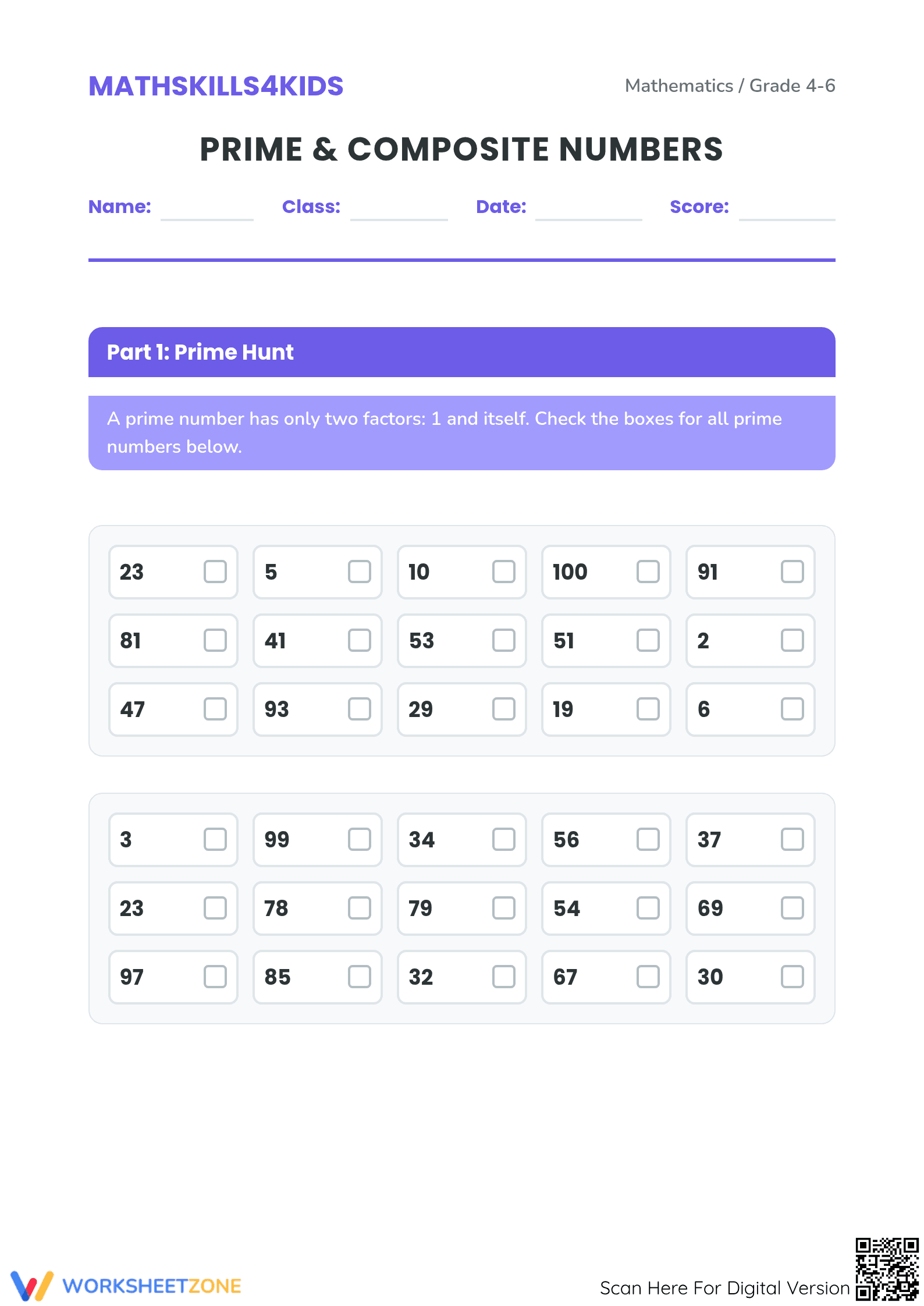


Printable Prime & Composite Numbers Worksheet | Grade 4 Math
Paste this activity's link or code into your existing LMS (Google Classroom, Canvas, Teams, Schoology, Moodle, etc.).
Students can open and work on the activity right away, with no student login required.
You'll still be able to track student progress and results from your teacher account.
Mastering Prime and Composite Numbers
Strengthen your Grade 4 students' number sense with this comprehensive worksheet focused on prime and composite numbers. Through a variety of engaging tasks, learners will practice identifying, sorting, and factoring numbers up to 100, building a solid foundation for more advanced mathematical concepts and problem-solving. This is a must have for your classroom.
At a Glance
- Grade: 4 · Subject: Math
- Standard:
CCSS.MATH.CONTENT.4.OA.B.4— Gain familiarity with factors and multiples to identify prime and composite numbers.- Skill Focus: Identifying Prime and Composite Numbers
- Format: 5 pages · 46 problems · Answer key included · PDF
- Best For: Independent practice, math centers, or homework
- Time: 25–40 minutes
What's Inside
This five-page PDF includes a diverse set of activities to keep students engaged. The worksheet begins with coloring and identification tasks, moves to number mazes and factor trees, and concludes with a cut-and-paste sorting activity. A complete, easy-to-use answer key is provided for quick checking and feedback.
A Progression of Skills
- Guided Practice: The worksheet opens with a number grid coloring task, visually introducing the concept and allowing students to discover patterns among prime numbers. This serves as a warm-up activity.
- Supported Practice: Students then move to identifying prime or composite for 24 individual numbers and creating factor trees for 6 more, with the structured format providing clear support for their reasoning.
- Independent Practice: The resource culminates in two number mazes and a cut-and-paste sorting challenge, requiring students to apply their knowledge independently across dozens of numbers in a more complex format.
This progression follows a gradual-release model, perfect for scaffolding instruction from "I Do" to "You Do."
Standards Alignment
This resource is directly aligned to Common Core standard CCSS.MATH.CONTENT.4.OA.B.4, which requires students to gain familiarity with factors and multiples and determine whether a given whole number in the range 1–100 is prime or composite. It also supports foundational skills for CCSS.MATH.CONTENT.5.OA.A.2. Both standard codes can be copied directly into lesson plans, IEP goals, or district curriculum mapping tools.
How to Use It
Use this worksheet as independent practice after a direct instruction lesson on prime and composite numbers. It is also an excellent activity for math centers or as a homework assignment. For a formative assessment, observe which students struggle with the factor trees, as this can indicate a misunderstanding of factors versus multiples. Most students will complete the worksheet in 25–40 minutes.
Who It's For
This worksheet is designed for fourth-grade students but can serve as a review for fifth graders or an extension for advanced third graders. The variety of tasks helps support different learning styles. Pair this activity with a factor pairs anchor chart to provide visual support for students who need it.
This worksheet's design reflects the gradual release of responsibility framework, a key instructional strategy for building student independence (Fisher & Frey, 2014). By moving from guided visual tasks to independent application, it helps students internalize the process for meeting standard CCSS.MATH.CONTENT.4.OA.B.4. This standard, which involves identifying prime and composite numbers, is a critical gateway to understanding number theory and successfully factoring algebraic expressions in later grades. The structured practice provided here is more effective than rote memorization, as it builds conceptual understanding of why a number is prime or composite. Providing varied tasks, as seen in this resource, has been shown to increase student engagement and time on task, leading to greater retention of foundational mathematical skills necessary for future learning and standardized assessments. Students will gain fluency with factors and multiples.


