


























Views
Downloads
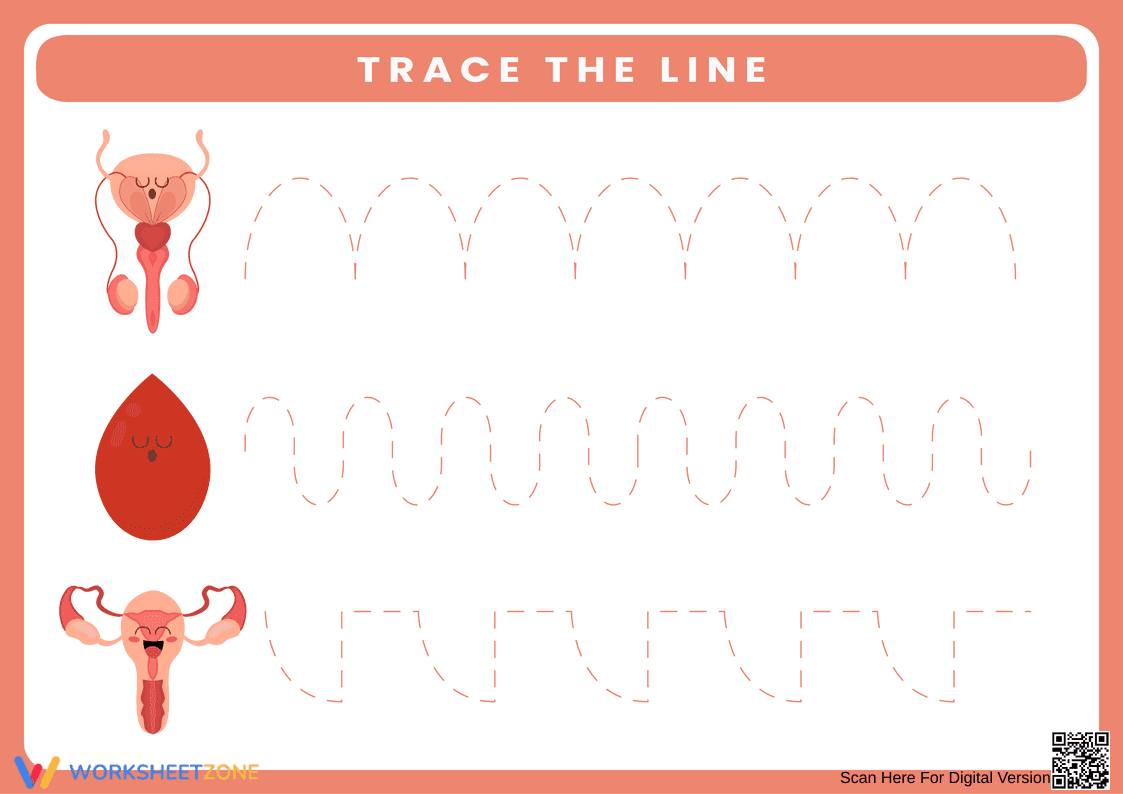

Preschool Tracing Worksheet | Essential Fine Motor Ready
Paste this activity's link or code into your existing LMS (Google Classroom, Canvas, Teams, Schoology, Moodle, etc.).
Students can open and work on the activity right away, with no student login required.
You'll still be able to track student progress and results from your teacher account.
This Preschool tracing worksheet provides foundational fine motor practice by challenging students to follow complex paths. By navigating curved, wavy, and angular lines, learners build the hand-eye coordination necessary for future letter formation. This resource bridges the gap between simple scribbling and intentional writing through engaging, themed illustrations.
At a Glance
- Grade: Preschool · Subject: Handwriting
- Standard:
PK.PD.4— Develop small muscle control and coordination through purposeful pre-writing tracing tasks- Skill Focus: Fine motor line tracing
- Format: 1 page · 3 problems · Answer key included · PDF
- Best For: Morning work or fine motor centers
- Time: 5–10 minutes
What's Inside: This single-page PDF features three distinct tracing paths designed to test different wrist movements. The first row offers a series of small arches, the second a continuous wavy line, and the third a rhythmic angular pattern. Each path is anchored by stylized illustrations of the reproductive system, providing a unique visual context for daily handwriting practice.
Zero-Prep Workflow: Teachers can implement this activity in under two minutes. First, print the required number of copies (30 seconds). Second, distribute the sheets during a transition period or as part of a dedicated fine motor station (1 minute). Finally, review student progress by observing grip stability and line accuracy as they complete the 3 tasks (30 seconds). This makes it an ideal sub plan or quick-start activity.
Standards Alignment: This resource aligns with `PK.PD.4`, which focuses on developing the small muscle control required for writing and drawing. By following specific paths, students demonstrate the ability to control writing tools with increasing precision. Both standard codes can be copied directly into lesson plans, IEP goals, or district curriculum mapping tools.
How to Use It: Assign this worksheet during the "during" phase of a fine motor lesson to reinforce grip techniques. As a formative assessment, observe if students use their non-dominant hand to stabilize the paper, which is a key developmental milestone. Completion typically takes 5 to 10 minutes depending on the child's current dexterity level.
Who It's For: This is designed for preschool students, early kindergarteners, or students in Occupational Therapy (OT) programs requiring extra coordination practice. It pairs naturally with a direct instruction lesson on proper pencil grip or a tactile sand-tracing activity to build muscle memory.
The use of tracing activities to support pre-literacy skills is well-documented in early childhood education research. According to Fisher & Frey (2014), the gradual release of responsibility in fine motor tasks—moving from guided tracing to independent drawing—is essential for cognitive and physical development. This worksheet addresses standard PK.PD.4 by providing structured paths that require varying degrees of wrist rotation and finger pressure. By engaging with these 3 specific line types, preschoolers develop the foundational neural pathways required for the complex task of letter construction. Research from the NAEP suggests that early intervention in fine motor control is a significant predictor of later academic success in writing-heavy subjects. This resource provides a practical, low-stakes environment for students to master these essential skills before transitioning to formal handwriting instruction.


