


























Views
Downloads

Essential Prepositions Worksheet | Grades 1-3 Grammar
Paste this activity's link or code into your existing LMS (Google Classroom, Canvas, Teams, Schoology, Moodle, etc.).
Students can open and work on the activity right away, with no student login required.
You'll still be able to track student progress and results from your teacher account.
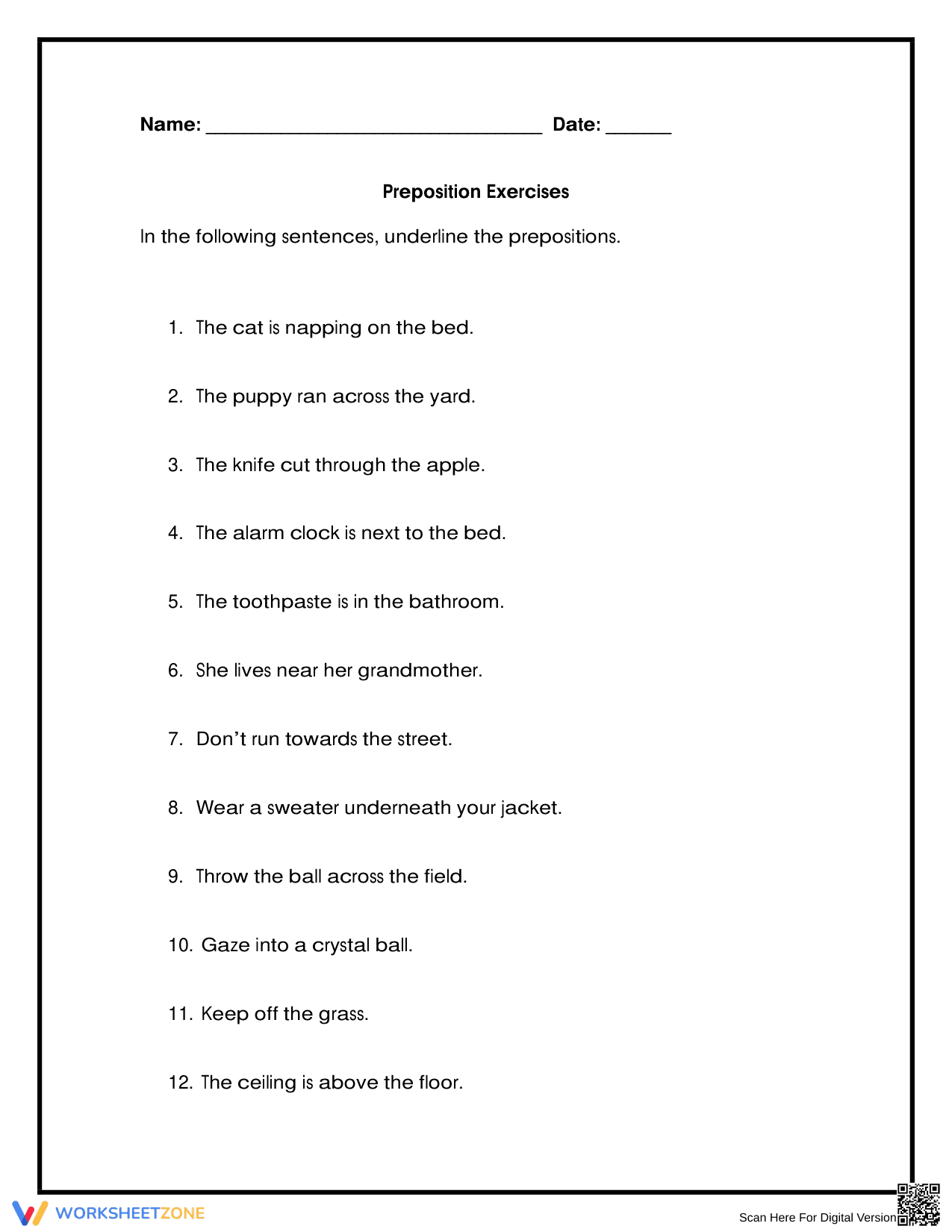
Mastering frequently occurring prepositions is a foundational skill for early writers to describe relationships between people, places, and objects. This Grade 1-3 grammar worksheet provides twelve clear sentences for students to analyze and identify spatial and directional prepositions. By underlining the key terms, learners strengthen their syntactic awareness and improve sentence comprehension across various contexts.
At a Glance
- Grade: 1-3 · Subject: English Language Arts
- Standard:
CCSS.ELA-LITERACY.L.1.1.I— Use frequently occurring prepositions such as during, beyond, and toward- Skill Focus: Preposition Identification
- Format: 1 page · 12 problems · Answer key included · PDF
- Best For: Independent grammar practice or sub plans
- Time: 10–15 minutes
This single-page PDF resource features twelve structured sentences designed for young learners. Each sentence contains a common preposition (such as "on," "across," "through," "near," and "above") that students must identify and underline. The layout is clean and distraction-free, providing ample white space for student work. A complete answer key is provided to ensure quick and accurate grading or self-correction.
This resource is designed for immediate classroom implementation with three simple steps. First, print the single-page document (takes less than 30 seconds). Second, distribute the worksheet to your students as a morning warm-up or transition activity (takes 1 minute). Finally, use the provided answer key to review responses together or during a quick check (takes 1 minute). Total teacher preparation time is under two minutes, making it an ideal choice for busy mornings or emergency sub folders.
The primary focus of this worksheet is CCSS.ELA-LITERACY.L.1.1.I, which requires students to use and identify frequently occurring prepositions in sentences. By isolating these parts of speech, students develop the grammatical foundation necessary for more complex sentence structures in later grades. Both standard codes can be copied directly into lesson plans, IEP goals, or district curriculum mapping tools.
Use this worksheet during the "Independent Practice" phase of a grammar lesson after introducing the concept of prepositions as "where" or "when" words. It also serves as an excellent formative assessment tool; teachers can observe whether students consistently identify prepositions versus other parts of speech like adjectives. Completion typically takes 10 to 15 minutes, fitting perfectly into literacy centers or as a homework reinforcement task.
This activity is tailored for first through third-grade students who are developing their primary grammar skills. It is particularly effective for English Language Learners (ELL) who need focused practice identifying spatial relationships in English sentences. Pair this resource with a preposition anchor chart or a short reading passage to provide students with multiple exposures to the target skill.
Grammatical instruction focusing on parts of speech, specifically prepositions, is essential for developing syntactical fluency in early elementary education. According to Fisher & Frey (2014), explicit practice in identifying word functions within sentences allows students to internalize the rules of language, leading to improved writing clarity and reading comprehension. This worksheet directly addresses CCSS.ELA-LITERACY.L.1.1.I by providing twelve high-frequency prepositional examples in varied sentence structures. Research from RAND AIRS 2024 suggests that high-quality, focused practice sheets help solidify these "closed-class" word categories, which are often challenging for novice writers. By isolating the preposition within a complete sentence, the resource supports the gradual release of responsibility model, moving students from guided identification to independent usage in their own compositions. This standalone practice is a critical component of a comprehensive ELA curriculum aimed at meeting national literacy benchmarks.


