


























Views
Downloads

Dinosaur Crossword Worksheet | Essential Kindergarten ELA
Paste this activity's link or code into your existing LMS (Google Classroom, Canvas, Teams, Schoology, Moodle, etc.).
Students can open and work on the activity right away, with no student login required.
You'll still be able to track student progress and results from your teacher account.
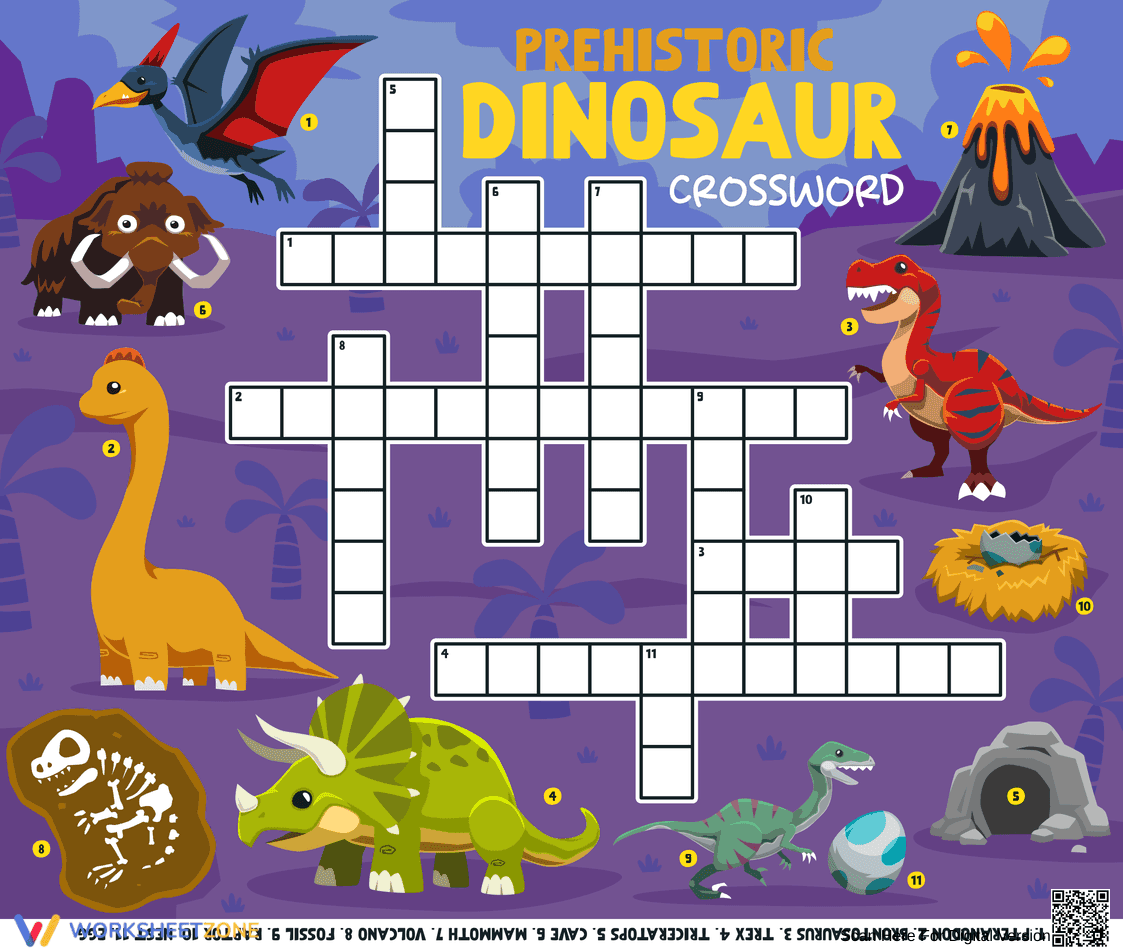
This Kindergarten dinosaur crossword worksheet helps young learners master prehistoric vocabulary and spelling through engaging visual associations. By connecting 11 distinct prehistoric images to their written names, students build foundational literacy skills while exploring a high-interest science topic. It provides a structured way to practice letter formation and word recognition in a fun, puzzle-based format.
At a Glance
- Grade: Kindergarten · Subject: ELA
- Standard:
CCSS.ELA-LITERACY.L.K.6— Use words and phrases acquired through conversations, reading and being read to- Skill Focus: Dinosaur Vocabulary & Spelling
- Format: 1 page · 11 problems · Answer key included · PDF
- Best For: Independent morning work or literacy centers
- Time: 15–20 minutes
The resource features a single-page layout containing a central crossword grid surrounded by vibrant prehistoric illustrations. There are 11 specific tasks where students identify images such as a Triceratops, Volcano, and Fossil. A convenient word bank is located at the bottom of the page to support early spellers, though it can be folded over by the teacher to increase the difficulty for advanced learners who are ready for a challenge.
The zero-prep workflow is designed for maximum efficiency in busy classrooms. First, print the single-page PDF (30 seconds). Second, distribute the sheets to students during a literacy block or as a transition activity (1 minute). Finally, review the answers as a whole group using the provided key to reinforce correct spelling and pronunciation (5 minutes). This makes it an ideal resource for substitute folders or unexpected schedule gaps where high-quality instruction is still required.
This worksheet is primarily aligned with `CCSS.ELA-LITERACY.L.K.6`, which requires students to use words and phrases acquired through reading and being read to. It also supports `CCSS.ELA-LITERACY.L.K.1.E`, focusing on using frequently occurring nouns. Both standard codes can be copied directly into lesson plans, IEP goals, or district curriculum mapping tools to ensure instructional compliance and track student progress toward grade-level mastery.
Use this worksheet during a "Dinosaur" thematic unit to bridge the gap between science content and ELA skills. It works exceptionally well as a formative assessment after a read-aloud session about prehistoric life. Teachers should observe if students can independently match the picture to the word bank, which indicates strong visual-lexical processing. Completion typically takes 15 to 20 minutes depending on the student's familiarity with the terms.
This resource is tailored for Kindergarten students but remains highly effective for Grade 1 review or English Language Learners (ELL) who benefit from heavy visual scaffolding. It pairs naturally with a classroom anchor chart featuring prehistoric animals or a non-fiction picture book about the Mesozoic era to provide context for the vocabulary terms. The colorful design ensures that even reluctant writers stay engaged with the task.
Research by Fisher & Frey (2014) emphasizes the importance of visual scaffolding in early literacy, noting that "picture-to-text" associations significantly accelerate vocabulary acquisition in primary grades. This dinosaur crossword leverages that principle by providing 11 high-quality visual cues that anchor the spelling of complex terms like "Pteranodon" and "Triceratops." By integrating science-themed content into ELA practice, the worksheet aligns with modern pedagogical trends that favor cross-curricular instruction to increase student engagement. The inclusion of a word bank provides the necessary support for students working within their zone of proximal development, ensuring that the cognitive load remains focused on word recognition rather than rote memorization. According to the Fisher & Frey framework, such structured practice is essential for moving students toward independent word usage. This resource provides a measurable way to track progress toward CCSS.ELA-LITERACY.L.K.6 while maintaining a high level of student interest through its prehistoric theme.


