


























Views
Downloads

Essential Hook Sentences Practice | Grade 6-9 ELA
Paste this activity's link or code into your existing LMS (Google Classroom, Canvas, Teams, Schoology, Moodle, etc.).
Students can open and work on the activity right away, with no student login required.
You'll still be able to track student progress and results from your teacher account.
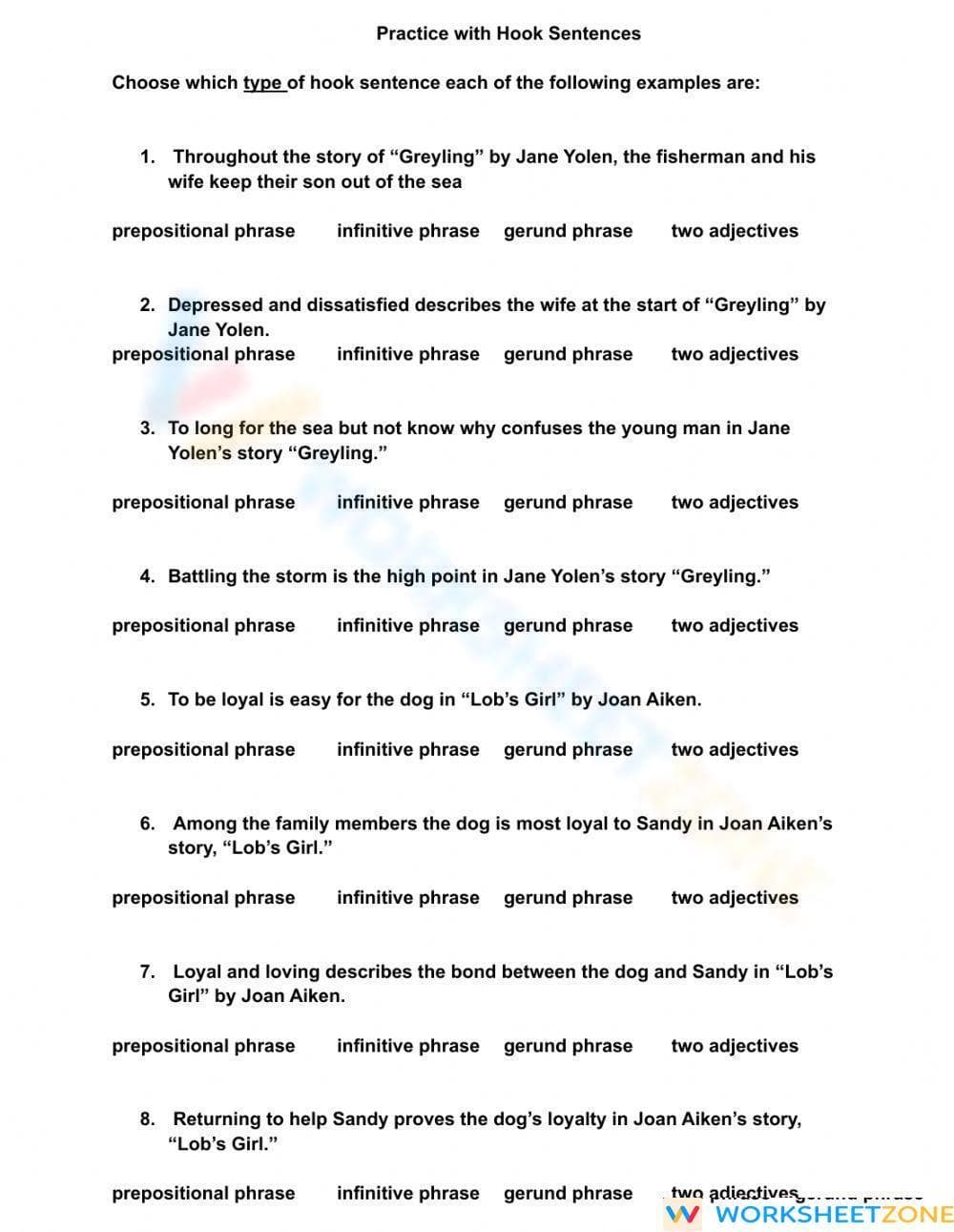
Crafting a compelling introduction is the first step toward essay success. This worksheet guides students through identifying and creating effective hook sentences to immediately engage their audience. By mastering various hook types—from provocative questions to startling statistics—learners build the foundational skills needed for sophisticated middle and high school writing across all genres.
At a Glance
- Grade: 6–9 · Subject: ELA
- Standard:
CCSS.ELA-LITERACY.W.6.2.A— Introduce a topic and organize ideas to engage and inform the reader.- Skill Focus: Identifying and writing essay hook sentences
- Format: 1 page · 8 problems · Answer key included · PDF
- Best For: Writing workshops and introduction-focused bell ringers
- Time: 15–20 minutes
This comprehensive one-page resource features eight structured tasks designed to sharpen student writing. Each problem presents a specific essay theme and challenges students to select or construct the most effective opening line from multiple high-quality options. The worksheet includes a clear answer key for immediate assessment and is formatted for both traditional paper printing and interactive digital use via auto-grading overlays.
The worksheet follows a structured progression to ensure skill mastery.
- Guided practice begins with two interactive examples that model how to identify effective hooks using the "I Do" method.
- Supported practice involves four targeted selection tasks where students evaluate and choose the best opening sentence from a set of four options, providing a "We Do" environment.
- Independent practice concludes with two higher-level application questions where students must justify their choices, completing the gradual release of responsibility.
This resource is directly aligned with CCSS.ELA-LITERACY.W.6.2.A, which requires students to introduce a topic and organize complex ideas, concepts, and information. It also supports higher-grade standards for argumentative and informative writing by focusing on the "lead" or "hook" necessary for academic rigor. Both standard codes can be copied directly into lesson plans, IEP goals, or district curriculum mapping tools.
Deploy this worksheet as a "bell ringer" activity at the start of a writing unit to activate prior knowledge about introductions. Alternatively, use it as a formative assessment after a direct instruction lesson on "The Lead." Teachers should observe if students can distinguish between a "question hook" and a "strong statement," providing immediate feedback. Most students will complete the exercise in approximately 20 minutes.
This worksheet is ideal for middle school students in grades 6 through 8, as well as ninth graders needing a refresher on essay structure. It serves as an excellent differentiation tool when paired with a graphic organizer or an anchor chart displaying different hook types. It is particularly effective for reluctant writers who struggle to overcome "blank page syndrome" during the drafting phase.
Research by Fisher & Frey (2014) emphasizes the importance of the gradual release of responsibility in developing writing proficiency. This worksheet utilizes that model by providing scaffolds that help students bridge the gap between recognizing a good hook and writing one independently. According to a RAND AIRS 2024 analysis, targeted practice on specific writing elements—such as the introduction—leads to significant improvements in overall essay coherence and student confidence. This resource aligns with evidence-based literacy instruction, ensuring Grade 6-9 students meet rigorous Common Core State Standards by effectively introducing topics in any writing context.


