


























Views
Plays
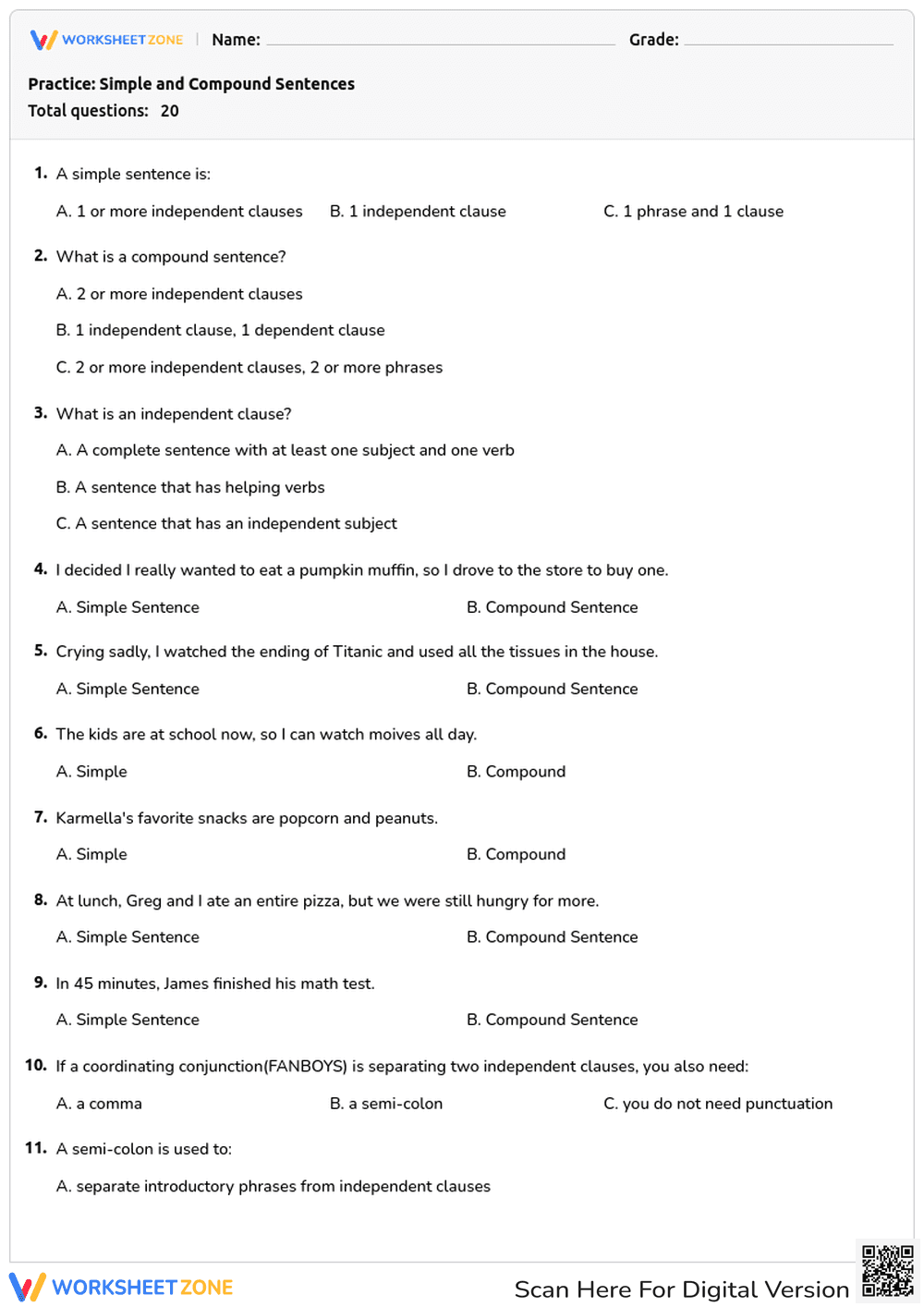


Grade 4-6 Simple and Compound Sentences | Essential Practice
Paste this activity's link or code into your existing LMS (Google Classroom, Canvas, Teams, Schoology, Moodle, etc.).
Students can open and work on the activity right away, with no student login required.
You'll still be able to track student progress and results from your teacher account.
This Grade 4-6 ELA worksheet provides comprehensive practice for identifying and punctuating simple and compound sentences. Students will master the mechanics of independent clauses and coordinating conjunctions through 20 targeted multiple-choice questions. It is designed to move students from basic definitions to applied grammar mastery in a single session.
At a Glance
- Grade: 4-6 · Subject: ELA Grammar
- Standard:
CCSS.ELA-LITERACY.L.4.2.C— Use a comma before a coordinating conjunction in a compound sentence- Skill Focus: Sentence Structure & Punctuation
- Format: 2 pages · 20 problems · Answer key included · PDF
- Best For: Quick assessment or grammar review
- Time: 15–25 minutes
The two-page PDF contains 20 multiple-choice questions. The first section focuses on conceptual definitions of clauses and sentence types. The middle section requires students to classify specific examples as simple or compound. The final section challenges students to identify correct punctuation, specifically focusing on commas with FANBOYS and the proper use of semicolons between independent clauses.
This resource is designed for immediate classroom implementation. Teachers can print the two-page spread in under 30 seconds, distribute it to the class for a 20-minute independent work block, and use the included answer key for a 2-minute rapid review or peer-grading session. It serves as an ideal sub plan or bell ringer activity for busy educators.
This worksheet aligns primarily with CCSS.ELA-LITERACY.L.4.2.C, which requires students to use a comma before a coordinating conjunction in a compound sentence. It also supports CCSS.ELA-LITERACY.L.4.1.F by reinforcing the production of complete sentences and recognizing fragments. Both standard codes can be copied directly into lesson plans, IEP goals, or district curriculum mapping tools.
Use this as a formative assessment after a direct instruction lesson on coordinating conjunctions. It works best during the independent practice phase of a gradual release model. Teachers should observe students during questions 12-16 to see if they are correctly placing commas before the conjunction rather than after. Expect completion within 15 to 25 minutes depending on student proficiency.
This practice set is ideal for upper elementary students in grades 4 through 6 who are refining their writing mechanics. It is particularly helpful for students who struggle with run-on sentences or comma splices. Pair this worksheet with a FANBOYS anchor chart or a short mentor text passage to reinforce the concepts in a real-world context.
According to the RAND AIRS 2024 report, structured grammar practice that isolates specific sentence mechanics leads to higher retention of writing conventions in middle school transitions. This worksheet targets CCSS.ELA-LITERACY.L.4.2.C by providing 20 distinct opportunities for students to differentiate between simple and compound structures. By focusing on the relationship between independent clauses and coordinating conjunctions, the resource addresses common developmental hurdles in sentence variety. Research from Fisher & Frey (2014) emphasizes that checking for understanding through multiple-choice identification allows teachers to quickly pivot instruction based on student errors in punctuation placement. This PDF provides the necessary scaffolding to bridge the gap between recognizing a compound sentence and correctly punctuating one in original composition. It is a reliable tool for ELA educators seeking evidence-based grammar reinforcement.


