




























Views
Downloads

Plant Life Cycle Sequencing Worksheet | Grade 5 Essential

Paste this activity's link or code into your existing LMS (Google Classroom, Canvas, Teams, Schoology, Moodle, etc.).
Students can open and work on the activity right away, with no student login required.
You'll still be able to track student progress and results from your teacher account.
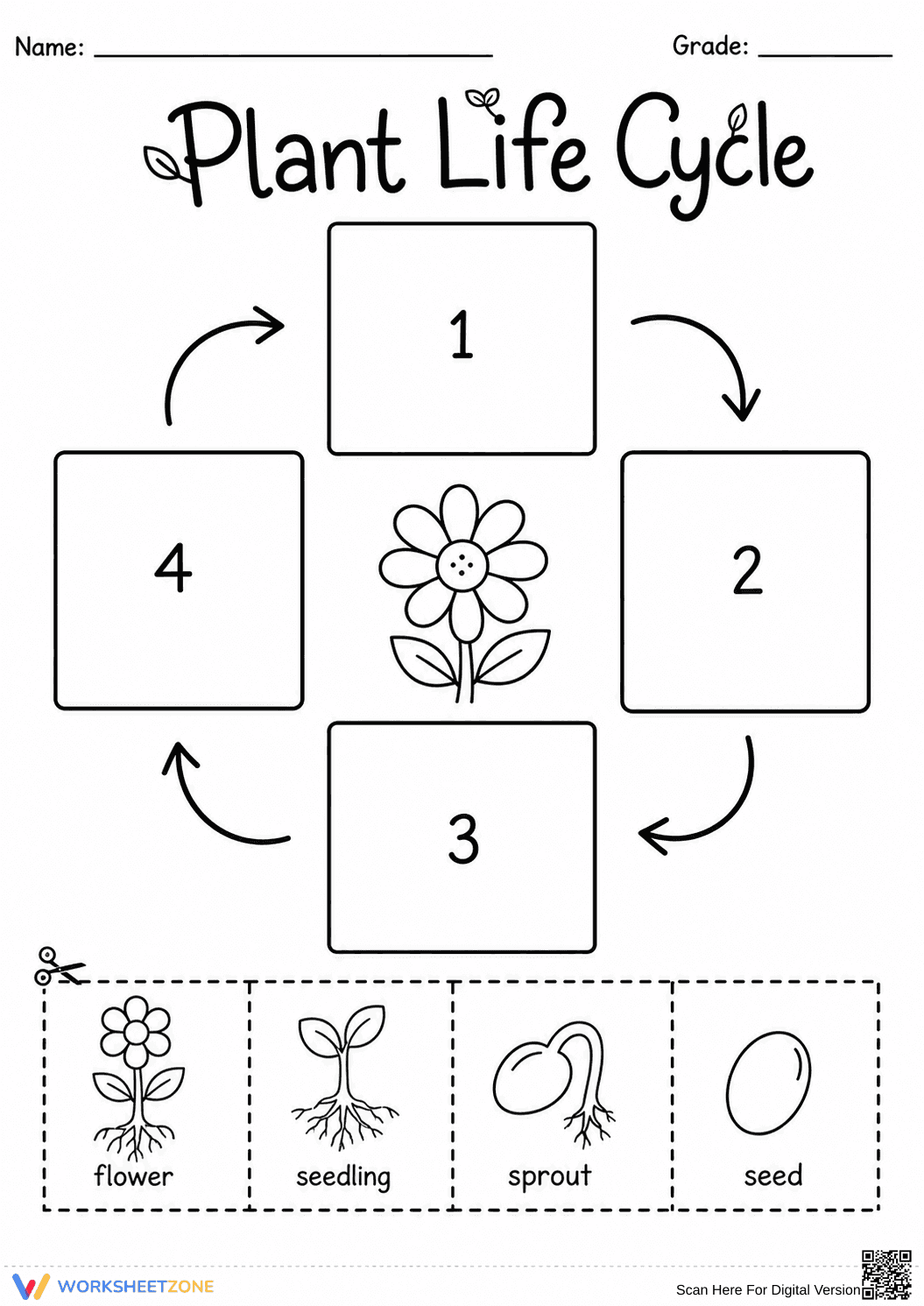
This plant life cycle sequencing worksheet helps students master the chronological stages of botanical growth. By identifying and ordering the transition from seed to mature flower, learners develop a concrete understanding of biological development and life science patterns. It provides a clear visual framework for understanding how organisms change over time.
At a Glance
- Grade: 5 · Subject: Science
- Standard:
3-LS1-1— Develop models to describe that organisms have unique and diverse life cycles- Skill Focus: Plant growth sequencing
- Format: 1 page · 4 problems · Answer key included · PDF
- Best For: Science centers and quick formative assessment
- Time: 10–15 minutes
This single-page PDF features a central life cycle diagram with four numbered positions and a cut-and-paste strip at the bottom. Students interact with four distinct stages: seed, sprout, seedling, and flower. The worksheet includes clear labels and high-contrast illustrations to support visual learners and English Language Learners (ELLs) during independent practice or small group instruction.
Zero-Prep Workflow
- Print: Generate the required number of copies for your class in under 30 seconds.
- Distribute: Hand out the sheets along with scissors and glue for an immediate hands-on activity (1 minute).
- Review: Check the completed sequences as a whole group or through peer-checking to confirm mastery (5 minutes).
This resource is an ideal "grab-and-go" option for substitute folders or unexpected schedule changes where meaningful science practice is required.
Standards Alignment
This resource aligns with `3-LS1-1`, which requires students to develop models to describe that organisms have unique and diverse life cycles but all have in common birth, growth, reproduction, and death. While used here for Grade 5 review, it supports the foundational understanding of plant structures and environmental needs. Both standard codes can be copied directly into lesson plans, IEP goals, or district curriculum mapping tools.
How to Use It
Use this worksheet during the "Explore" phase of a 5E lesson model to assess prior knowledge of plant biology. It also serves as an effective exit ticket after a lesson on plant reproduction or photosynthesis. For a formative assessment tip, observe if students can explain the difference between a sprout and a seedling while they are gluing the pieces. Expected completion time is 10 to 15 minutes.
Who It's For
This activity is designed for Grade 5 and 6 students who require a visual review of life science concepts or for inclusion in interactive science notebooks. It pairs naturally with a classroom seed-planting experiment or a botanical anchor chart. The simple layout makes it accessible for students with fine motor goals or those needing modified curriculum materials.
According to the RAND AIRS 2024 report, visual sequencing tasks significantly improve retention of scientific processes in middle-grade learners. This worksheet addresses the 3-LS1-1 standard by providing a tactile model for the plant life cycle, moving from seed to flower. Research from Fisher & Frey (2014) emphasizes that cut-and-paste activities serve as effective scaffolds for complex biological concepts, allowing students to manipulate information before committing to a final answer. By focusing on the four core stages of growth, this resource ensures that students can articulate the progression of life without being overwhelmed by technical jargon. It provides a reliable data point for teachers tracking mastery of life science standards across diverse classroom settings. This printable tool bridges the gap between abstract biological concepts and concrete visual representation.


