


























0
Views
0
Downloads

0.0
0
Save
0 Likes
Share
Potential Versus Kinetic Energy: Comparative Analysis
0 Views
0 Downloads
Paste this activity's link or code into your existing LMS (Google Classroom, Canvas, Teams, Schoology, Moodle, etc.).
Students can open and work on the activity right away, with no student login required.
You'll still be able to track student progress and results from your teacher account.
Information
Description
What It Is:
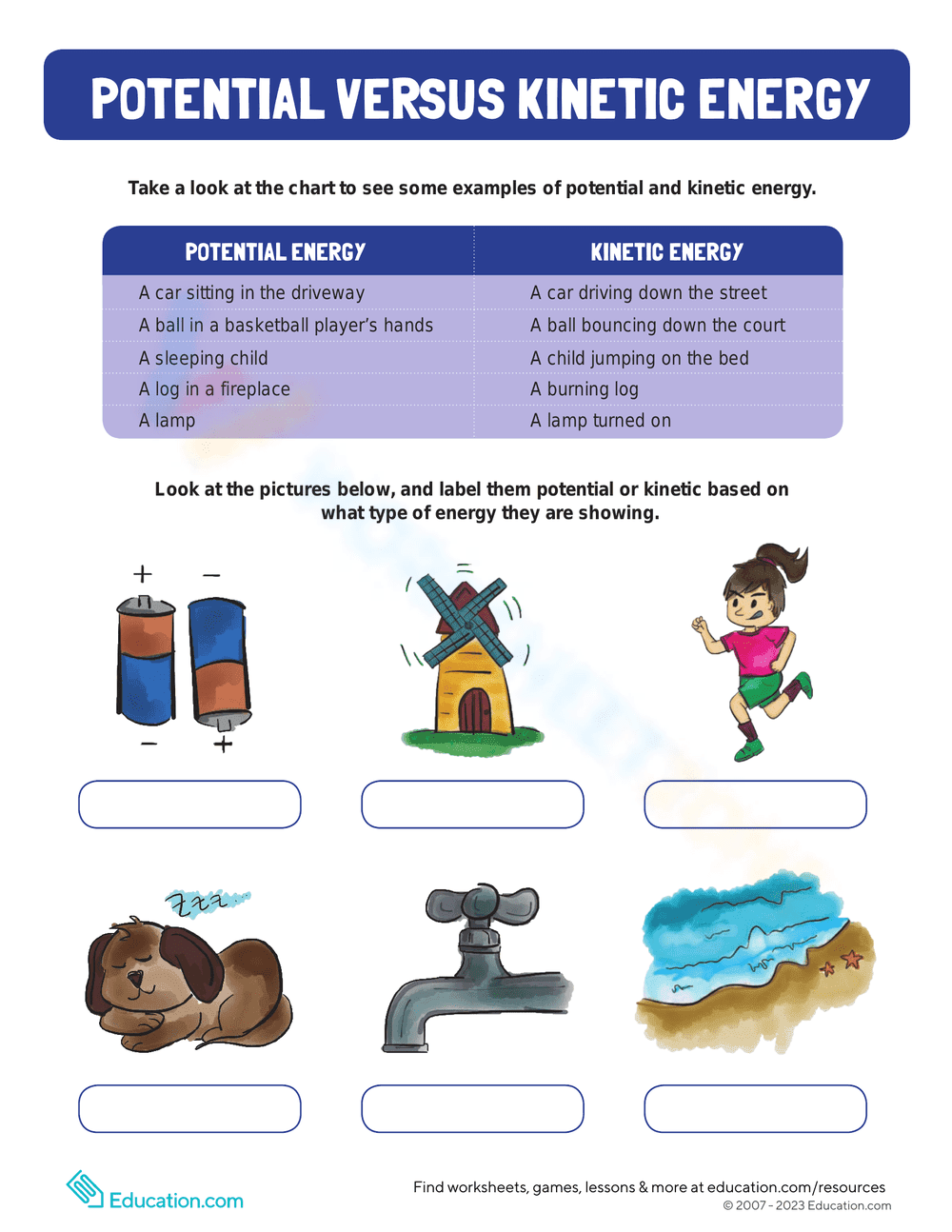
This is a worksheet about potential and kinetic energy. It includes a chart with examples of both types of energy, such as 'a car sitting in the driveway' for potential energy and 'a car driving down the street' for kinetic energy. Below the chart, there are six images: batteries, a windmill, a girl running, a sleeping dog, a water faucet, and waves on a beach. Students are instructed to label each picture as either potential or kinetic energy.
Grade Level Suitability:
This worksheet is suitable for grades 2-4. The concepts are introduced in a simple way with relatable examples, and the labeling activity is appropriate for this age group's reading and comprehension skills.
Why Use It:
This worksheet helps students learn the difference between potential and kinetic energy by providing clear examples and visual aids. It reinforces the understanding of these concepts through a hands-on labeling activity, encouraging critical thinking and application of knowledge.
How to Use It:
First, review the chart at the top of the worksheet to understand the difference between potential and kinetic energy. Then, examine each picture and determine whether it represents potential or kinetic energy. Finally, write the correct type of energy in the blank space below each picture.
Target Users:
This worksheet is designed for elementary school students learning about basic physics concepts, particularly potential and kinetic energy. It's also suitable for teachers looking for engaging and straightforward activities to supplement their science lessons.
This is a worksheet about potential and kinetic energy. It includes a chart with examples of both types of energy, such as 'a car sitting in the driveway' for potential energy and 'a car driving down the street' for kinetic energy. Below the chart, there are six images: batteries, a windmill, a girl running, a sleeping dog, a water faucet, and waves on a beach. Students are instructed to label each picture as either potential or kinetic energy.
Grade Level Suitability:
This worksheet is suitable for grades 2-4. The concepts are introduced in a simple way with relatable examples, and the labeling activity is appropriate for this age group's reading and comprehension skills.
Why Use It:
This worksheet helps students learn the difference between potential and kinetic energy by providing clear examples and visual aids. It reinforces the understanding of these concepts through a hands-on labeling activity, encouraging critical thinking and application of knowledge.
How to Use It:
First, review the chart at the top of the worksheet to understand the difference between potential and kinetic energy. Then, examine each picture and determine whether it represents potential or kinetic energy. Finally, write the correct type of energy in the blank space below each picture.
Target Users:
This worksheet is designed for elementary school students learning about basic physics concepts, particularly potential and kinetic energy. It's also suitable for teachers looking for engaging and straightforward activities to supplement their science lessons.


