


























Views
Downloads
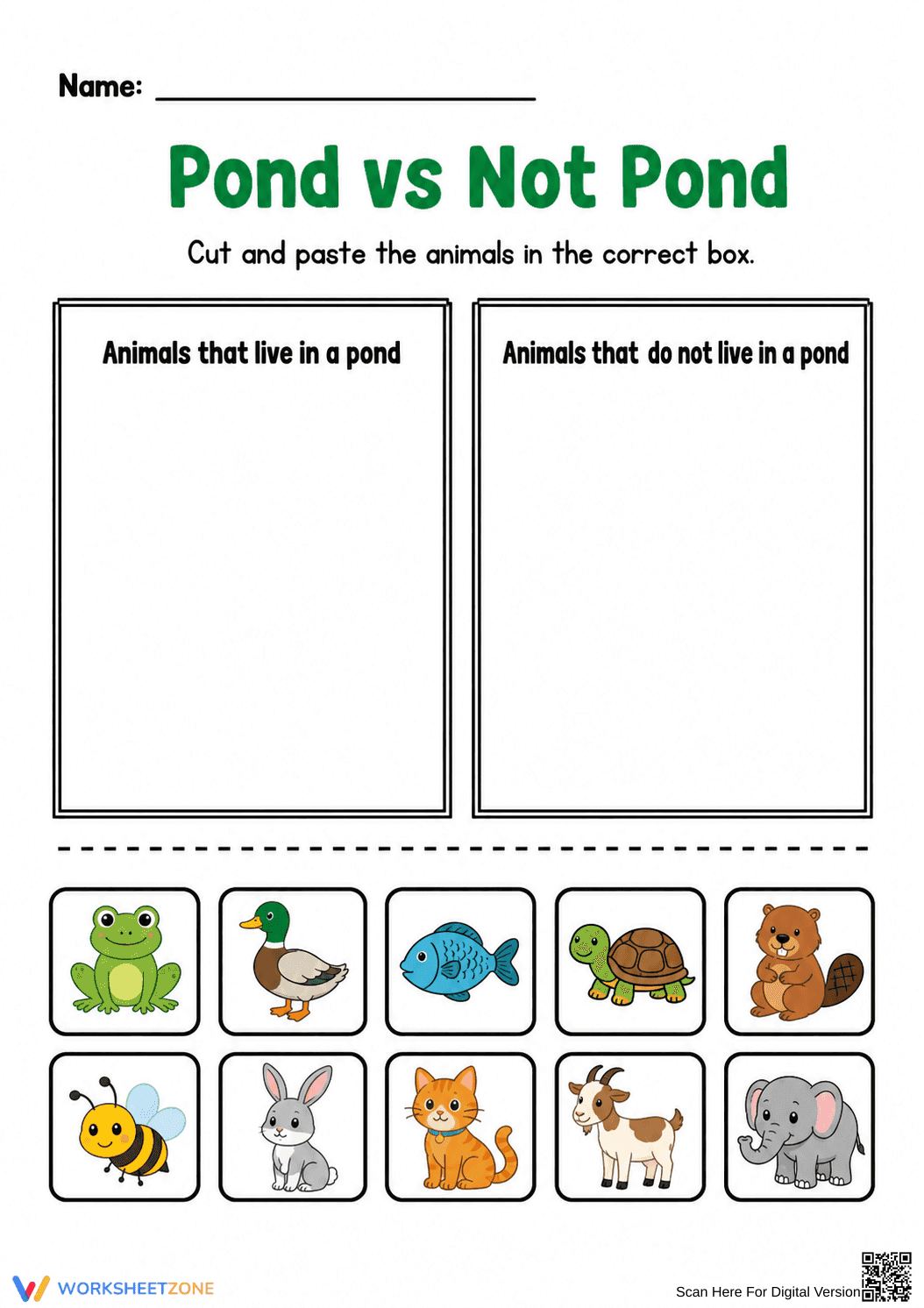

Grade 2 Pond Habitat — Printable No-Prep Worksheet
Paste this activity's link or code into your existing LMS (Google Classroom, Canvas, Teams, Schoology, Moodle, etc.).
Students can open and work on the activity right away, with no student login required.
You'll still be able to track student progress and results from your teacher account.
This Grade 2 animal habitat worksheet helps students identify and classify organisms based on their natural environments. By sorting 10 different animals into pond and non-pond categories, learners develop foundational observation skills and understand how specific traits allow animals to thrive in freshwater ecosystems. It provides immediate visual feedback for young scientists.
At a Glance
- Grade: 2 · Subject: Science
- Standard:
2-LS4-1— Compare the diversity of life in different habitats through observation- Skill Focus: Habitat classification
- Format: 1 page · 10 problems · Cut-and-paste · PDF
- Best For: Science centers, morning work, and independent practice
- Time: 15–20 minutes of classroom time
What's Inside
This single-page PDF features a clear two-column sorting mat and 10 high-quality animal illustrations. The task includes familiar creatures like frogs, ducks, and fish, alongside non-pond animals like elephants and cats. The cut-and-paste format provides a tactile learning experience that reinforces classification without heavy writing requirements, making it accessible for diverse learners.
Zero-Prep Workflow
The workflow for this activity is designed for maximum efficiency. First, print the single-page document in under 30 seconds. Next, distribute scissors and glue to students for immediate engagement, which takes about 1 minute. Finally, review the sorted categories as a whole group to check for understanding in 5 minutes. Total teacher prep time is under 2 minutes, making this resource an ideal sub plan.
Standards Alignment
This resource aligns with `2-LS4-1`: "Make observations of plants and animals to compare the diversity of life in different habitats." It supports the core idea that different animals live in different places based on their needs. Both standard codes can be copied directly into lesson plans, IEP goals, or district curriculum mapping tools.
How to Use It
Use this worksheet as a formative assessment after a lesson on freshwater ecosystems. Observe students as they sort to identify misconceptions about which animals require aquatic environments. It also works well as a quiet-time activity for early finishers, requiring approximately 15 to 20 minutes for completion during a science block.
Who It's For
This activity is designed for second-grade science students, but is also suitable for Grade 1 learners or ESL students building basic vocabulary. It pairs perfectly with a read-aloud about pond life or a classroom anchor chart showing various global habitats to provide a complete instructional sequence.
According to the RAND AIRS 2024 report, tactile sorting activities significantly improve retention of categorical information in early childhood science education. This 2-LS4-1 aligned worksheet utilizes a "Pond vs. Not Pond" framework to help students distinguish between aquatic and terrestrial life. By engaging in the physical act of cutting and pasting 10 distinct animal icons, learners move beyond passive observation to active classification. This method aligns with established pedagogical frameworks, providing a structured environment for students to demonstrate their understanding of habitat diversity. Research indicates that visual-spatial tasks in Grade 2 science help bridge the gap between concrete observation and abstract ecological concepts, making this a vital tool for meeting NGSS life science requirements in diverse classroom settings. The activity ensures students can identify specific environmental needs of common animals.


