




























Views
Downloads

Point of View Worksheet | Grade 7 Printable ELA

Paste this activity's link or code into your existing LMS (Google Classroom, Canvas, Teams, Schoology, Moodle, etc.).
Students can open and work on the activity right away, with no student login required.
You'll still be able to track student progress and results from your teacher account.
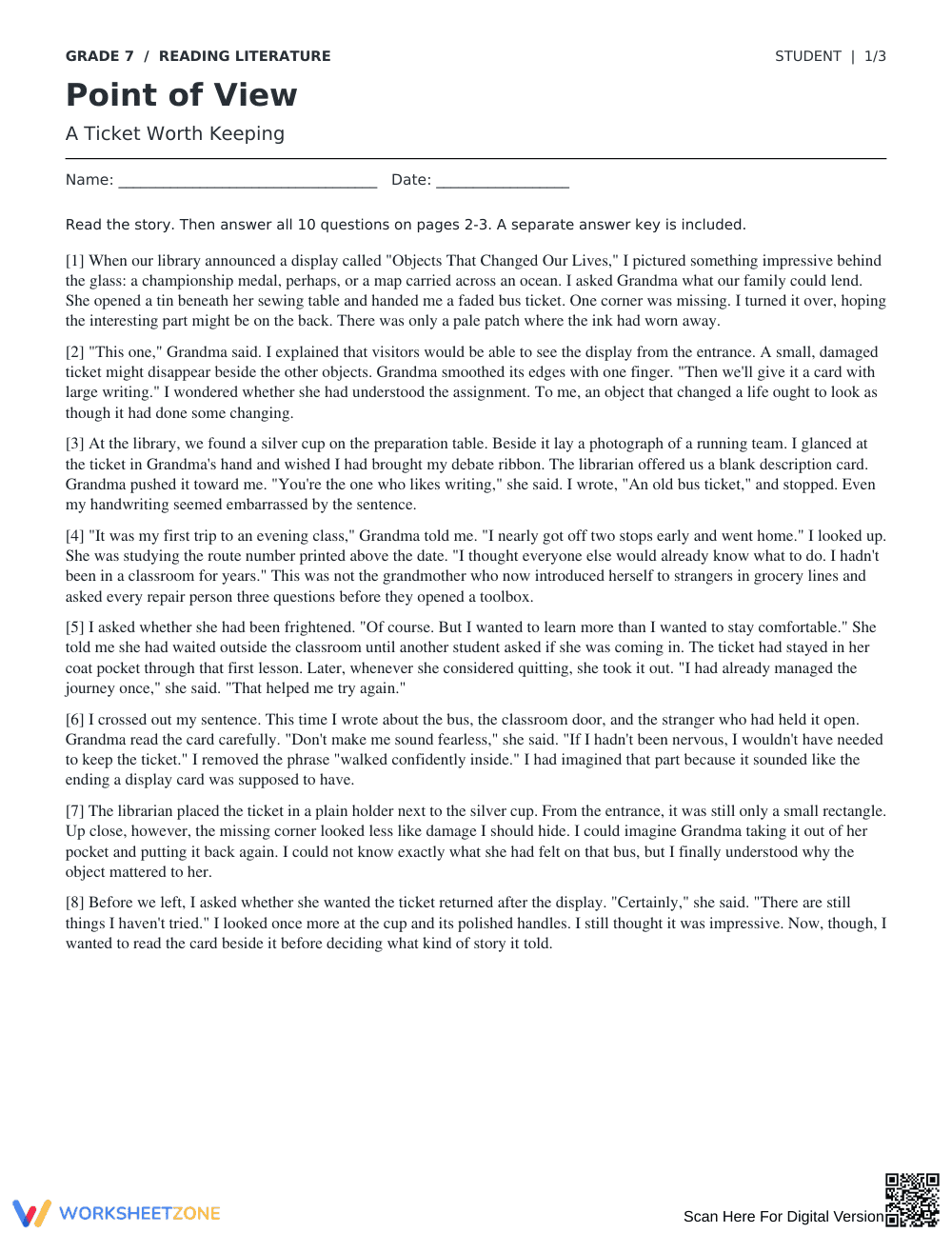
This Grade 7 point of view worksheet builds students' ability to analyze how an author's narrative choices shape meaning, using an engaging short passage called "A Ticket Worth Keeping." Students identify the narrator's perspective, examine how point of view influences tone and reader experience, and cite textual evidence to support their analysis — all in one focused, printable activity.
At a Glance
- Grade: 7 · Subject: English Language Arts
- Standard:
CCSS.ELA-LITERACY.RL.7.6— Analyze how an author develops and contrasts points of view in a text- Skill Focus: Point of view analysis in literary text
- Format: 3 pages · 10 problems · Answer key included · PDF
- Best For: Independent practice after direct instruction
- Time: 25–35 minutes
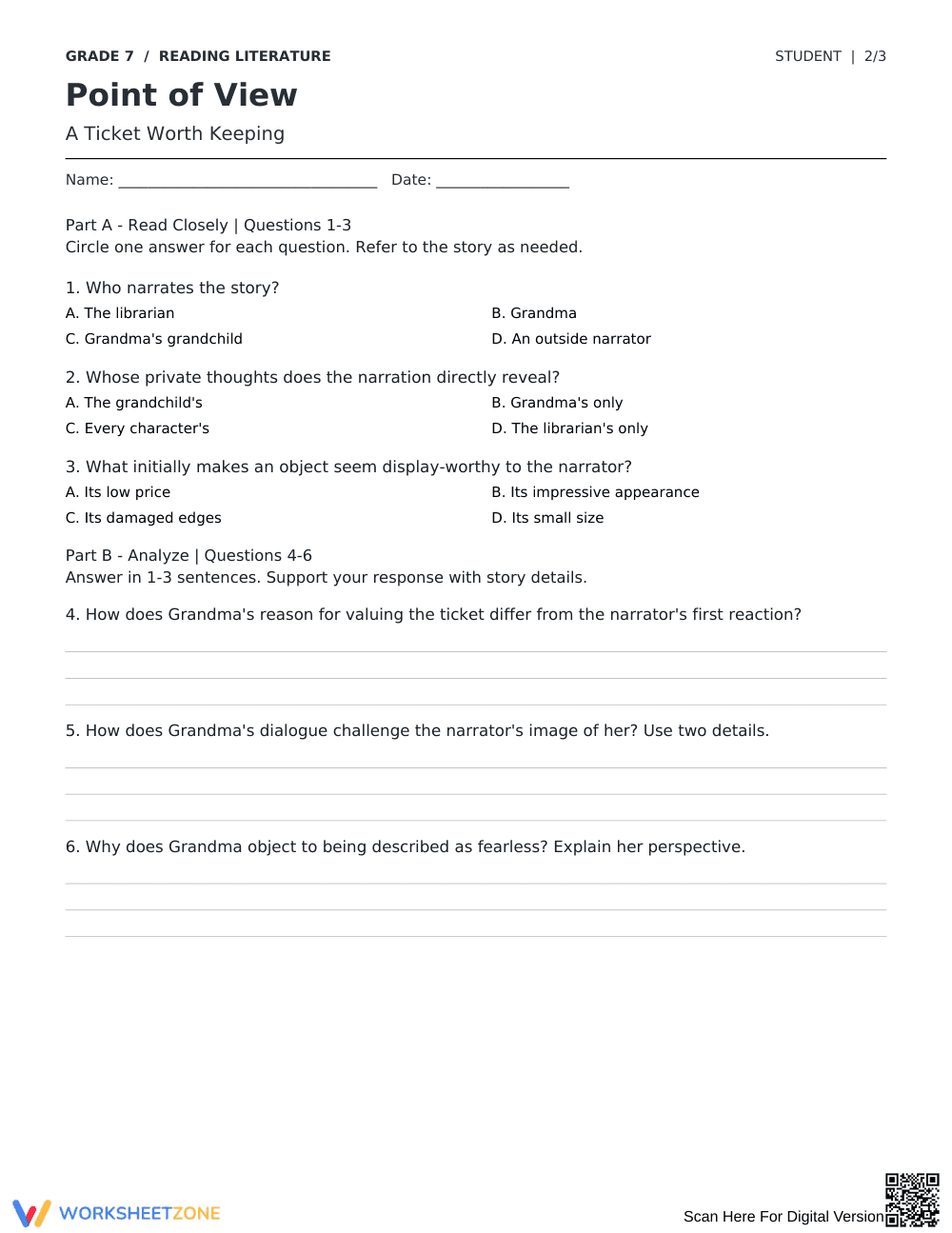
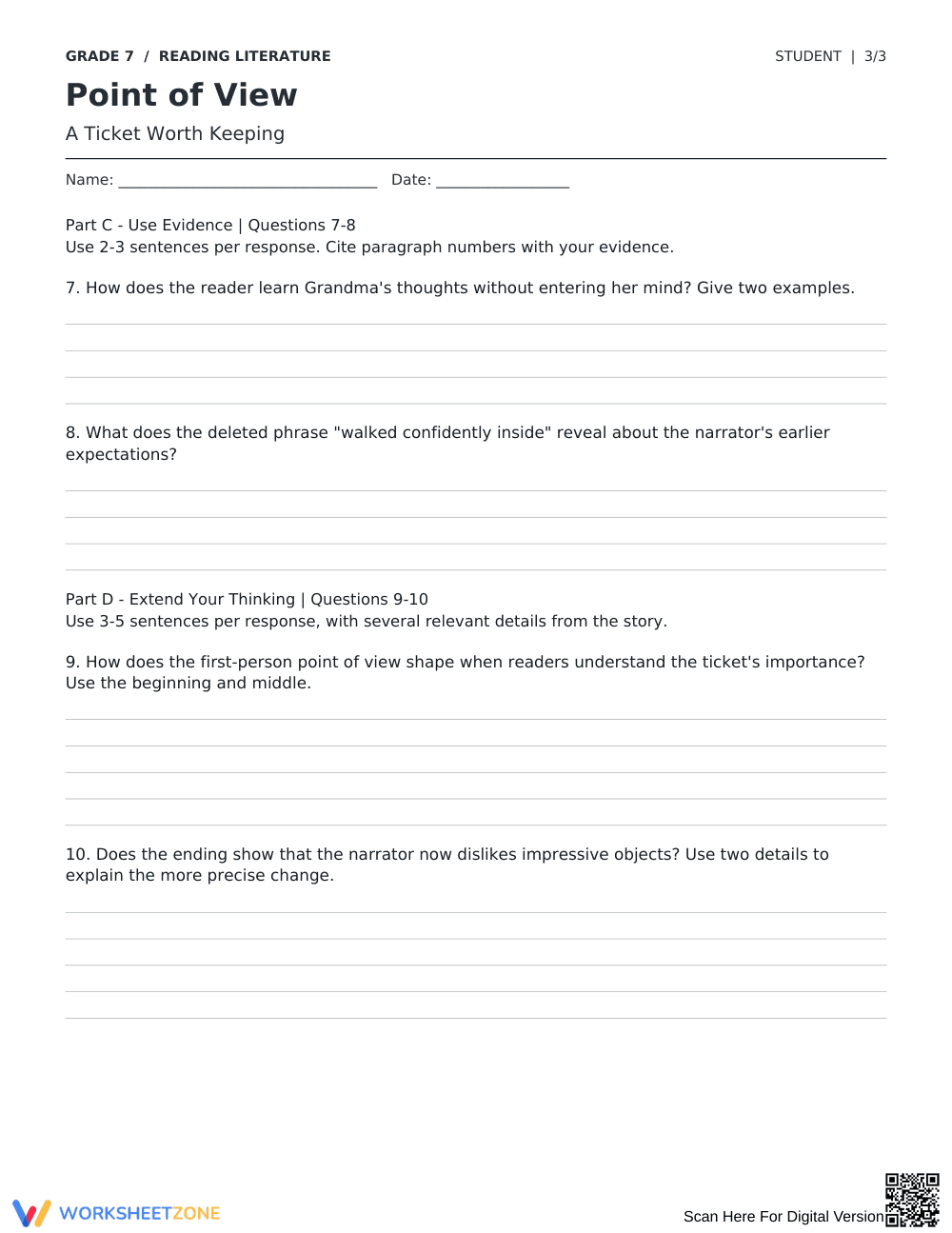
The worksheet includes a short literary passage followed by 10 comprehension and analysis questions. Questions progress from identifying the narrator's point of view to explaining how that perspective shapes the reader's understanding of events and characters. The answer key provides complete model responses, making scoring straightforward for teachers and useful for student self-review.
Skill Progression
- Guided practice (Questions 1–3): Students identify the narrative point of view and locate explicit textual evidence with direct support from the passage structure.
- Supported practice (Questions 4–7): Students explain how the narrator's perspective influences word choice, tone, and the reader's impression of key events.
- Independent practice (Questions 8–10): Students construct written responses analyzing how the author contrasts perspectives and what effect that contrast creates, with no scaffolding provided.
This gradual-release sequence mirrors the I Do, We Do, You Do model, allowing teachers to assign the full worksheet or select sections to match where students are in the instructional cycle.
The primary standard is CCSS.ELA-LITERACY.RL.7.6: Analyze how an author develops and contrasts the points of view of different characters or narrators in a text. A supporting standard, CCSS.ELA-LITERACY.RL.7.1 — citing textual evidence — is reinforced throughout the question set. Both standard codes can be copied directly into lesson plans, IEP goals, or curriculum mapping tools.
How to Use It
Assign this worksheet after direct instruction on first-person versus third-person narration and narrative distance. Students who complete it independently can be observed for their ability to move beyond labeling point of view toward explaining its effect — a key formative signal for RL.7.6 mastery. Alternatively, use Questions 1–3 as a warm-up before discussion, then assign Questions 4–10 as a post-discussion check. Most students finish in 25–35 minutes.
Who It's For
This worksheet is designed for on-grade seventh graders working toward proficiency in literary analysis. It pairs naturally with any short story or memoir excerpt used during a point-of-view unit. Teachers may pair it with an anchor chart listing signal words for each narrative perspective to support students who need a visual reference.
Point of view is a consistently assessed skill on state ELA assessments, underscoring the need for structured, repeated practice at the Grade 7 level. The 10-item format gives teachers a manageable data point for tracking individual progress toward RL.7.6 and can document skill development in IEP progress monitoring or small-group intervention records. Print and assign to support your point-of-view unit today.


