


























Views
Downloads

Essential Poetry Project: Lyrics Analysis — College ELA
Paste this activity's link or code into your existing LMS (Google Classroom, Canvas, Teams, Schoology, Moodle, etc.).
Students can open and work on the activity right away, with no student login required.
You'll still be able to track student progress and results from your teacher account.
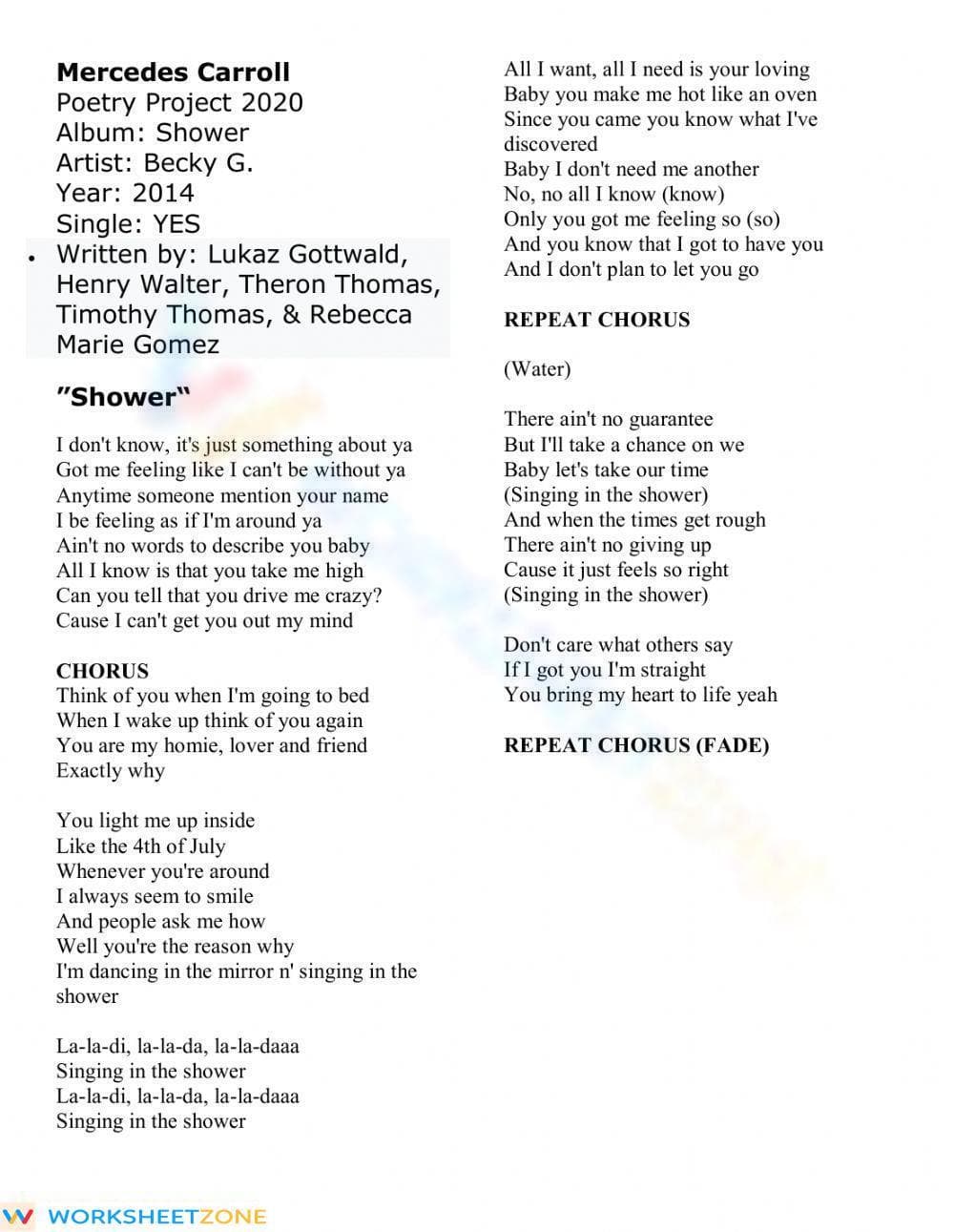
This lyric analysis worksheet provides a rigorous framework for college students to deconstruct modern poetry through the lens of popular music. By examining Becky G's "Shower," students identify rhetorical devices, tone shifts, and structural patterns. This resource effectively bridges pop culture and academic literary theory in a single-page format.
At a Glance
- Grade: College · Subject: ELA
- Standard:
CCSS.ELA-LITERACY.RL.11-12.4— Analyze the impact of specific word choices on meaning and tone- Skill Focus: Lyric Analysis & Interpretation
- Format: 1 page · 1 project · Answer key included · PDF
- Best For: Contemporary poetry seminars and introductory literature
- Time: 45–60 minutes
The worksheet features the complete lyrics to "Shower" as a primary text for week 13 of a poetry project. It includes a layout for annotation, space for thematic exploration, and features that facilitate analysis of figurative language. This single-page PDF serves as a foundation for student-led discussions or individual research papers.
Skill Progression
- Guided practice: Identification of metaphors and similes within the lyrics to establish a baseline for analysis.
- Supported practice: Evaluating the relationship between the chorus and the verses to determine structural impact.
- Independent practice: A written synthesis of the song's primary theme and its connection to contemporary culture.
The analysis follows a gradual-release model, ensuring students can apply these analytical tools to any contemporary text.
Standards Alignment
Aligned to CCSS.ELA-LITERACY.RL.11-12.4, students determine the meaning of phrases, including figurative and connotative meanings. It specifically challenges students to evaluate how the repetition of the chorus contributes to the emotional arc of the piece. Both standard codes can be copied directly into lesson plans, IEP goals, or district curriculum mapping tools.
How to Use It
This resource is ideal after direct instruction on poetic devices. It functions well as a formative-assessment tool; teachers should observe how students categorize "pop" lyrics versus traditional poetry to gauge understanding. Completion typically ranges from 45 to 60 minutes depending on the depth of the required written response or group discussion.
Who It's For
Designed for college-level literature students, this worksheet offers a relatable entry point into complex textual analysis. It is effective for first-year composition classes. Pair this resource with an anchor chart on rhetorical devices or a comparative passage from a traditional poet to highlight shifts in lyrical expression across different eras.
This worksheet utilizes a pedagogical framework supported by Fisher & Frey (2014), emphasizing the importance of diverse text selection in developing advanced literacy skills. By integrating modern lyrics into a formal poetry project, educators leverage student familiarity to build the stamina required for higher-order literary analysis. Research indicates that when students engage with multimodal texts—including song lyrics that mirror poetic structures—they demonstrate higher rates of engagement and a more nuanced understanding of authorial intent. The alignment with CCSS.ELA-LITERACY.RL.11-12.4 ensures that the rigor of the task meets collegiate expectations for evidence-based interpretation. This approach facilitates a transition from basic reading comprehension to the complex synthesis of meaning, tone, and structure. By treating lyrics as a primary source for week 13 of the poetry project, this resource provides a measurable artifact for evaluating a student's ability to navigate the intricacies of contemporary verse.


