


























Views
Downloads

Poetic Rhyme and Structure Worksheet | Grade 7 Essential
Paste this activity's link or code into your existing LMS (Google Classroom, Canvas, Teams, Schoology, Moodle, etc.).
Students can open and work on the activity right away, with no student login required.
You'll still be able to track student progress and results from your teacher account.
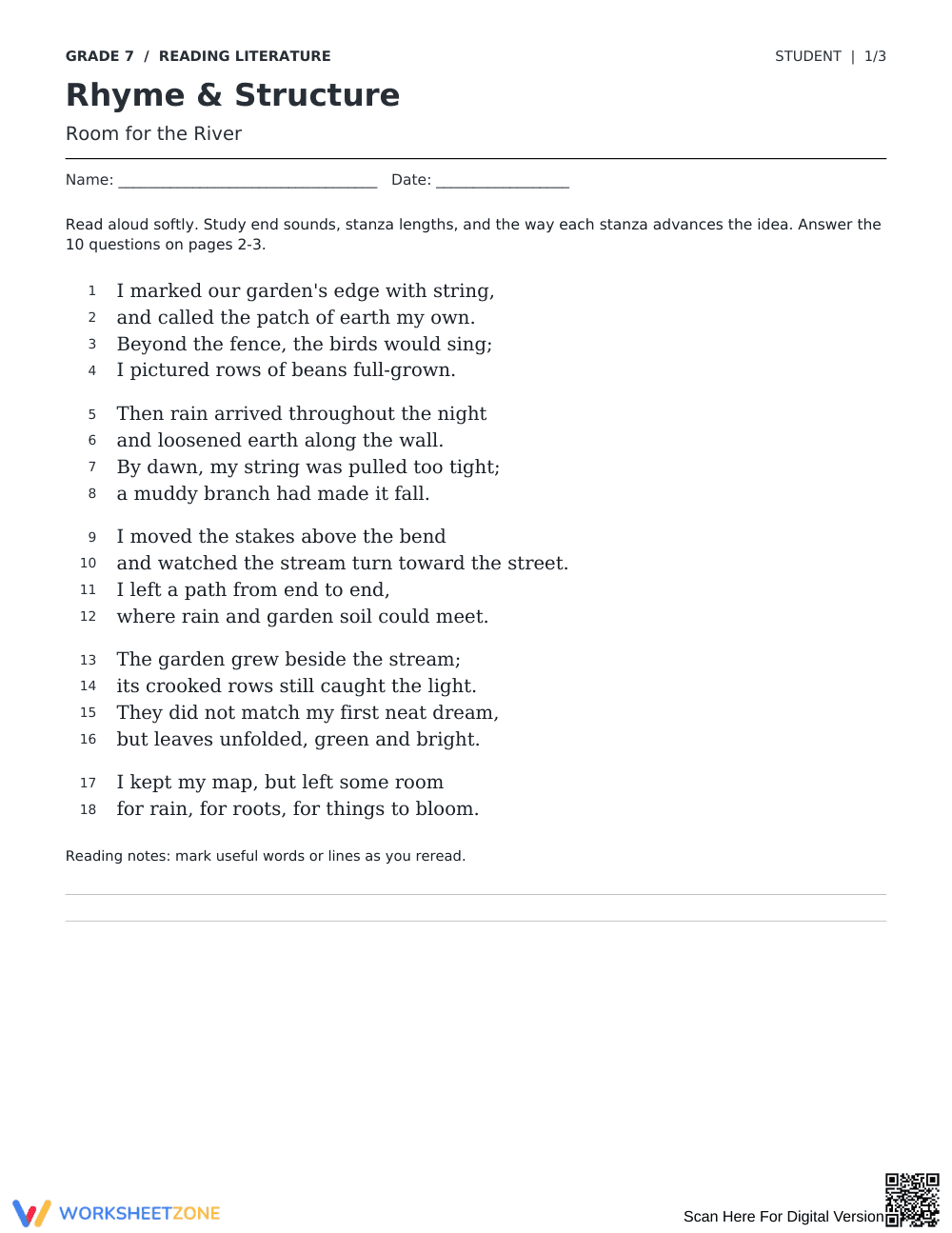
This Grade 7 poetry worksheet guides students through structural analysis of the 18-line poem "Room for the River." Through 10 scaffolded questions, students examine rhyme schemes, stanza breaks, and line lengths to analyze how poetic form develops meaning and thematic resolution.
At a Glance
- Grade: 7 · Subject: English Language Arts
- Standard:
CCSS.ELA-LITERACY.RL.7.5— Analyze how a poem's form and structure contribute to its meaning- Skill Focus: Rhyme scheme and poetic structure
- Format: 3 pages · 10 problems · Answer key included · PDF
- Best For: Poetry unit core practice, review, or assessment
- Time: 25–35 minutes
What's Inside
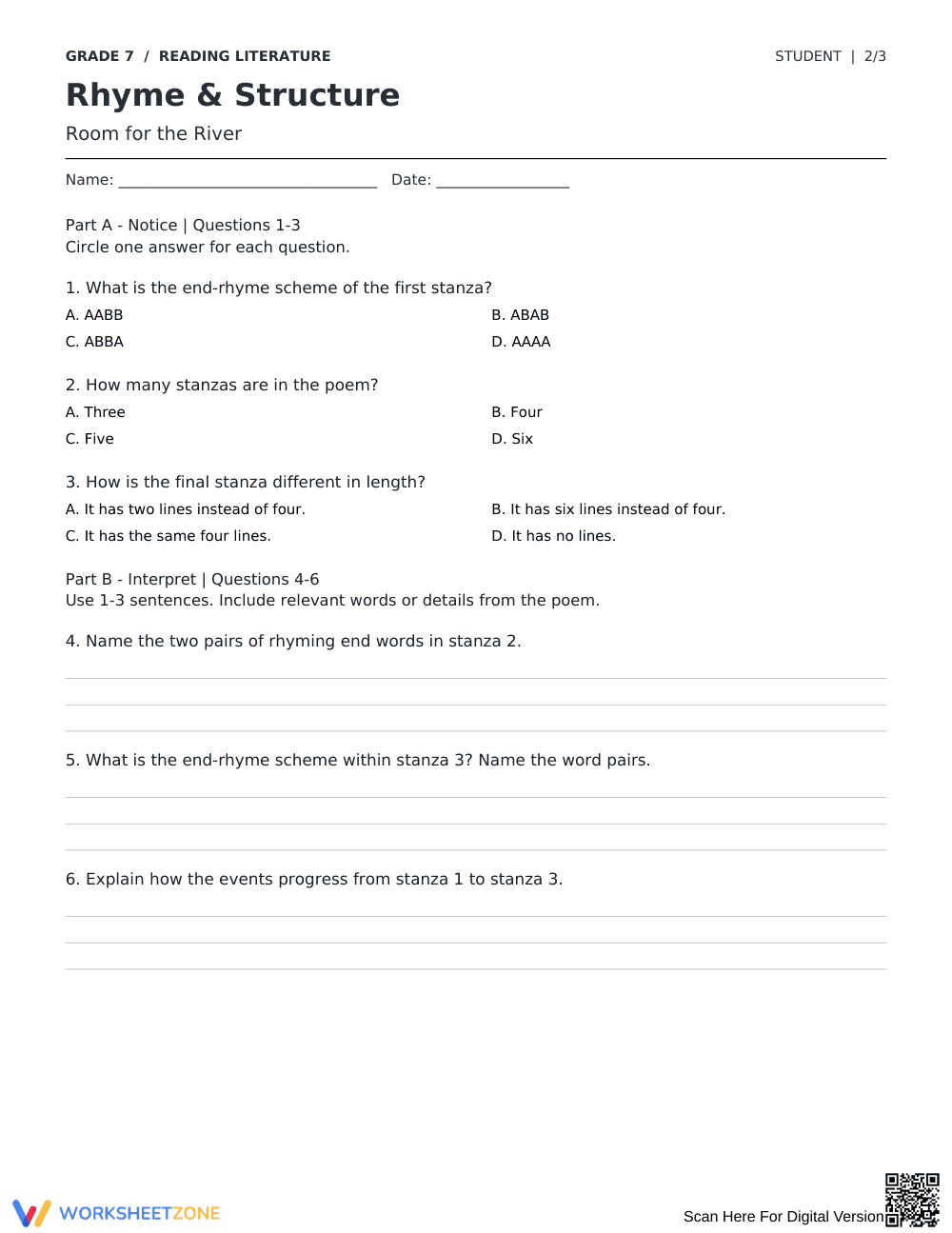
This 3-page printable includes the complete 18-line poem with line numbers and student note-taking space. The 10-item question set features multiple-choice identification, short-response interpretations, line citation exercises, and extended analytical prompts, accompanied by a complete 2-page answer key with model explanations and a 30-point scoring guide.
Skill Progression
- Guided practice (Questions 1–3): Students identify concrete formal elements, determining stanza counts, ABAB rhyme schemes, and couplet lengths through multiple-choice prompts.
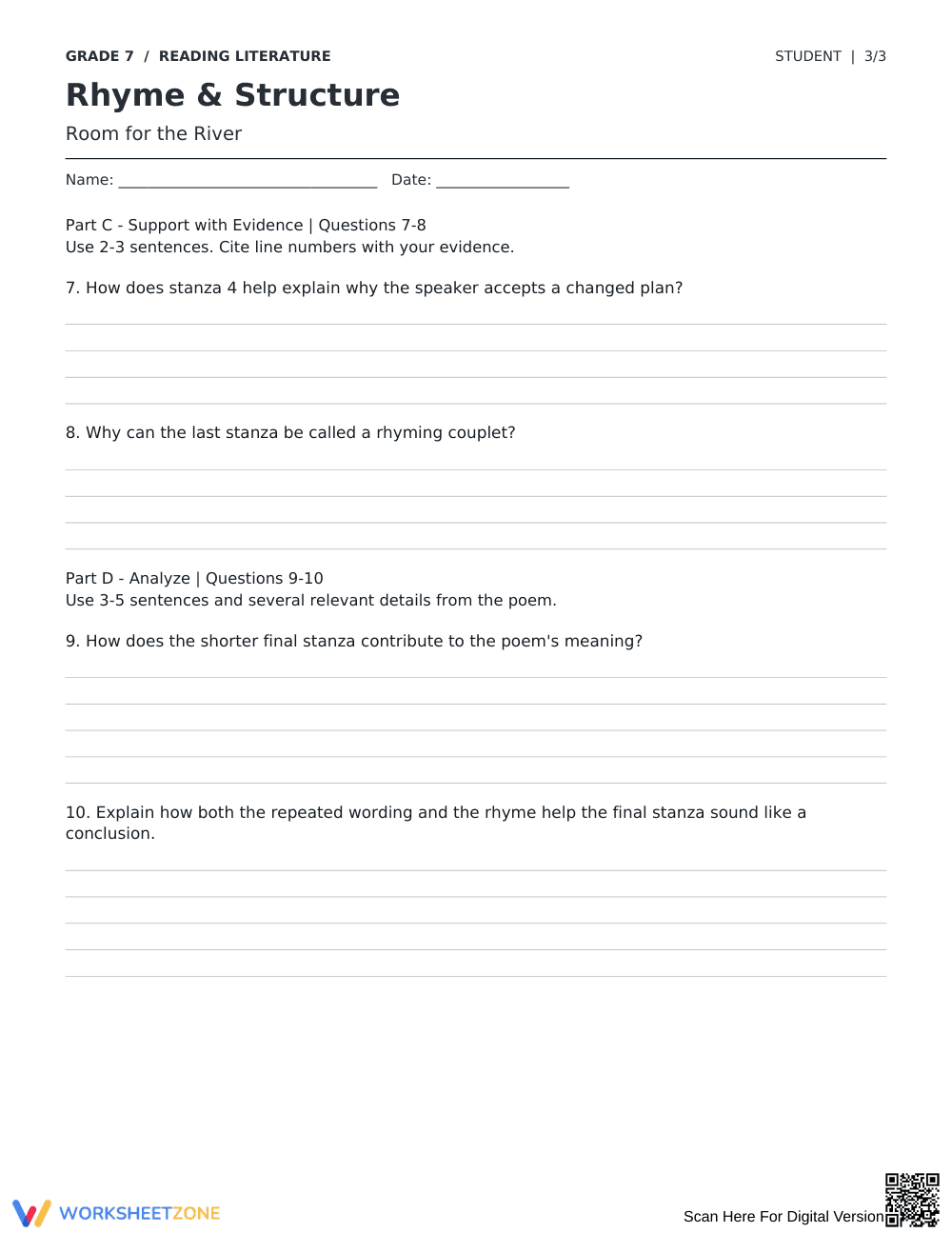
- Supported practice (Questions 4–8): Learners write 1-to-3-sentence answers pairing rhyming end words, summarizing plot progression across stanzas, and citing line numbers as evidence.
- Independent practice (Questions 9–10): Students write 3-to-5-sentence analytical paragraphs explaining how the final couplet's altered length, repeated phrasing, and rhyme create resolution.
This progression embodies the gradual release of responsibility model, moving from observation to deep analysis.
Standards Alignment
This worksheet directly targets `CCSS.ELA-LITERACY.RL.7.5` by requiring students to analyze how poetic form and structure contribute to meaning. It also supports `CCSS.ELA-LITERACY.RL.7.1` by requiring explicit line-level textual evidence for all analytical claims. Both standard codes can be copied directly into lesson plans, IEP goals, or district curriculum mapping tools.
How to Use It
Administer this activity following direct instruction on poetic forms or as a mid-unit assessment. During work time, check Question 7 to verify that students cite specific line numbers rather than general impressions. Expect students to complete the 10 problems within 25 to 35 minutes.
Who It's For
This worksheet supports Grade 7 readers developing formal text analysis skills. Scaffolding supports strive-to-read students, while analytical items challenge advanced learners. Pair this printable with a mini-lesson on stanza types or an anchor chart detailing rhyme schemes.
Teaching poetic structure under CCSS.ELA-LITERACY.RL.7.5 helps Grade 7 students understand how formal elements such as rhyme scheme, stanza breaks, and lineation shape literary meaning. According to Fisher & Frey (2014), structured instructional progressions that guide learners from surface-level identification to independent evidentiary analysis significantly enhance text comprehension and analytical rigor. This Grade 7 reading literature worksheet operationalizes that framework using the original poem "Room for the River." Through 10 sequential tasks, students identify alternating ABAB rhyme schemes, trace narrative progression across stanzas, and analyze why the poem concludes with a two-line couplet. By requiring students to cite specific line numbers and articulate how structural shifts reflect thematic changes, this resource reinforces critical evidence-based thinking. The accompanying two-page answer key provides complete model responses and a 30-point scoring guide, allowing teachers to assess student mastery of structural analysis with precision and instructional clarity.


