


























Views
Downloads
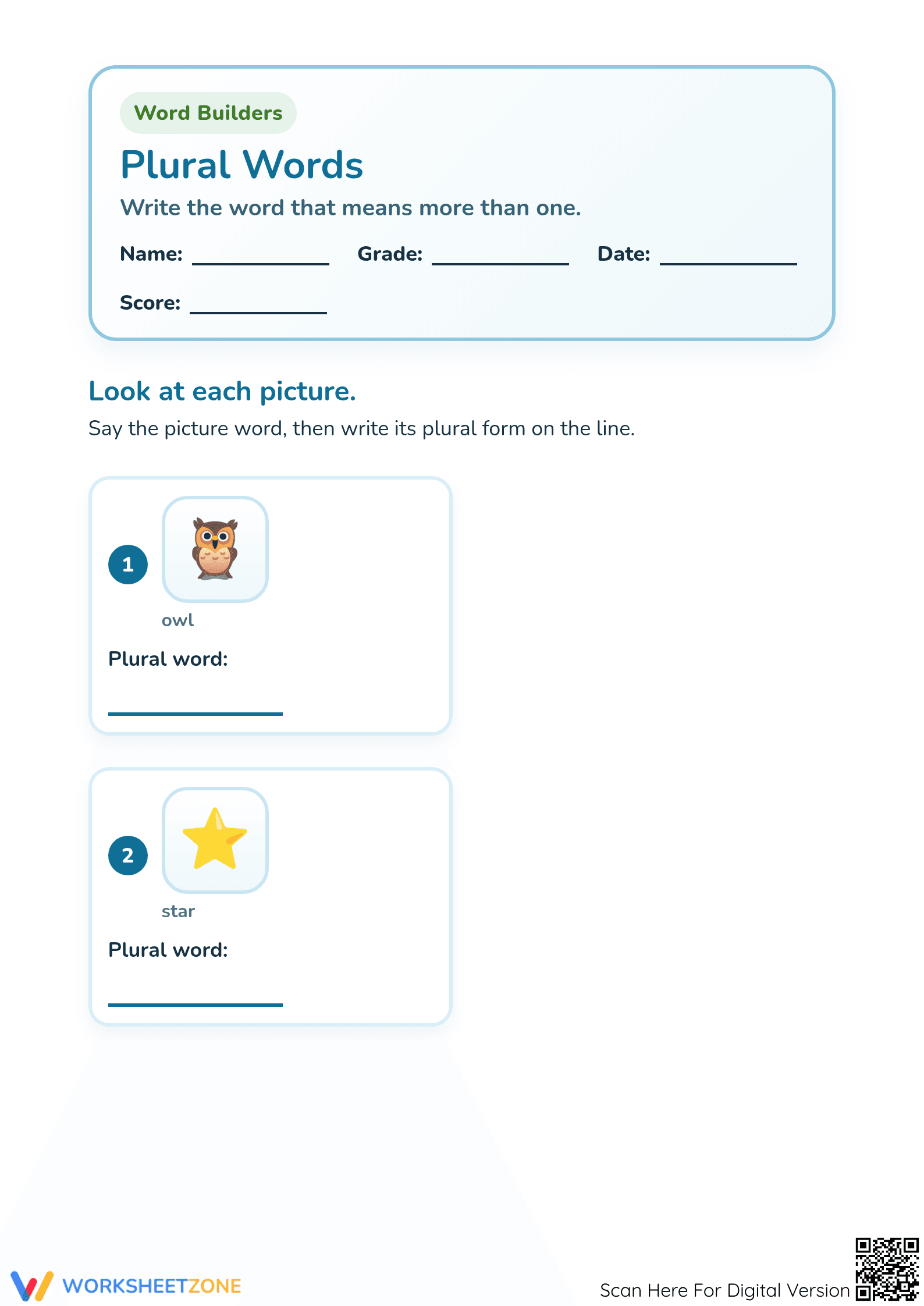
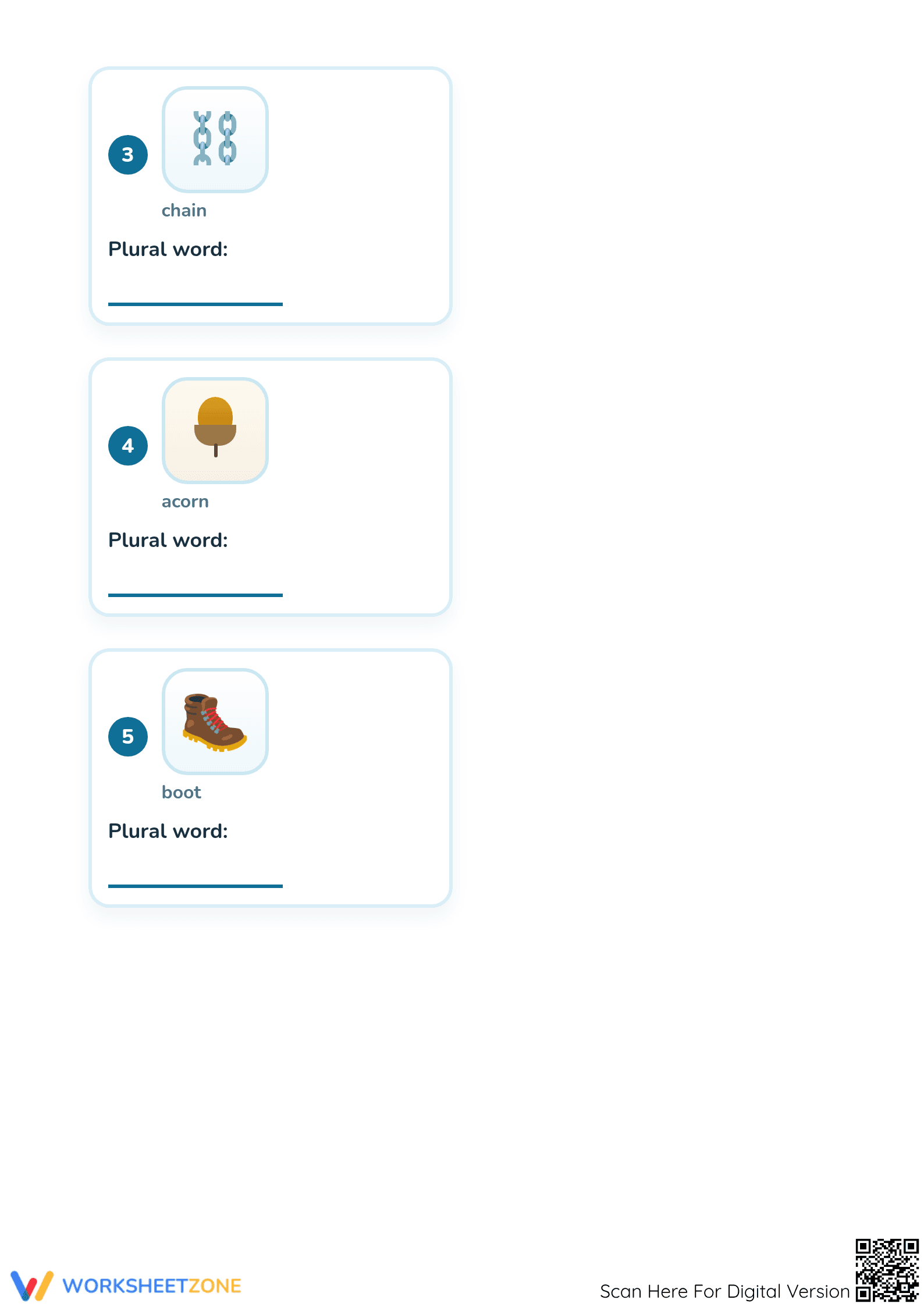


Plural Nouns Practice Worksheet | Grade 1 Essential
Paste this activity's link or code into your existing LMS (Google Classroom, Canvas, Teams, Schoology, Moodle, etc.).
Students can open and work on the activity right away, with no student login required.
You'll still be able to track student progress and results from your teacher account.
This Grade 1 plural nouns worksheet provides a focused environment for students to master the concept of "more than one." By transitioning from singular labels to plural forms, learners develop a foundational understanding of English morphology. This resource ensures students can confidently identify and write plural nouns using standard conventions.
At a Glance
- Grade: 1 · Subject: ELA
- Standard:
CCSS.ELA-LITERACY.L.1.1.C— Use singular and plural nouns with matching verbs in basic sentences- Skill Focus: Forming plural nouns
- Format: 3 pages · 6 problems · Answer key included · PDF
- Best For: Independent literacy center practice
- Time: 15–20 minutes
This comprehensive 3-page PDF includes 6 distinct vocabulary tasks paired with clear, engaging illustrations. Each page features high-frequency nouns such as "owl," "star," and "boot" to ensure accessibility for early readers. The layout provides ample writing space for developing fine motor skills, and a full 3-page answer key is included for rapid grading or student self-correction.
Skill Progression
- Guided Practice: Students observe a singular noun and its corresponding image to establish a baseline for the word's meaning and spelling.
- Supported Practice: Learners vocalize the word before writing, reinforcing the phonological connection to the plural "s" sound across 5 standard examples.
- Independent Practice: The final task involving "sheep" serves as a critical thinking challenge, introducing the concept of irregular plurals that do not change form.
This sequence follows the gradual-release model to build student confidence before introducing linguistic exceptions.
Standards Alignment: This resource is specifically designed to meet CCSS.ELA-LITERACY.L.1.1.C: "Use singular and plural nouns with matching verbs in basic sentences." While this worksheet focuses on the morphological formation of plurals, it serves as the prerequisite step for sentence-level mastery. Both standard codes can be copied directly into lesson plans, IEP goals, or district curriculum mapping tools.
How to Use It: Use this as a formative assessment after an introductory lesson on noun suffixes. It is ideal for literacy centers where students can work independently for 15–20 minutes. Teachers should observe if students are phonetically sounding out the "s" or "z" sound at the end of words to gauge their phonemic awareness during the writing process.
Who It's For: This resource is designed for Kindergarten and Grade 1 students, as well as English Language Learners (ELL) who require visual support to understand quantity-based word changes. It pairs naturally with a "Singular vs. Plural" anchor chart or a direct instruction lesson on word endings.
According to research by Fisher & Frey (2014) on the gradual release of responsibility, structured practice with morphological markers like the plural "-s" is essential for early literacy development. This worksheet aligns with CCSS.ELA-LITERACY.L.1.1.C by providing the necessary repetition required for students to internalize the concept of "more than one." By using visual cues to bridge the gap between concrete objects and abstract grammatical rules, the resource supports the "I Do, We Do, You Do" instructional framework. Data from the NAEP suggests that early mastery of basic grammar conventions is a strong predictor of later reading comprehension success. This 6-task activity provides a low-stakes environment for students to experiment with word endings, ensuring they build the confidence needed for more complex writing tasks. The inclusion of an irregular plural like "sheep" further stimulates higher-order thinking and linguistic curiosity in young learners.


