


























Views
Downloads

Plant Life Cycle Coloring Worksheet | Essential Grade 3-4
Paste this activity's link or code into your existing LMS (Google Classroom, Canvas, Teams, Schoology, Moodle, etc.).
Students can open and work on the activity right away, with no student login required.
You'll still be able to track student progress and results from your teacher account.
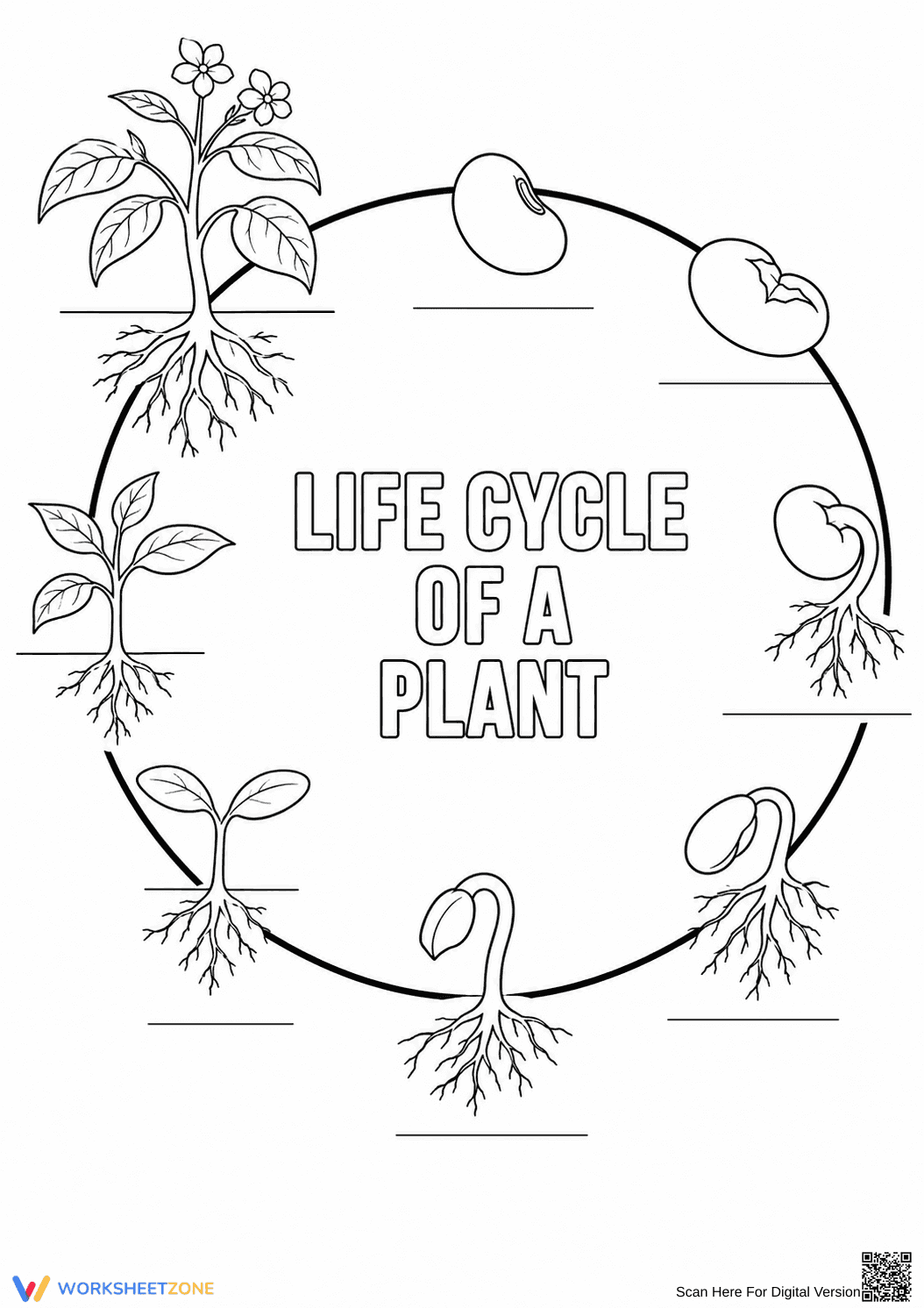
This Grade 3 and 4 science worksheet provides a visual model of the plant life cycle, allowing students to identify and label key stages from seed to maturity. By combining fine motor coloring with scientific vocabulary, learners internalize the biological sequence of growth and reproduction in flowering plants.
At a Glance
- Grade: 3-4 · Subject: Science
- Standard:
3-LS1-1— Develop models to describe that organisms have unique and diverse life cycles- Skill Focus: Plant growth stages and labeling
- Format: 1 page · 7 tasks · Coloring diagram · PDF
- Best For: Introduction to botany or formative assessment
- Time: 15–25 minutes
This single-page PDF features a high-quality circular diagram illustrating seven distinct phases of a plant's development. Each stage includes a dedicated line for students to write the corresponding vocabulary term, such as seed, germination, or seedling. The clean line art is specifically designed for coloring, making it an excellent resource for visual learners who benefit from artistic engagement while studying life science concepts.
The zero-prep workflow is designed for maximum efficiency in busy classrooms. First, print the single-page PDF (30 seconds). Second, distribute the sheets to students along with colored pencils or markers (1 minute). Third, review the completed labels as a whole-class check to ensure scientific accuracy (5 minutes). Total teacher preparation time is under 2 minutes, making this an ideal sub plan or last-minute science center addition for any elementary curriculum.
This resource aligns with 3-LS1-1: "Develop models to describe that organisms have unique and diverse life cycles but all have in common birth, growth, reproduction, and death." It also supports ELA standards for technical vocabulary acquisition and fine arts standards for controlled coloring. This standard code can be copied directly into lesson plans, IEP goals, or district curriculum mapping tools.
Use this worksheet during the "Explain" phase of a 5E lesson cycle to solidify vocabulary after a hands-on planting activity. It also serves as an effective formative assessment tool; observe whether students correctly sequence the germination process before the seedling stage. Expected completion time ranges from 15 to 25 minutes depending on the level of coloring detail required by the instructor.
This activity is tailored for third and fourth-grade students beginning their study of life sciences. It is particularly beneficial for English Language Learners (ELLs) who require visual scaffolds to master new terminology. Pair this worksheet with a live bean plant observation or a digital time-lapse video of plant growth for a multi-sensory experience that reinforces the concept of biological cycles.
According to the RAND AIRS 2024 report on elementary science instruction, the use of visual models and labeling tasks significantly improves the retention of complex biological sequences in young learners. This worksheet addresses the 3-LS1-1 standard by requiring students to interact with a model of a plant's life cycle, reinforcing the concept that all organisms undergo a predictable pattern of growth and reproduction. By integrating fine art through coloring, the resource lowers the affective filter for students who may struggle with text-heavy science materials. Research indicates that dual-coding—combining imagery with verbal labels—creates stronger neural pathways for scientific concepts. This printable provides a structured yet flexible framework for mastering the plain-English skill of describing how plants grow from seeds into mature, reproducing organisms. It is a reliable tool for meeting NGSS requirements while maintaining high student engagement through creative expression.


