


























Views
Downloads

Grade 1 Animal Diets — Printable No-Prep Worksheet
Paste this activity's link or code into your existing LMS (Google Classroom, Canvas, Teams, Schoology, Moodle, etc.).
Students can open and work on the activity right away, with no student login required.
You'll still be able to track student progress and results from your teacher account.
This foundational Grade 1 science worksheet helps young learners categorize animals based on their dietary patterns. By identifying what different organisms consume, students develop a core understanding of biological classification and survival needs, distinguishing between herbivores, carnivores, and omnivores while building essential scientific vocabulary.
At a Glance
- Grade: 1 · Subject: Science
- Standard:
K-LS1-1— Describe patterns of what animals need to survive- Skill Focus: Animal Diet Classification
- Format: 2 pages · 6 problems · Answer key included · PDF
- Best For: Independent practice or science centers
- Time: 10–15 minutes
What's Inside
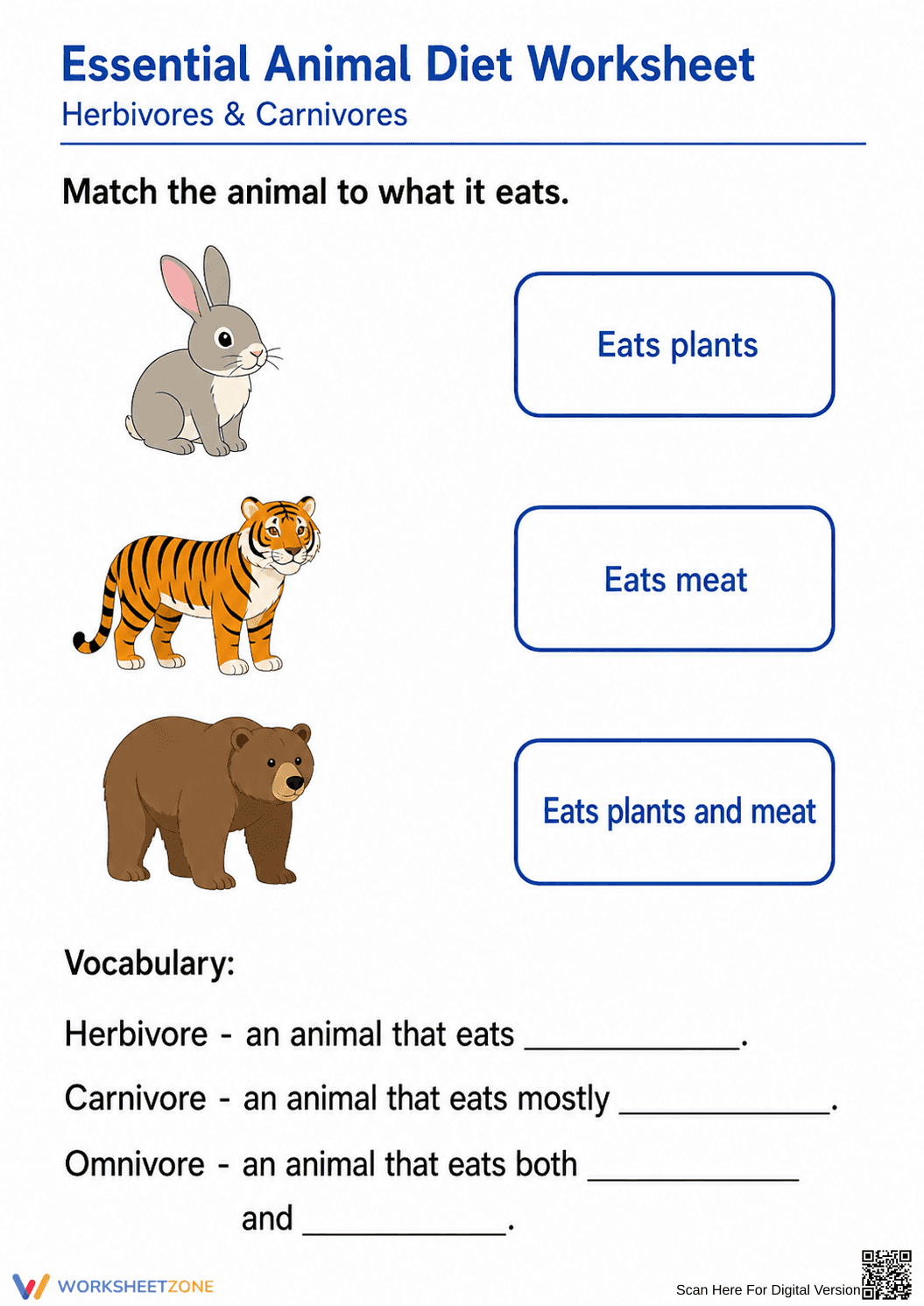
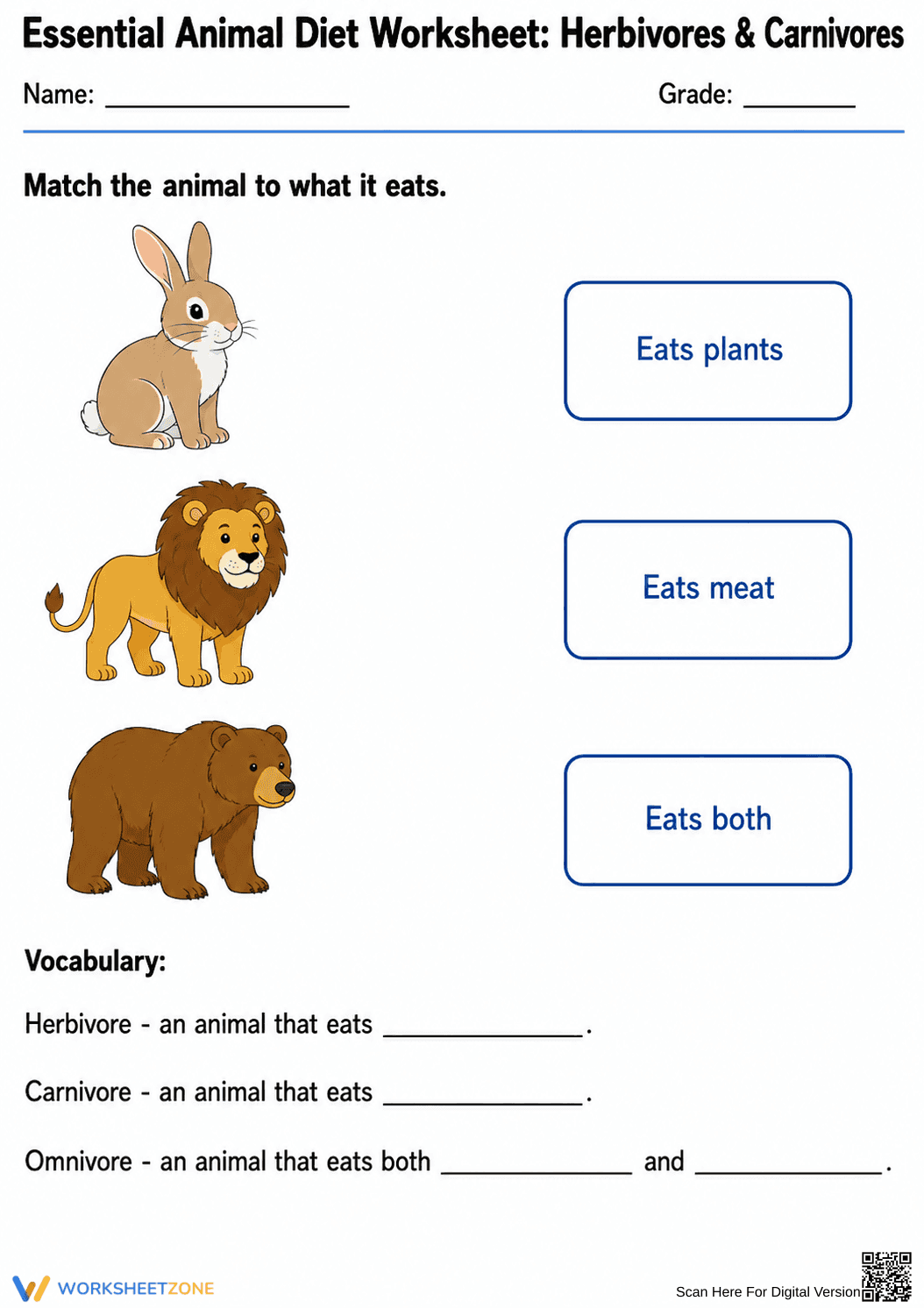
The worksheet features two distinct sections designed to reinforce conceptual understanding. The first part presents a visual matching activity where students connect images of animals, such as a rabbit or bear, to their respective food sources. The second section focuses on vocabulary acquisition, providing fill-in-the-blank sentences to define the scientific terms herbivore, carnivore, and omnivore. A full answer key is included for immediate feedback.
Zero-Prep Workflow
- Print: Print the document in seconds (1 minute).
- Distribute: Provide the worksheet to students for independent or small-group work (10 minutes).
- Review: Check answers using the provided key to address any misconceptions about animal diets (4 minutes).
The total teacher preparation time is under two minutes, making it an ideal choice for emergency sub plans or quick reinforcement activities.
Standards Alignment
This resource is aligned to K-LS1-1, requiring students to use observations to describe patterns of what plants and animals need to survive. It also supports early life science frameworks by introducing the diversity of life and basic biological needs. Both standard codes can be copied directly into lesson plans, IEP goals, or district curriculum mapping tools.
How to Use It
Use this worksheet during the independent practice phase of a science lesson to formalize definitions after an initial observation of animal pictures. Teachers can observe students during the matching task to see if they recognize physical traits as a clue to diet, serving as a quick formative assessment. Expect completion in approximately 10 to 15 minutes during a center rotation or as an exit ticket.
Who It's For
This activity is tailored for Grade 1 and Grade 2 students beginning their study of life sciences. It includes clear visual supports for emerging readers and straightforward sentence frames for English language learners. It pairs naturally with an anchor chart depicting various animal habitats and food sources to provide a hands-on connection to the diet categories.
According to RAND AIRS 2024, the use of structured classification tasks in early childhood science significantly enhances long-term retention of biological concepts and categorical reasoning. This worksheet applies these findings by requiring students to move beyond simple identification into the higher-order task of defining scientific relationships. By connecting observable traits to standardized vocabulary, the resource bridges the gap between informal observation and formal scientific inquiry. Research indicates that early exposure to domain-specific language within a predictable framework supports vocabulary growth for all learner types, particularly when paired with visual stimuli. This science resource serves as a critical diagnostic tool for assessing student understanding of the fundamental needs of living things, ensuring that the primary standard K-LS1-1, where students describe patterns of what animals need to survive, is met through evidenced-based instructional design and clear, measurable student outcomes.


