


























Views
Downloads

Essential Grade 1 Science: Plant and Meat Eaters Worksheet
Paste this activity's link or code into your existing LMS (Google Classroom, Canvas, Teams, Schoology, Moodle, etc.).
Students can open and work on the activity right away, with no student login required.
You'll still be able to track student progress and results from your teacher account.
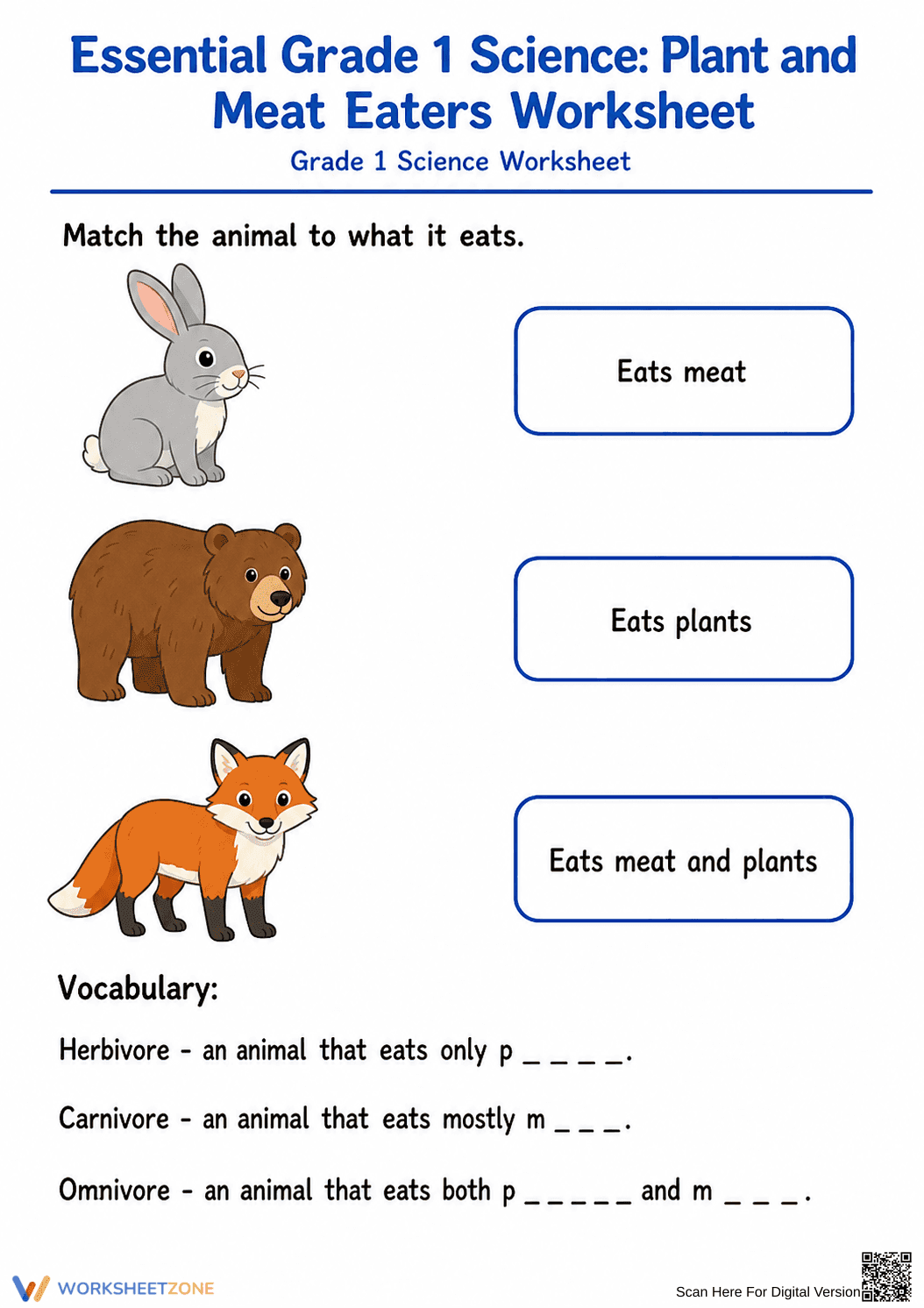
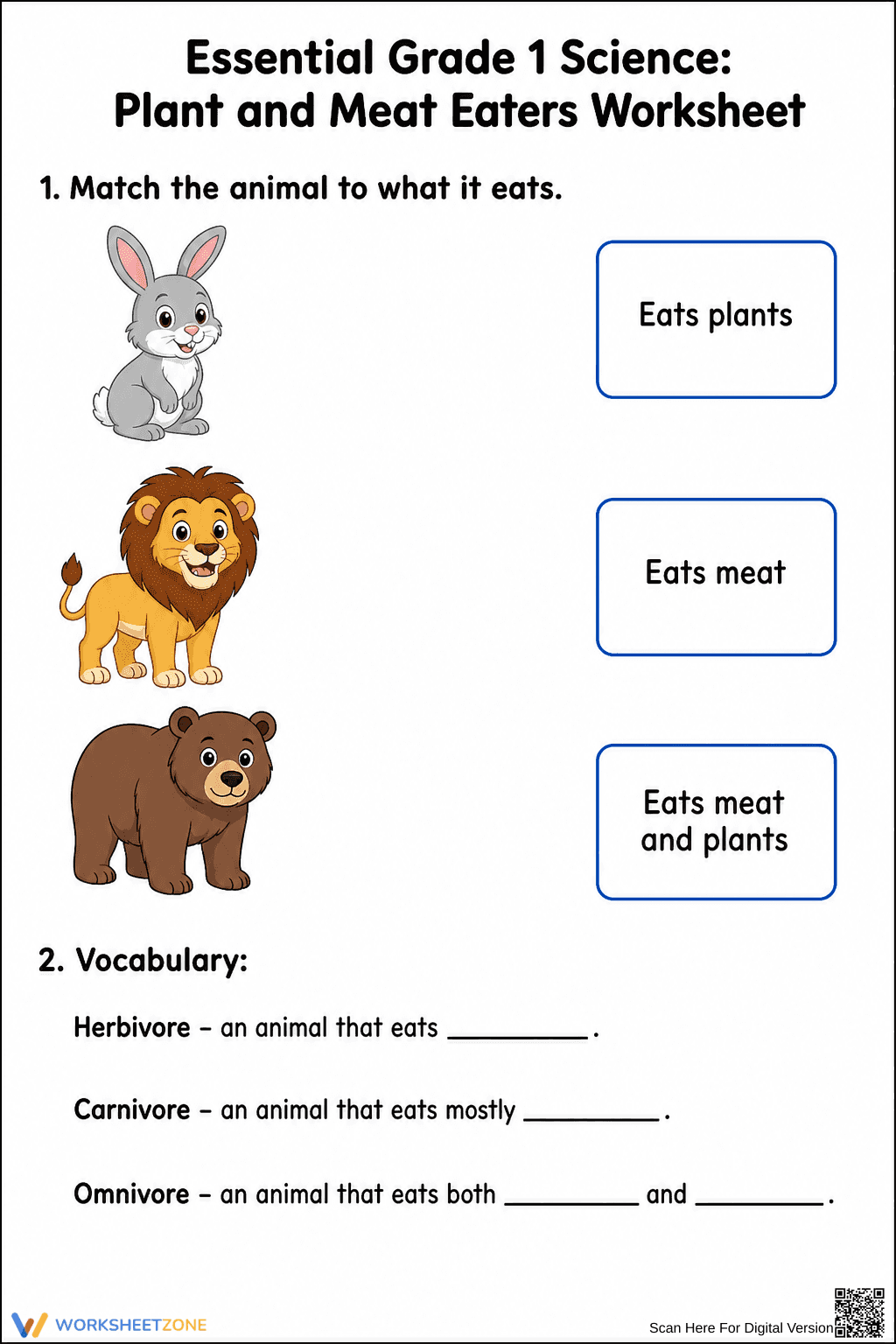
Help your first-grade students master the fundamental concept of animal diets with this clear and engaging science worksheet. By identifying what different animals eat, learners build a strong foundation for understanding ecosystems and life cycles. This resource focuses on classifying animals as herbivores, carnivores, or omnivores through visual matching and vocabulary reinforcement.
At a Glance
- Grade: Grade 1 · Subject: Science
- Standard:
1-LS1-1— Use external parts and behaviors to survive and meet basic needs- Skill Focus: Dietary classification (Herbivore, Carnivore, Omnivore)
- Format: 1 page · 6 problems · Answer key included · PDF
- Best For: Independent practice or quick formative assessment
- Time: 10–15 minutes
This single-page resource features two distinct sections designed for maximum clarity. The first half includes a matching activity where students connect illustrations of common animals like rabbits and bears to their primary food sources. The second half provides a vocabulary-building exercise with fill-in-the-blank sentences defining herbivores, carnivores, and omnivores. A full answer key is included for rapid grading.
Zero-Prep Workflow
- Print: Generate a single-page student copy in less than 30 seconds for your entire class.
- Distribute: Hand out the sheets as a low-stakes morning warm-up or an independent practice activity following a lesson on living things.
- Review: Utilize the provided answer key for instant feedback or display it on a projector for whole-class peer-grading.
Total teacher prep time is under 2 minutes, making this an ideal choice for busy mornings or emergency sub plans. Standards Alignment: This worksheet is specifically aligned to the NGSS standard 1-LS1-1. The standard focuses on how animals use their behaviors and needs to survive and grow. By identifying dietary habits, students explore how living organisms obtain energy. Both standard codes can be copied directly into lesson plans, IEP goals, or district curriculum mapping tools.
How to Use It: Assign this worksheet during the 'Explain' or 'Elaborate' phase of a 5E science lesson. It serves as an excellent formative assessment tool to gauge student understanding of consumer roles. For a quick extension, have students draw one additional animal for each of the three dietary categories on the back of the page.
Who It's For: This resource is tailored for Grade 1 students but is also appropriate for Kindergarten enrichment or Grade 2 review. The visual nature of the animal matching makes it highly accessible for English Language Learners and students requiring reading support. It pairs naturally with any introductory unit on habitats or life cycles.
As highlighted in the RAND AIRS 2024 report on elementary science literacy, early exposure to biological classification systems significantly enhances a student's ability to process complex ecological relationships in later grades. This worksheet specifically addresses the 1-LS1-1 standard by requiring students to recognize how animals use their biological needs—specifically their dietary requirements—to interact with their environment. By distinguishing between herbivores, carnivores, and omnivores, students develop the foundational vocabulary necessary for scientific discourse and inquiry-based learning. The inclusion of visual cues paired with linguistic reinforcement ensures that the learning objective is accessible to diverse learners, including those developing English proficiency. Mastering these basic life science concepts is a critical milestone in the Grade 1 curriculum, providing the scaffolding needed for more advanced topics such as food webs and habitat conservation. This printable resource serves as an effective tool for both initial instruction and subsequent mastery verification within any standards-based science program.


