


























Views
Downloads

Printable Place Value Worksheet | Essential Grade 2 Math
Paste this activity's link or code into your existing LMS (Google Classroom, Canvas, Teams, Schoology, Moodle, etc.).
Students can open and work on the activity right away, with no student login required.
You'll still be able to track student progress and results from your teacher account.
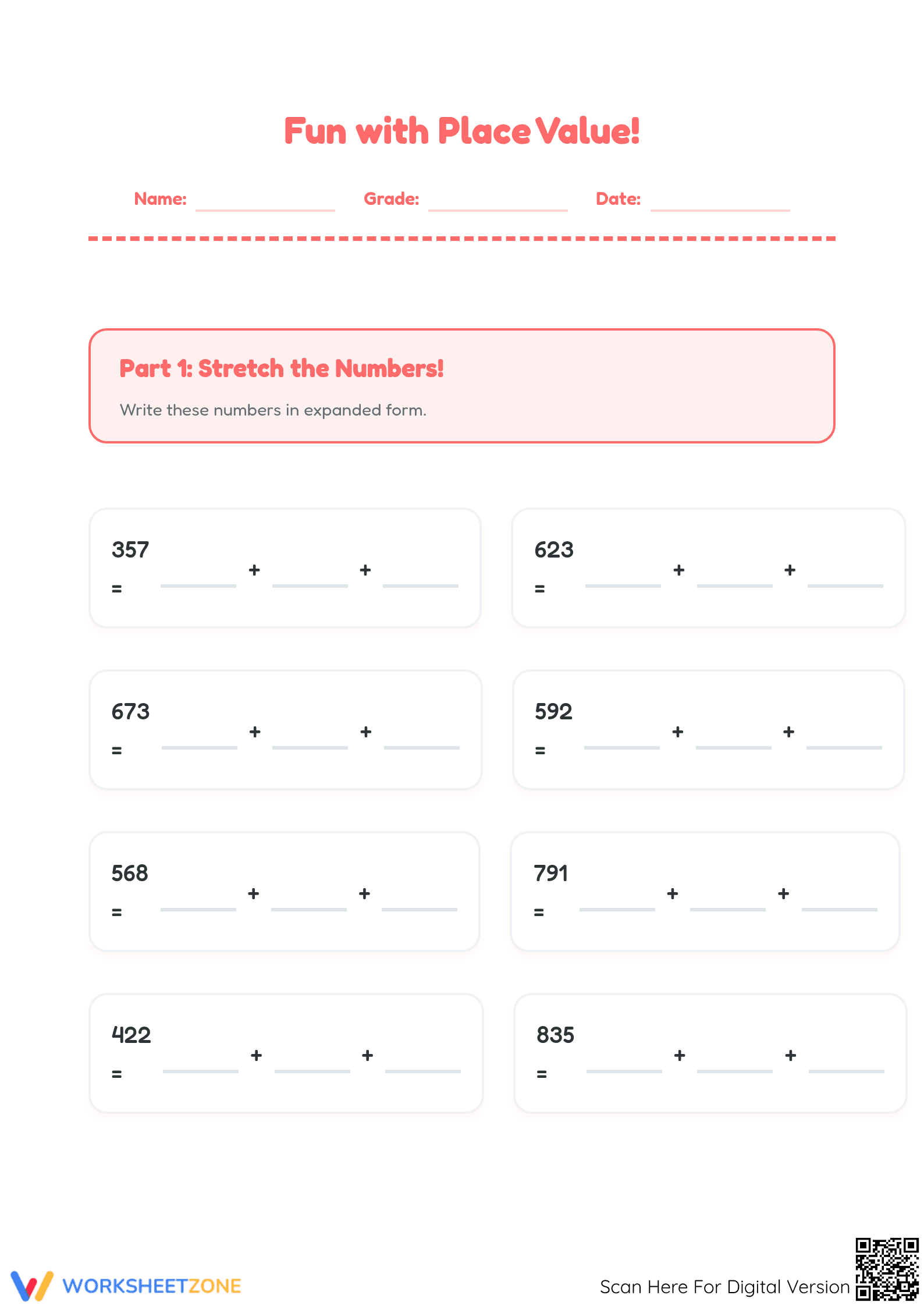
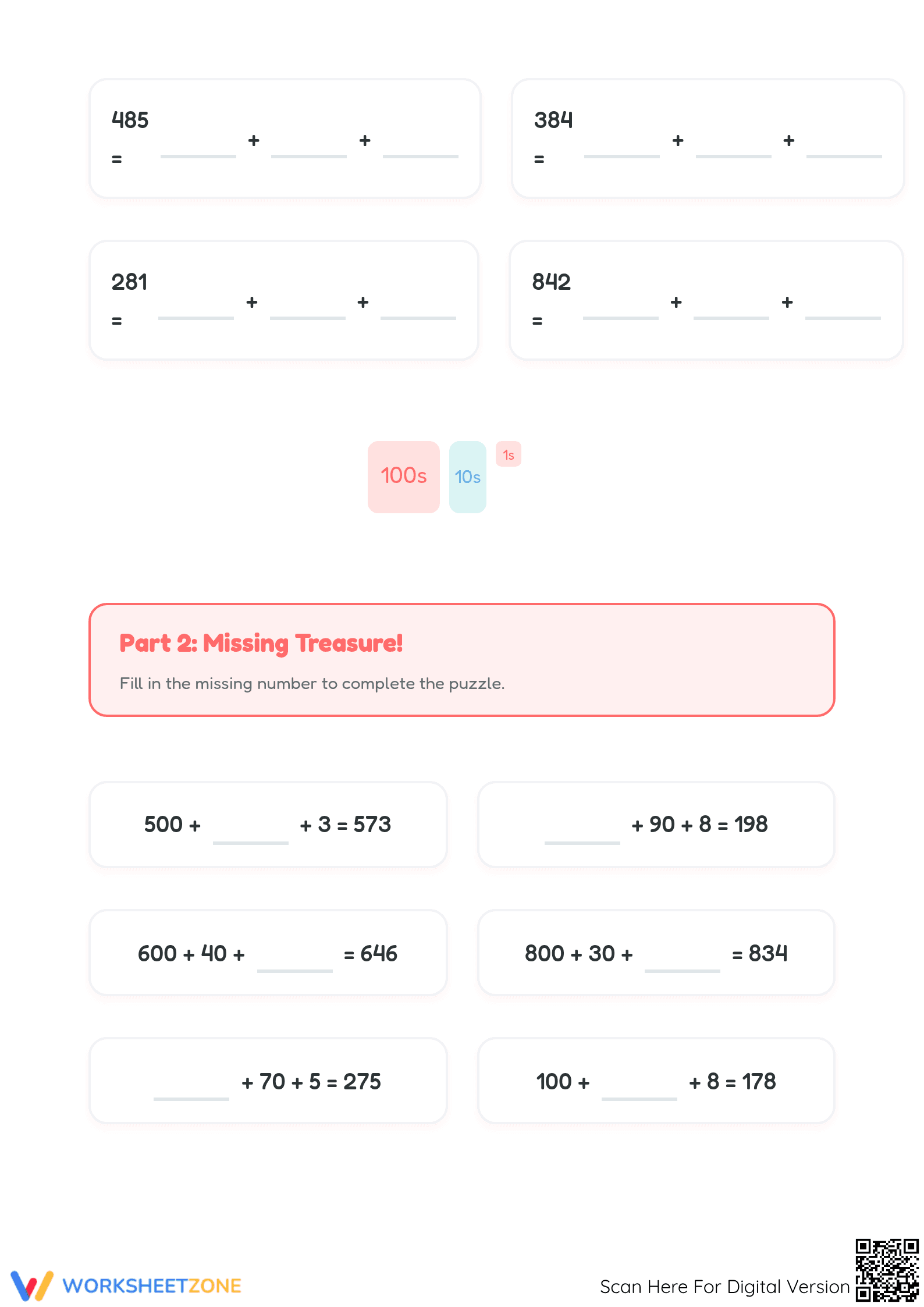
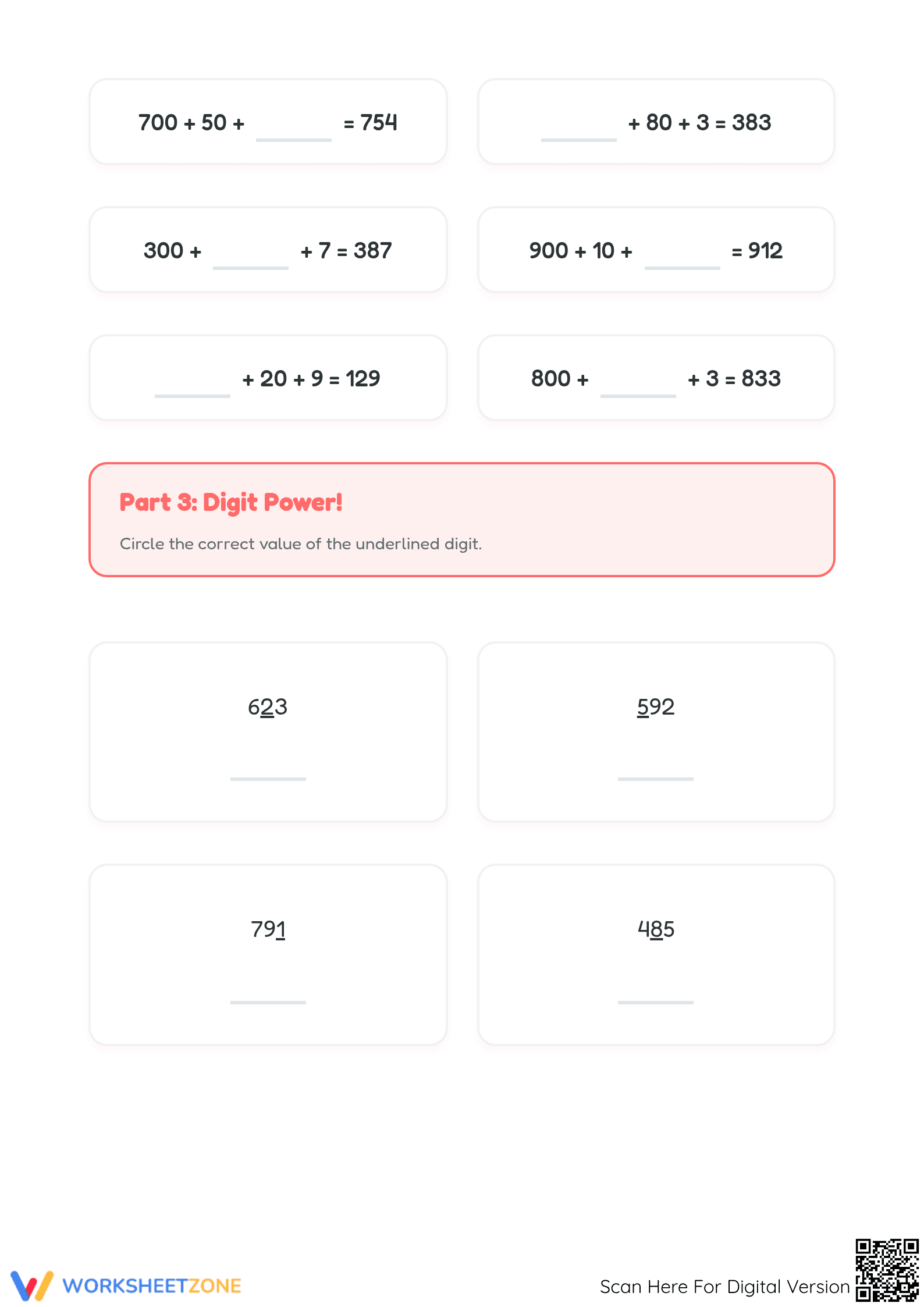
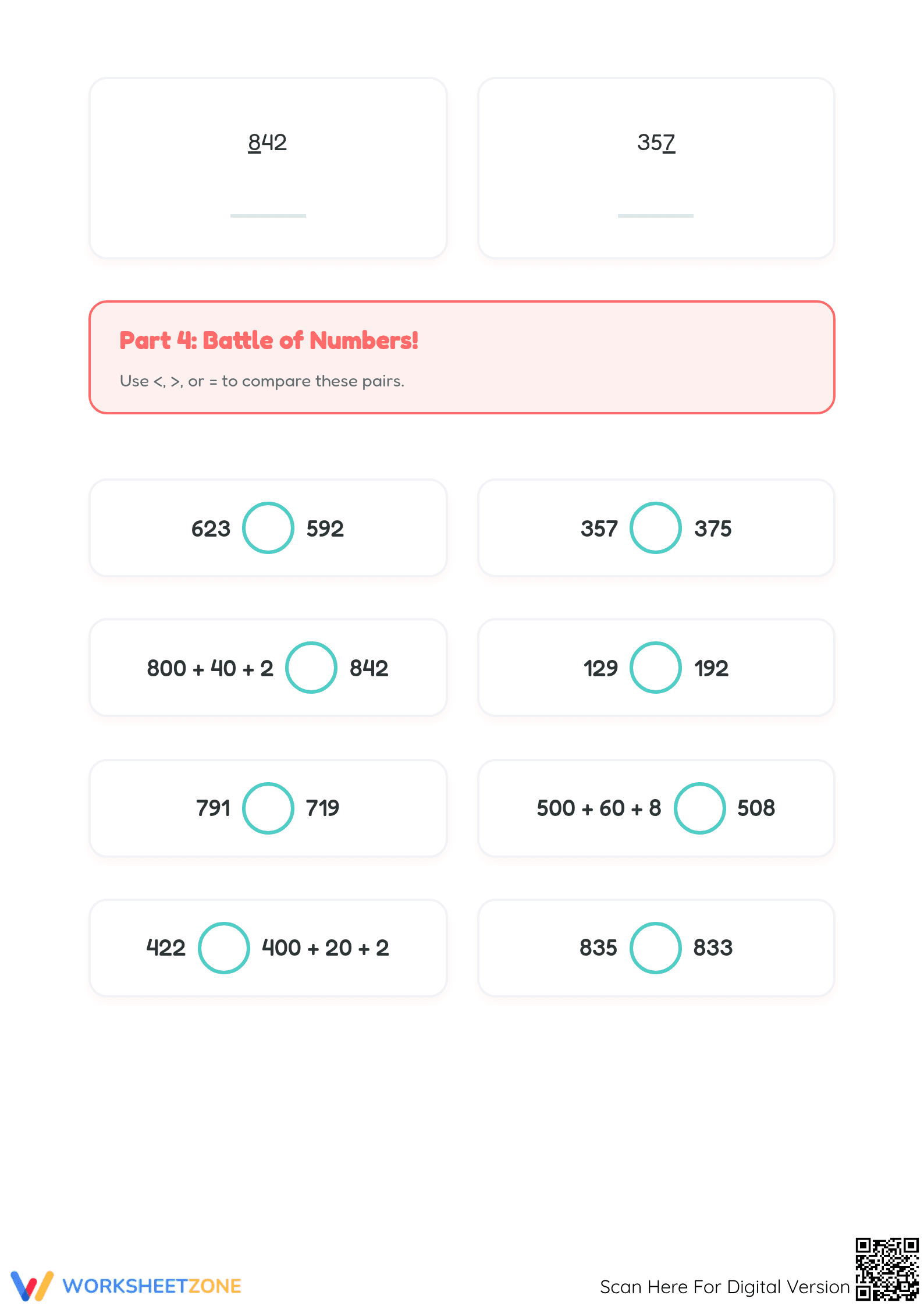
This Grade 2 Math worksheet provides comprehensive practice with 3-digit place value to help students master base-ten concepts. Students systematically work through expanded form, digit value identification, and number comparisons to build a strong foundation for future arithmetic. This resource ensures learners can confidently represent and manipulate hundreds, tens, and ones.
At a Glance
- Grade: 2 · Subject: Math
- Standard:
CCSS.MATH.CONTENT.2.NBT.A.3— Read and write numbers to 1000 using base-ten numerals and expanded form- Skill Focus: 3-Digit Place Value Mastery
- Format: 5 pages · 41 problems · Answer key included · PDF
- Best For: Independent practice and zero-prep sub plans
- Time: 30–45 minutes
What's Inside
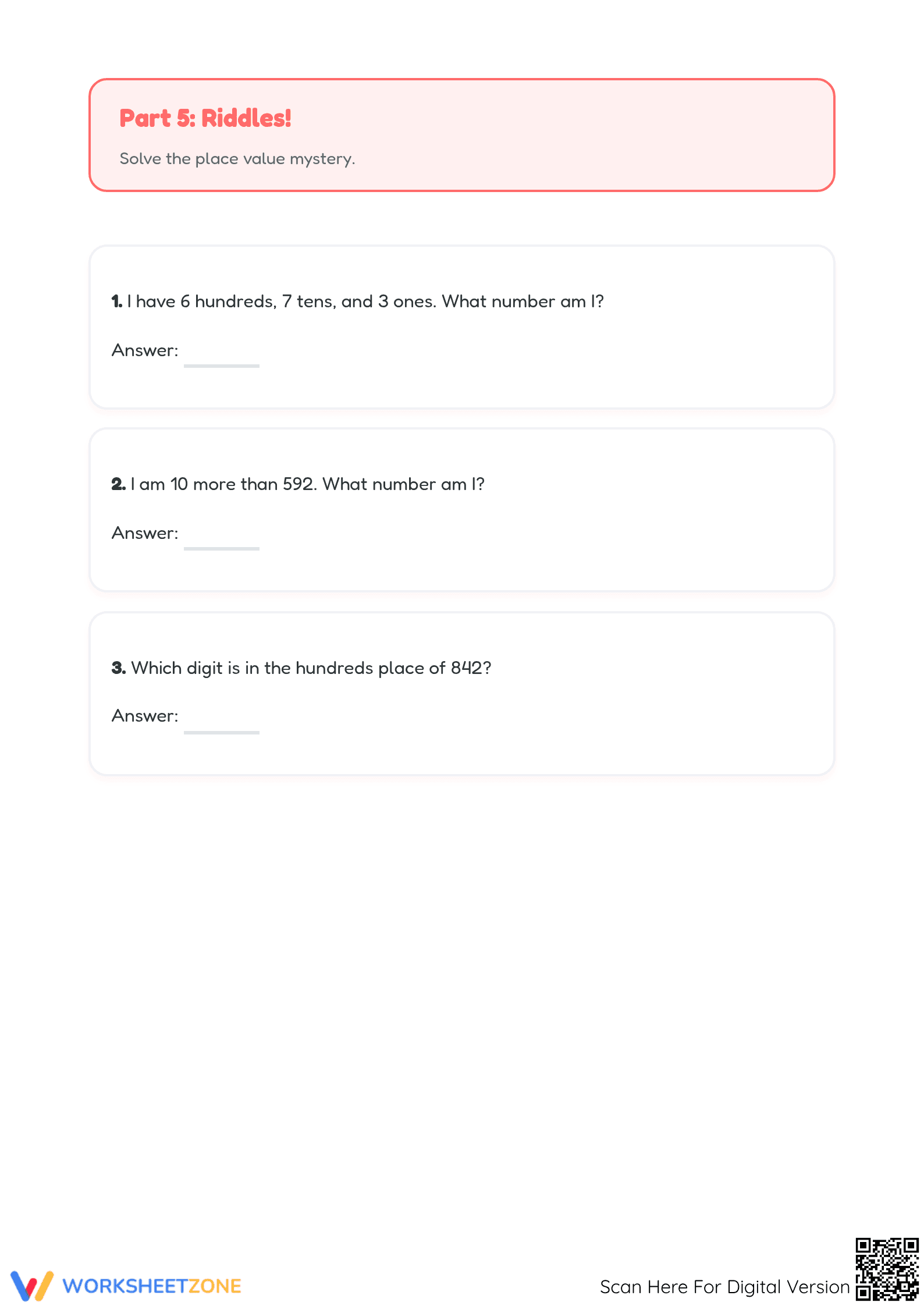
Across five structured pages, this worksheet offers 41 unique problems divided into five thematic sections. Part 1 focuses on stretching numbers into expanded form, while Part 2 challenges students to find missing digits in equations. Part 3 requires identifying specific digit values, Part 4 involves number comparison, and Part 5 concludes with place value riddles to encourage higher-order thinking.
Zero-Prep Workflow
Teachers can implement this resource with a zero-prep workflow designed for efficiency. Print the five-page packet for each student (one minute). Distribute the materials during a transition or as a main lesson component. Finally, review the completed work using the provided answer key, allowing for a quick diagnostic check of student understanding in under two minutes.
Standards Alignment
The primary alignment for this resource is `CCSS.MATH.CONTENT.2.NBT.A.3`, which requires students to read and write numbers to 1000 using expanded form. It also supports `CCSS.MATH.CONTENT.2.NBT.A.4` by facilitating the comparison of two three-digit numbers based on the meanings of the hundreds, tens, and ones digits. Both standard codes can be copied directly into lesson plans, IEP goals, or district curriculum mapping tools.
How to Use It
Use this worksheet as a summative assessment following a unit on base-ten operations or as a robust homework assignment. During independent practice, teachers should observe how students handle the missing treasure section to identify misconceptions regarding zero as a placeholder in the tens or ones place. The expected completion time for the full five-page set ranges from 30 to 45 minutes.
Who It's For
This resource is designed for Grade 2 students but serves as an effective intervention for Grade 3 learners needing to reinforce place value foundations. The inclusion of riddles offers natural differentiation for advanced students, while the expanded form sections provide visual scaffolds for struggling learners. Pair this worksheet with a set of base-ten blocks or a place value anchor chart for maximum instructional impact.
Mastering place value is a critical milestone in early mathematical development, as identified in the Fisher & Frey (2014) framework. This Grade 2 resource addresses CCSS.MATH.CONTENT.2.NBT.A.3 by requiring students to translate between standard numerals and expanded form, reinforcing the conceptual understanding of 3-digit magnitudes. Research from the RAND AIRS 2024 report indicates that high-quality, standards-aligned practice materials are essential for closing achievement gaps in foundational numeracy. By engaging with 41 tasks ranging from computation to deductive riddles, students develop the mental flexibility required for multi-digit addition. The systematic layout reduces cognitive load, allowing learners to focus on the relationships between digits and their relative values. This worksheet serves as a reliable instrument for both formative assessment and skill reinforcement, ensuring that students meet grade-level benchmarks for base-ten number systems. Teachers can utilize these findings to justify the integration of such targeted worksheets into their daily instructional routines and math centers.


