


























Views
Downloads
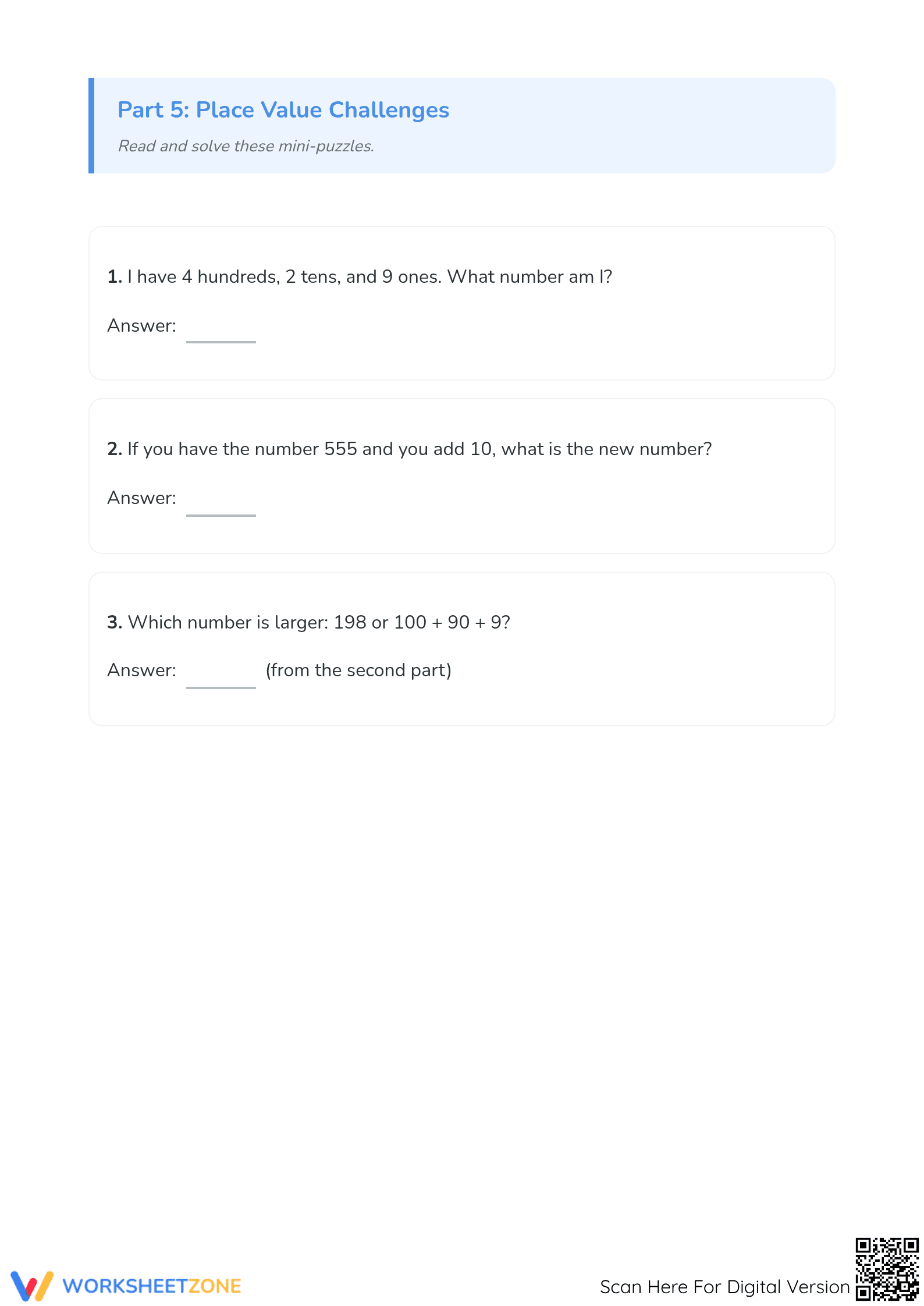

Grade 2 Place Value Mastery — Essential Printable Worksheet
Paste this activity's link or code into your existing LMS (Google Classroom, Canvas, Teams, Schoology, Moodle, etc.).
Students can open and work on the activity right away, with no student login required.
You'll still be able to track student progress and results from your teacher account.
Overview
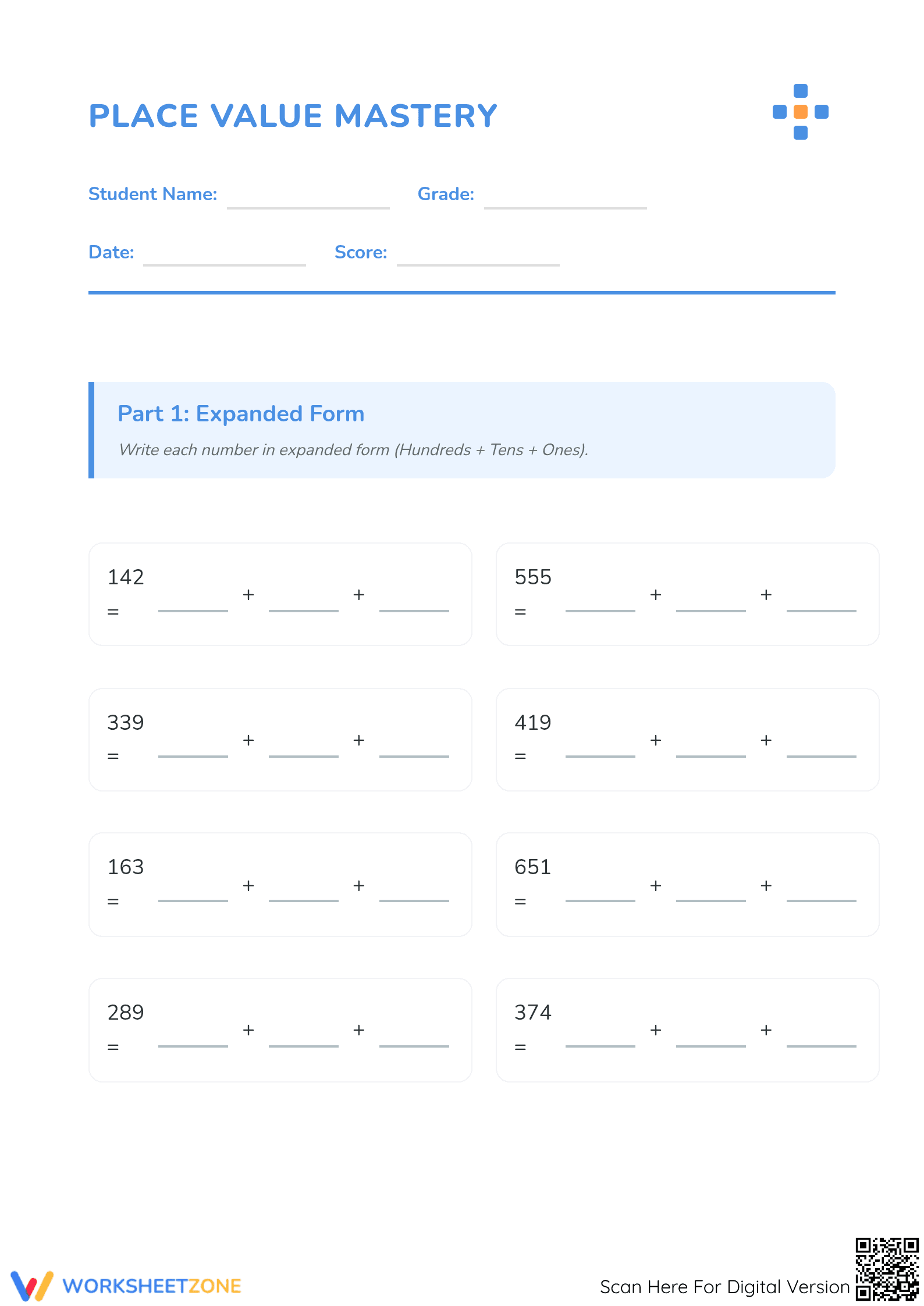
Help second graders master number structure with this comprehensive place value pack. Students understand the value of hundreds, tens, and ones through expanded form and comparison. This resource ensures learners decompose three-digit numbers and apply that knowledge to mathematical puzzles.
At a Glance
- Grade: Grade 2 · Subject: Math
- Standard:
2.NBT.A.3— Read and write numbers to 1000 using base-ten numerals, names, and expanded form- Skill Focus: 3-Digit Place Value Mastery
- Format: 5 pages · 49 problems · Answer key included · PDF
- Best For: Independent practice, center rotations, or sub plans
- Time: 30–45 minutes
What's Inside
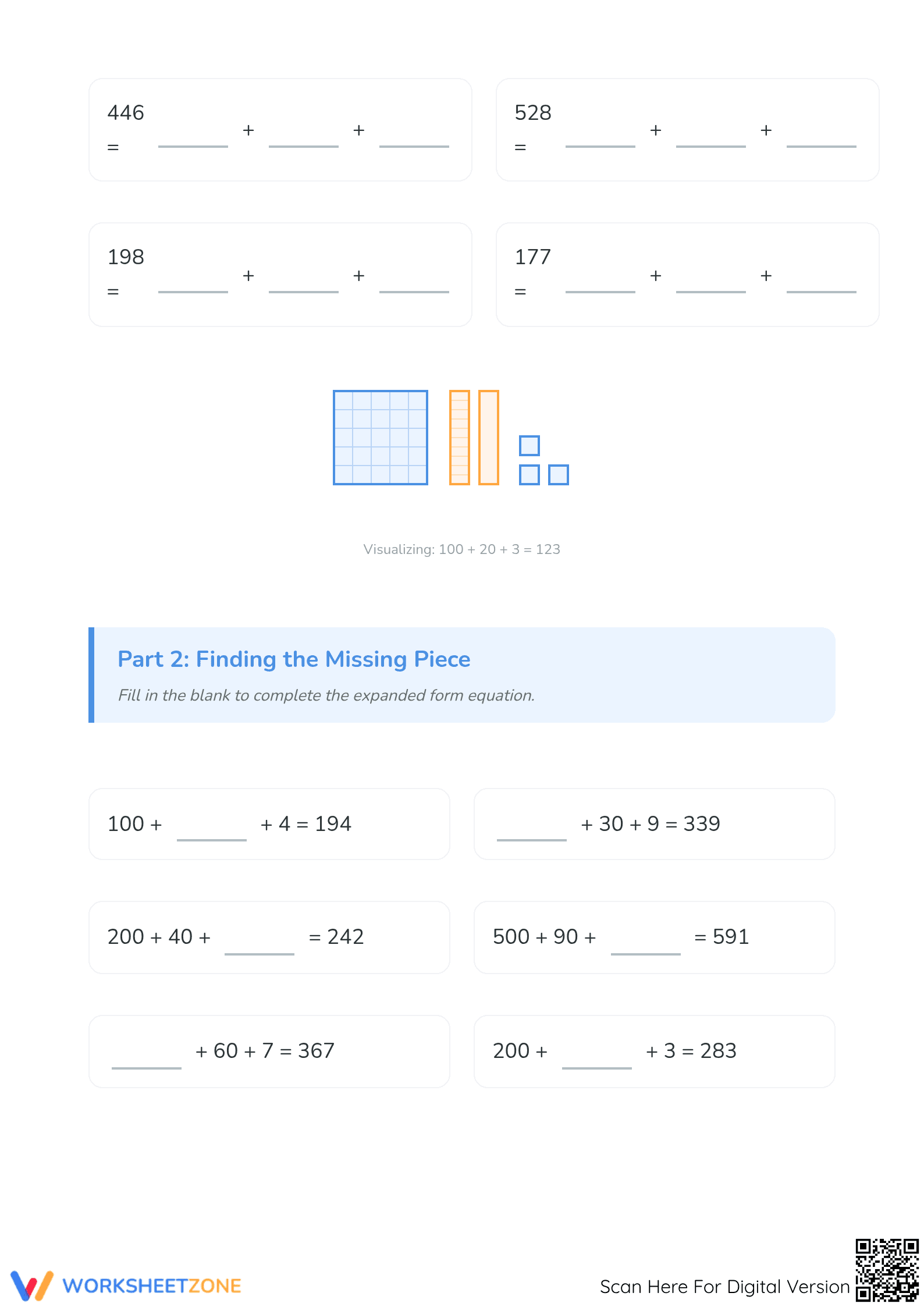
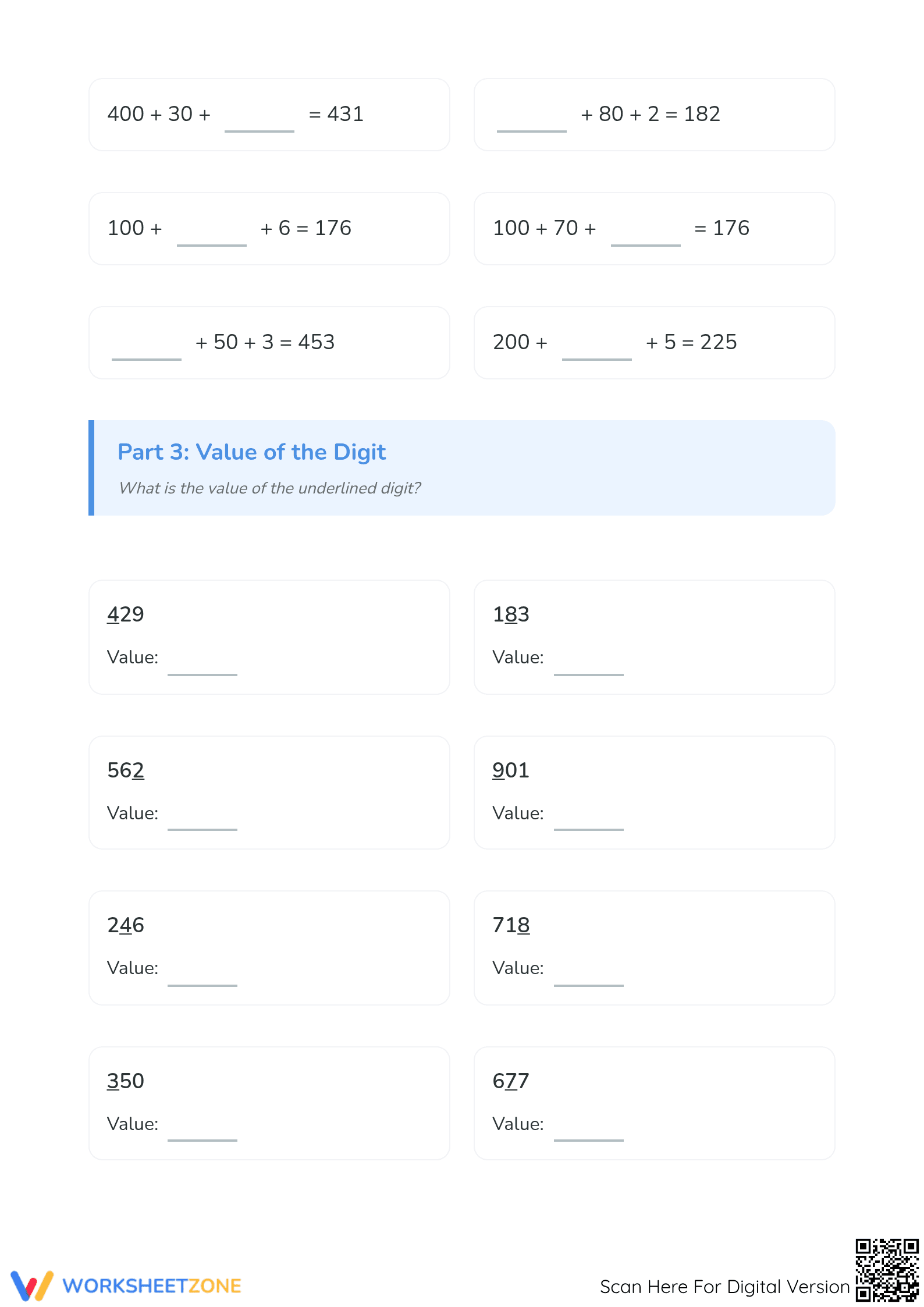
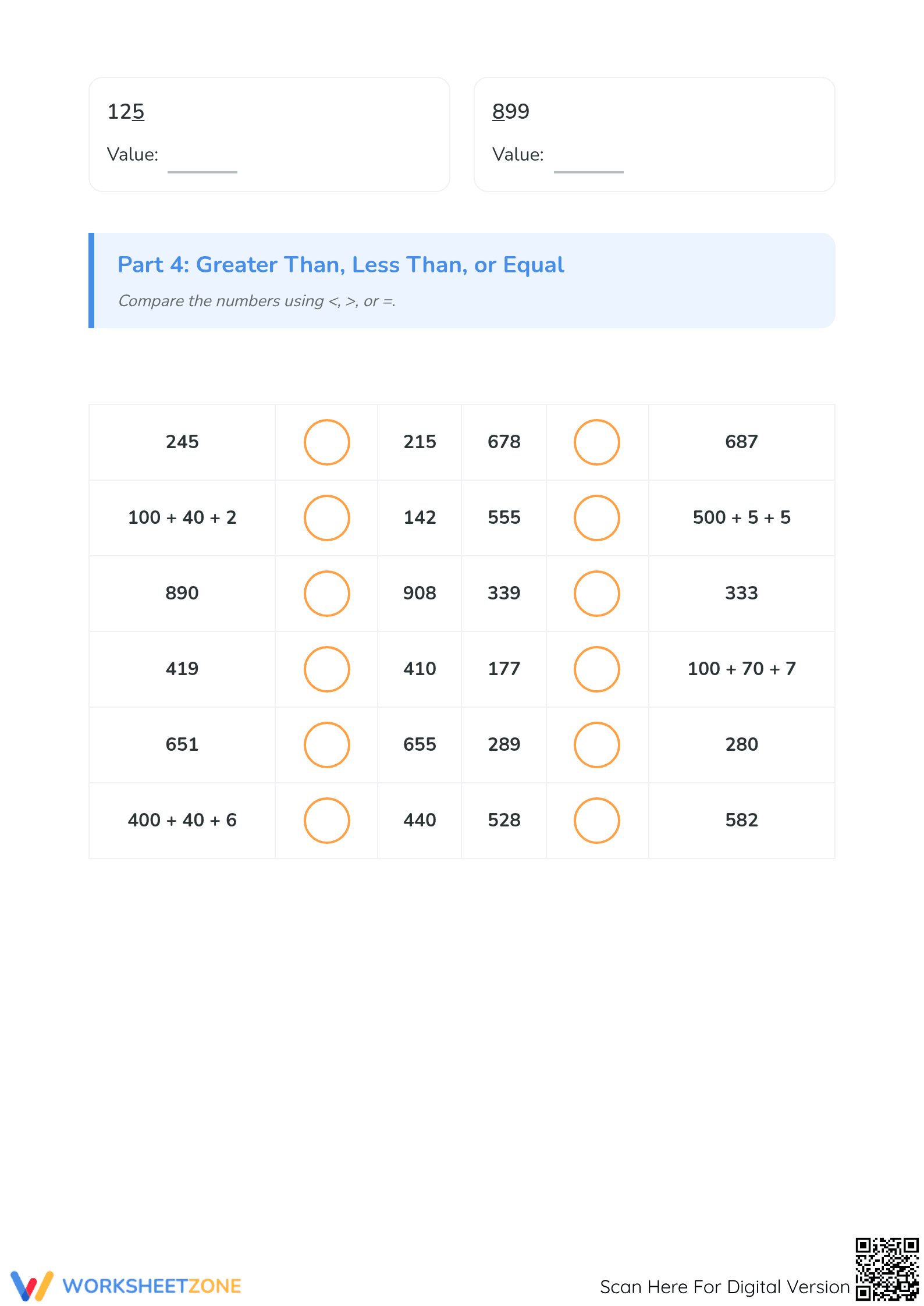
This 5-page PDF features five sections: Expanded Form, Finding the Missing Piece, Value of the Digit, Comparisons, and Challenges. Each page provides clear headings and visual supports like base-ten block diagrams. A full answer key is provided for quick grading and immediate student feedback.
Zero-Prep Workflow
Step 1: Print (1 minute) — Send the 5-page file to the copier for your entire class. Step 2: Distribute (1 minute) — Hand out the packets as a standalone unit or single pages for daily warm-ups. Step 3: Review (5 minutes) — Use the included answer key to check for common misconceptions in digit placement. Total teacher preparation time is less than two minutes, making this an ideal choice for emergency sub folders or busy morning transitions.
Standards Alignment
`CCSS.MATH.CONTENT.2.NBT.A.3` — Read and write numbers to 1000 using base-ten numerals, number names, and expanded form. This resource also supports `2.NBT.A.4` through the comparison section. Both standard codes can be copied directly into lesson plans, IEP goals, or district curriculum mapping tools.
How to Use It
Assign this packet during the "Independent Practice" phase of your place value unit to solidify decomposing numbers. Alternatively, use the "Place Value Challenges" on page 5 as a formative assessment to identify students ready for enrichment. Observe if students struggle more with the "Missing Piece" equations than standard expanded form to gauge conceptual depth. Expected completion time is 35 minutes.
Who It's For
This is designed for Grade 2 students but serves as an excellent intervention tool for Grade 3 learners needing a refresher on 3-digit structure. It pairs naturally with a base-ten block manipulative set or a place value anchor chart displayed in the classroom to support visual learners.
Scientific research by RAND AIRS 2024 highlights that procedural fluency in place value is a significant predictor of later success in multi-digit addition and subtraction. By providing 49 varied tasks—ranging from simple decomposition to comparison logic—this worksheet aligns with best practices for mathematical "spaced practice." Students who engage with expanded form consistently demonstrate higher accuracy in mental math because they visualize numbers as composite units rather than isolated digits. The inclusion of "missing piece" equations (e.g., 100 + ___ + 4 = 194) forces students to apply algebraic thinking to base-ten concepts, which is a key recommendation for early elementary rigor. This worksheet provides the high-volume, standard-aligned practice necessary for 2nd graders to transition from concrete manipulatives to abstract numerical reasoning. It effectively bridges the gap between seeing blocks and understanding value. This structured approach ensures that students develop the mental models required for higher-level arithmetic and satisfies the requirements of standard `CCSS.MATH.CONTENT.2.NBT.A.3`.


