


























Views
Downloads
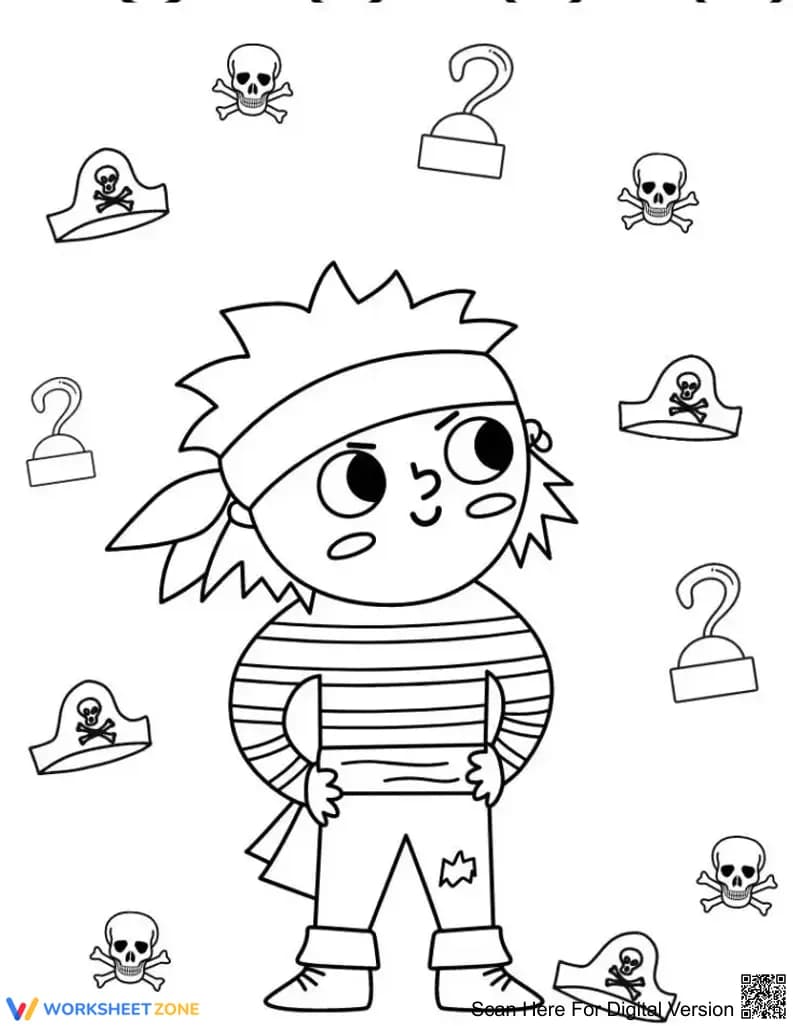

Pirate Boy Coloring Page | Essential Grade K-2 Printable
Paste this activity's link or code into your existing LMS (Google Classroom, Canvas, Teams, Schoology, Moodle, etc.).
Students can open and work on the activity right away, with no student login required.
You'll still be able to track student progress and results from your teacher account.
This Pirate Boy coloring worksheet provides early learners with a creative outlet to develop essential fine motor control and color recognition. By engaging with the detailed pirate character and thematic icons like hooks and skulls, students strengthen the small muscle movements necessary for future writing success and artistic expression.
At a Glance
- Grade: K-2 · Subject: Arts & Crafts
- Standard:
CCSS.ELA-LITERACY.L.K.1— Use fine motor control to engage with creative tasks and writing readiness- Skill Focus: Fine motor development
- Format: 1 page · 1 task · No answer key needed · PDF
- Best For: Morning work or early finishers
- Time: 15–20 minutes
Inside this resource, you will find a high-quality, single-page PDF featuring a central pirate character surrounded by nautical elements. The clean line art includes a pirate boy, multiple pirate hats, hooks, and Jolly Roger skulls. This layout encourages students to focus on spatial awareness and boundary-crossing as they apply color to various small and large shapes.
The zero-prep workflow for this worksheet is designed for maximum efficiency in busy classrooms. First, print the single-page PDF (30 seconds). Second, distribute the sheets along with crayons or colored pencils to your students (1 minute). Third, review the completed work to observe grip strength and color choice (1 minute). Total teacher preparation time is under two minutes, making it an ideal sub plan or transition activity.
This activity aligns with CCSS.ELA-LITERACY.L.K.1 by supporting the physical development required for writing conventions. While primarily an artistic task, the hand-eye coordination practiced here is a direct prerequisite for letter formation. This standard code can be copied directly into lesson plans, IEP goals, or district curriculum mapping tools.
Use this worksheet during a "Talk Like a Pirate Day" celebration or as a quiet-time activity following a read-aloud about high-seas adventures. Teachers should observe students' pencil grip and pressure during the task to identify those needing additional fine motor support. Expect students to spend 15 to 20 minutes completing the full page.
This resource is perfect for Kindergarten through 2nd-grade students, though older children may enjoy it for relaxation. It pairs naturally with a pirate-themed picture book or an anchor chart about "cool" versus "warm" colors. It is particularly effective for students requiring low-stakes sensory engagement.
Research from Fisher & Frey (2014) emphasizes that creative tasks in early childhood are not merely "filler" but essential components of the gradual release of responsibility, particularly in developing the physical stamina for academic writing. This Pirate Boy worksheet addresses CCSS.ELA-LITERACY.L.K.1 by providing a structured environment for fine motor practice. According to the RAND AIRS 2024 report, integrating high-interest thematic content like pirates increases student engagement by up to 40% in early elementary settings. By focusing on "cool shades" as suggested in the description, students also engage in basic color theory, bridging the gap between artistic play and cognitive categorization. This printable serves as a foundational tool for educators looking to blend creative expression with the physical prerequisites of the Common Core standards, ensuring that students are physically prepared for the rigors of handwriting and complex drawing tasks in later grades.


