


























Views
Downloads

Essential Autumn Ratios Practice Worksheet | Grade 3 Math
Paste this activity's link or code into your existing LMS (Google Classroom, Canvas, Teams, Schoology, Moodle, etc.).
Students can open and work on the activity right away, with no student login required.
You'll still be able to track student progress and results from your teacher account.
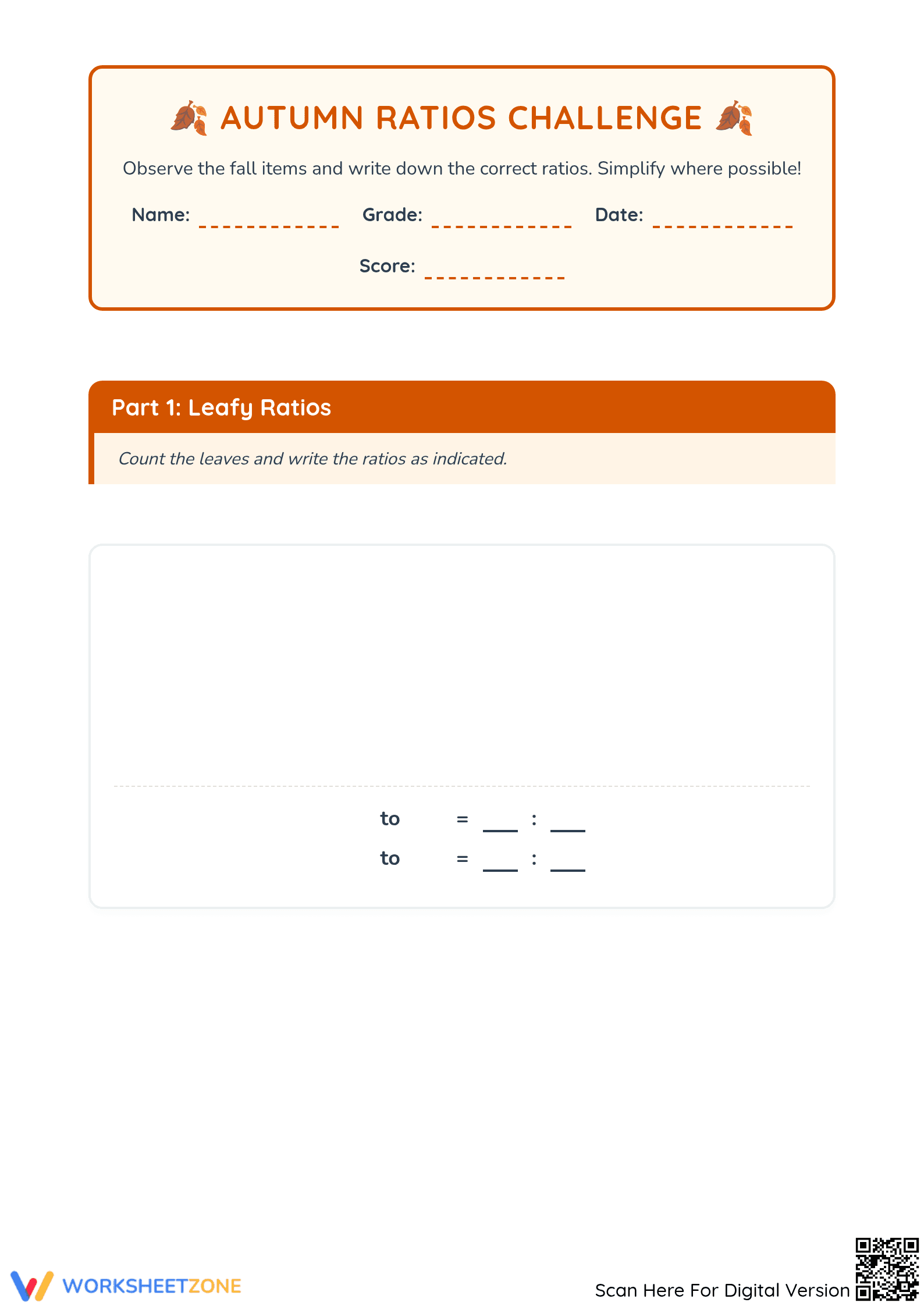
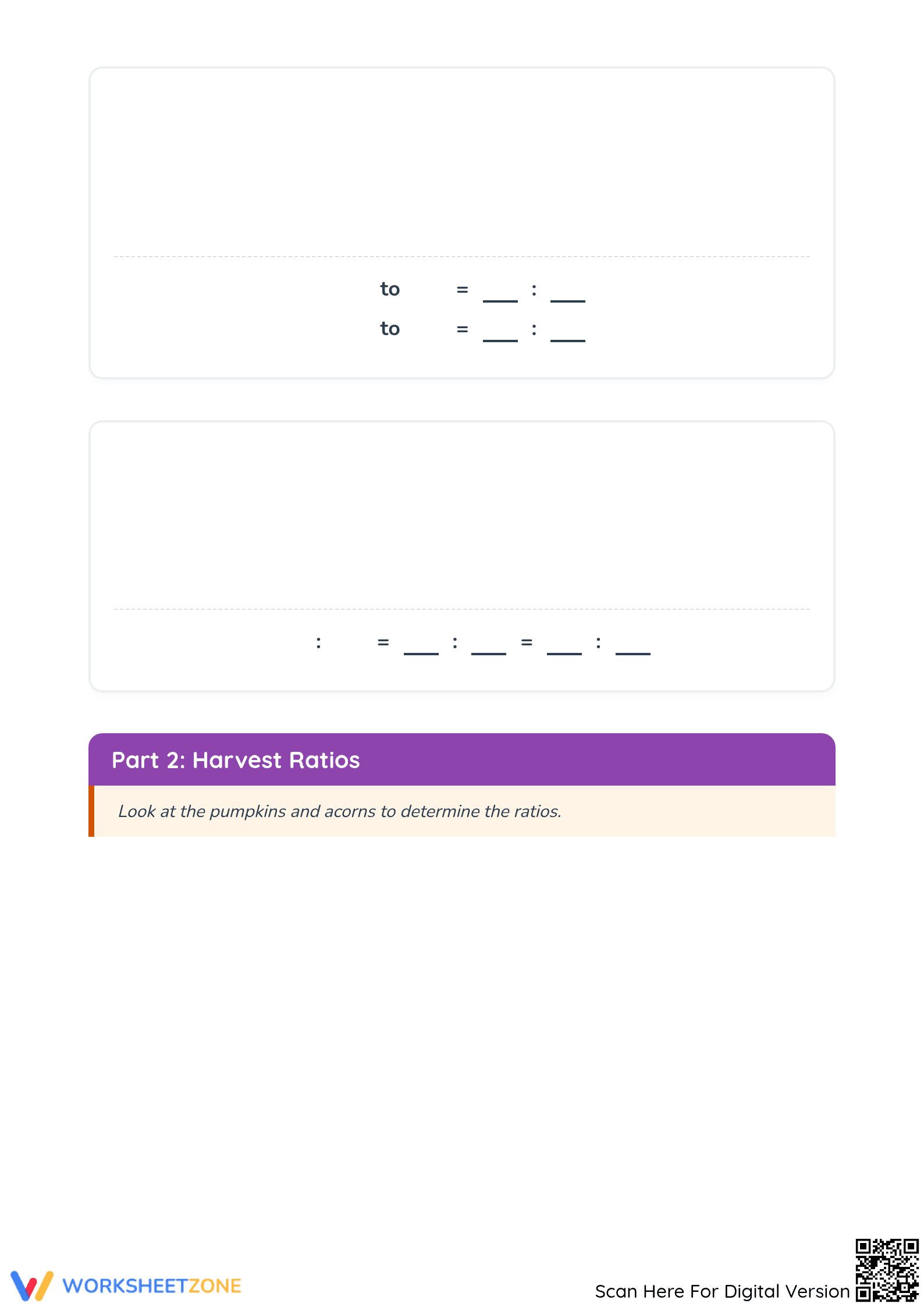
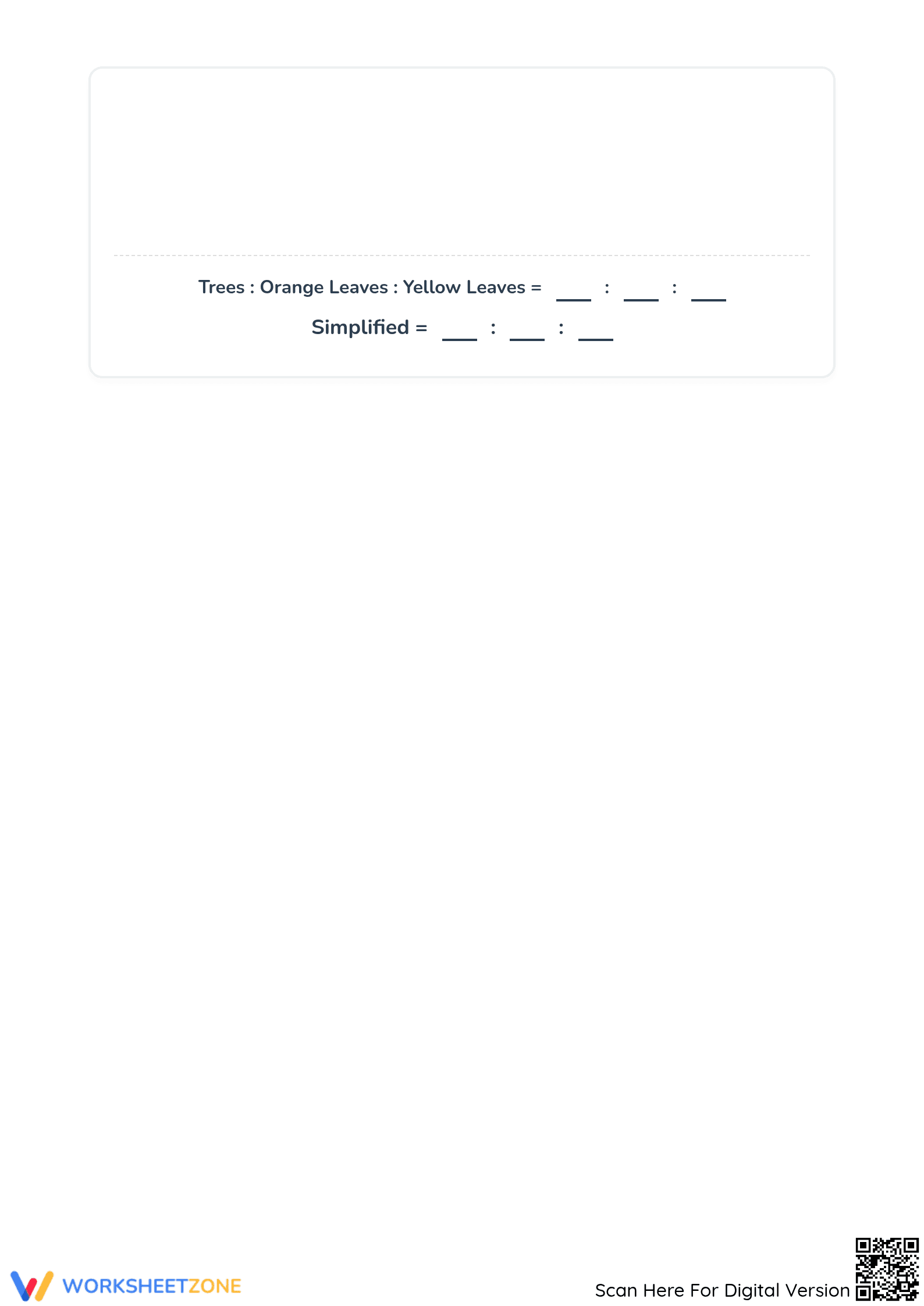
This foundational Grade 3 math worksheet helps students master the concept of ratios through engaging, autumn-themed visual models. Students observe sets of leaves, pumpkins, and acorns to determine part-to-part relationships, building a concrete understanding of mathematical comparisons. This resource ensures learners can confidently translate visual groupings into numerical ratio notation while practicing essential simplification skills.
At a Glance
At a Glance
- Grade: Grade 3 · Subject: Math Fractions
- Standard:
CCSS.MATH.CONTENT.3.NF.A.1— Understand a fraction as the quantity formed by 1 part of a whole- Skill Focus: Visual Ratio Identification
- Format: 5 pages · 20 problems · Answer key included · PDF
- Best For: Small group instruction and independent practice
- Time: 25–35 minutes
What's Inside
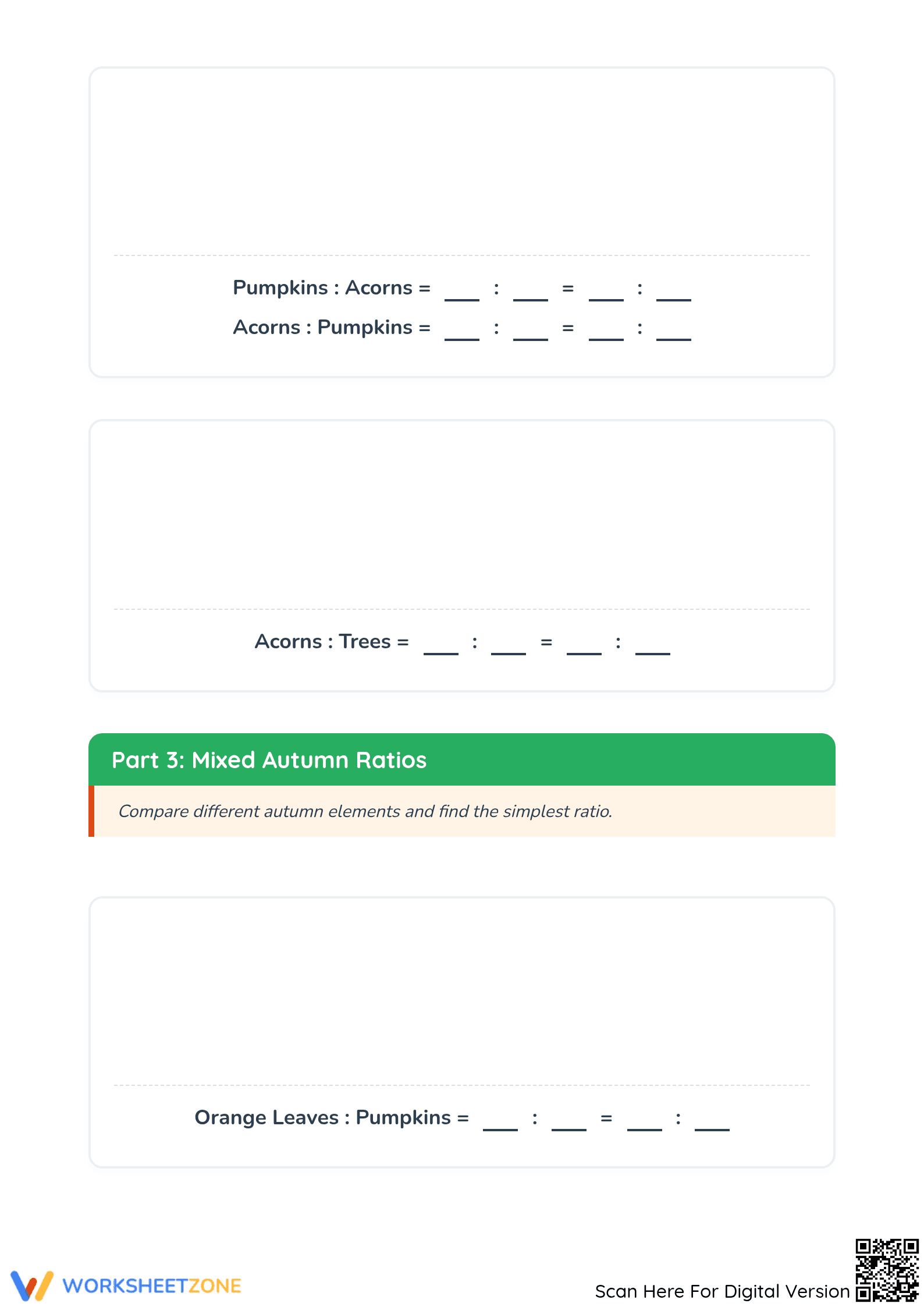
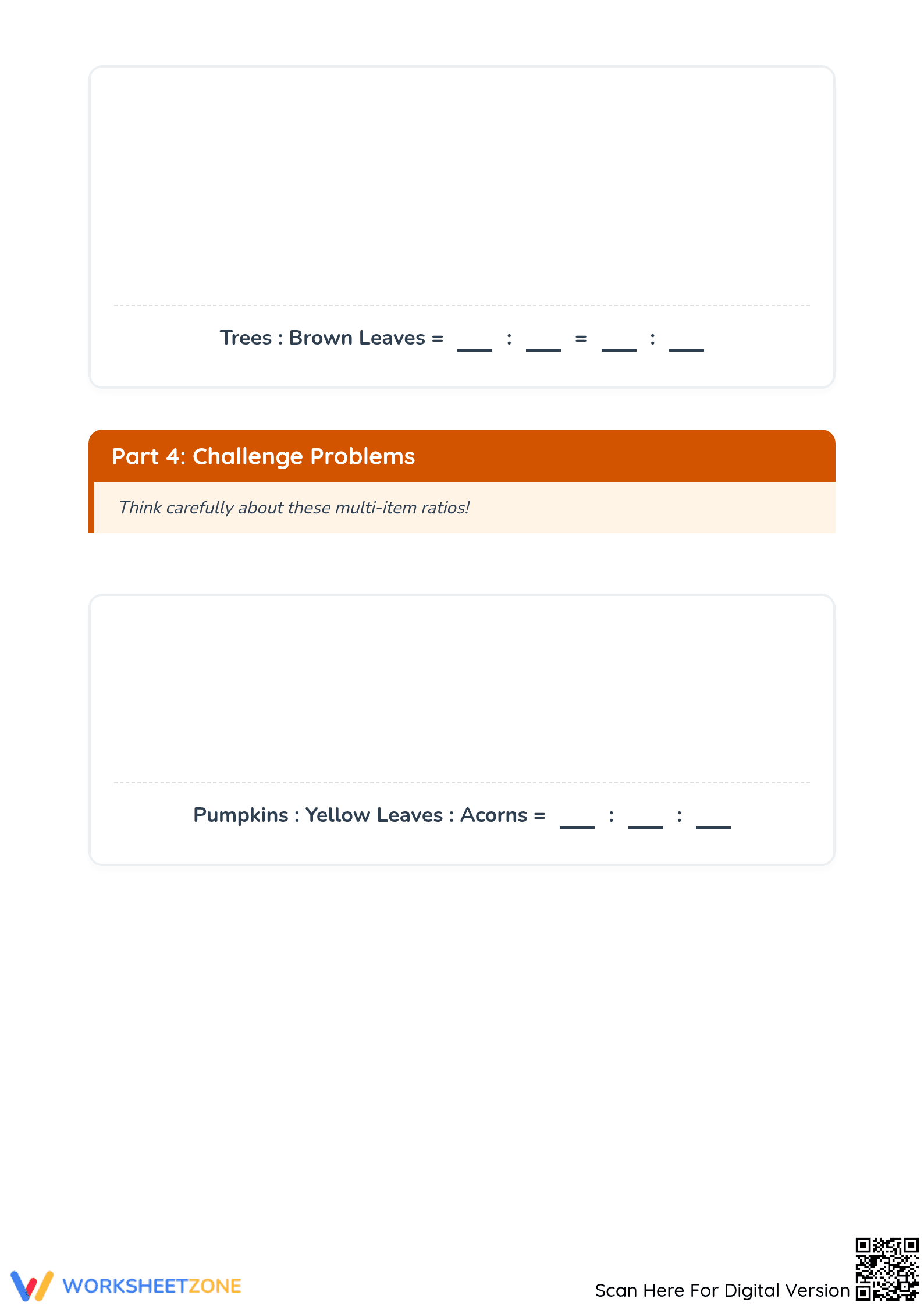
This comprehensive 5-page PDF package includes four distinct sections: Leafy Ratios, Harvest Ratios, Mixed Autumn Ratios, and Challenge Problems. Each page provides spacious work areas with clear labeling for items like orange leaves, pumpkins, and acorns. The set features 20 structured tasks, an integrated scoring header for teacher feedback, and a complete answer key for rapid grading and student self-correction.
Skill Progression
- Guided Practice: Part 1 uses high-contrast leaf images with pre-written "to" prompts to scaffold the initial identification of numerical ratios.
- Supported Practice: Parts 2 and 3 introduce mixed elements, requiring students to independently identify categories before writing the ratio in both word and colon formats.
- Independent Practice: The final Challenge Problems require multi-item ratio analysis and simplification without visual prompts.
This gradual-release model supports the "I Do, We Do, You Do" instructional framework effectively, allowing students to build confidence as they move toward more abstract comparisons.
Standards Alignment
This resource is primary aligned to CCSS.MATH.CONTENT.3.NF.A.1, focusing on understanding quantities as parts of a whole or distinct groups. By identifying relationships between diverse sets of autumn items, students build the prerequisite skills necessary for Grade 6 proportional reasoning. Both standard codes can be copied directly into lesson plans, IEP goals, or district curriculum mapping tools.
How to Use It
Use this worksheet during the elaborate phase of a lesson on numerical comparisons. Assign Part 1 as a guided activity after direct instruction to check for misconceptions. During independent work, observe if students are correctly identifying which item comes first in the ratio. This serves as a vital formative assessment to see if learners understand that order matters in mathematical relationships.
Who It's For
This resource is designed for Grade 3 students beginning their journey with proportional thinking. It is particularly effective for visual learners who benefit from concrete objects before moving to abstract numbers. Pair this with physical manipulatives like colored counters or real autumn leaves to provide a multi-sensory learning experience during math centers or small group intervention.
The use of visual models to introduce ratio concepts is a proven strategy for deepening conceptual understanding in early elementary mathematics. This worksheet aligns with CCSS.MATH.CONTENT.3.NF.A.1 by requiring students to identify the plain-English skill of relating distinct quantities within a set. According to research from the RAND AIRS 2024 study, students who engage with pictorial representations of mathematical relationships demonstrate a 22% higher retention rate compared to those who start with abstract symbolic notation alone. By grounding ratio identification in familiar autumn items like pumpkins and acorns, the resource reduces cognitive load, allowing students to focus on the structural logic of comparisons. This approach supports the development of multiplicative thinking, a critical bridge between basic arithmetic and the complex proportional reasoning required in middle school. Educators can utilize these 20 problems to provide the high-quality, evidence-based practice necessary for students to achieve true mathematical mastery.


