


























Views
Downloads

Essential Autumn Ratios Worksheet | Grade 3 Math Practice
Paste this activity's link or code into your existing LMS (Google Classroom, Canvas, Teams, Schoology, Moodle, etc.).
Students can open and work on the activity right away, with no student login required.
You'll still be able to track student progress and results from your teacher account.
This comprehensive Grade 3 ratios worksheet helps students develop a foundational understanding of proportional relationships through engaging autumn-themed activities. By counting foliage and trees, learners practice translating visual data into numerical ratios, ensuring they grasp the core concept of comparing two quantities. This resource provides a structured path from basic counting to solving complex ratio word problems.
At a Glance
- Grade: 3 · Subject: Math
- Standard:
6.RP.A.1— Understand the concept of a ratio and use ratio language to describe relationships- Skill Focus: Introductory ratios and simplification
- Format: 4 pages · 17 problems · Answer key included · PDF
- Best For: Early introduction to proportional reasoning
- Time: 25–40 minutes
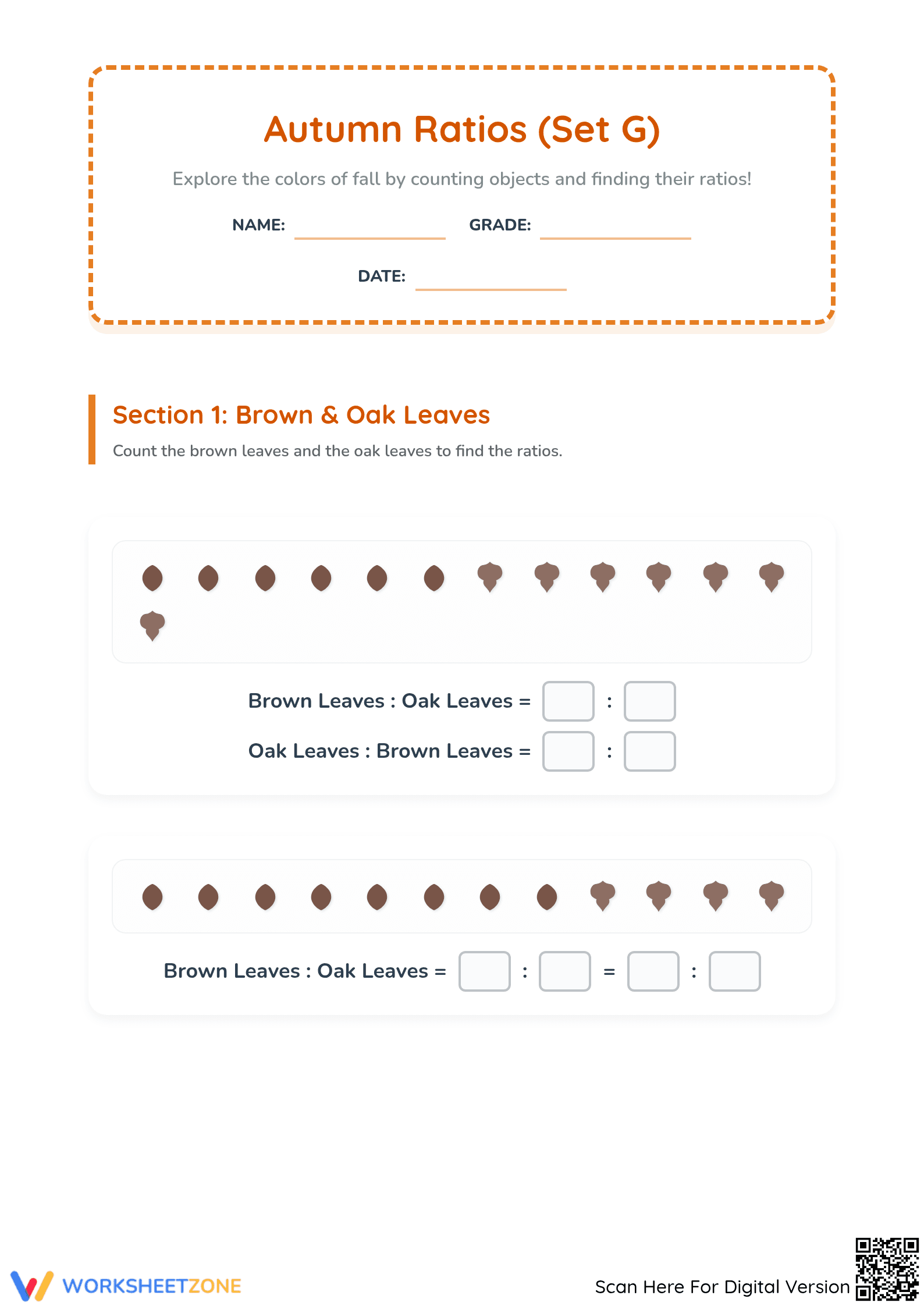
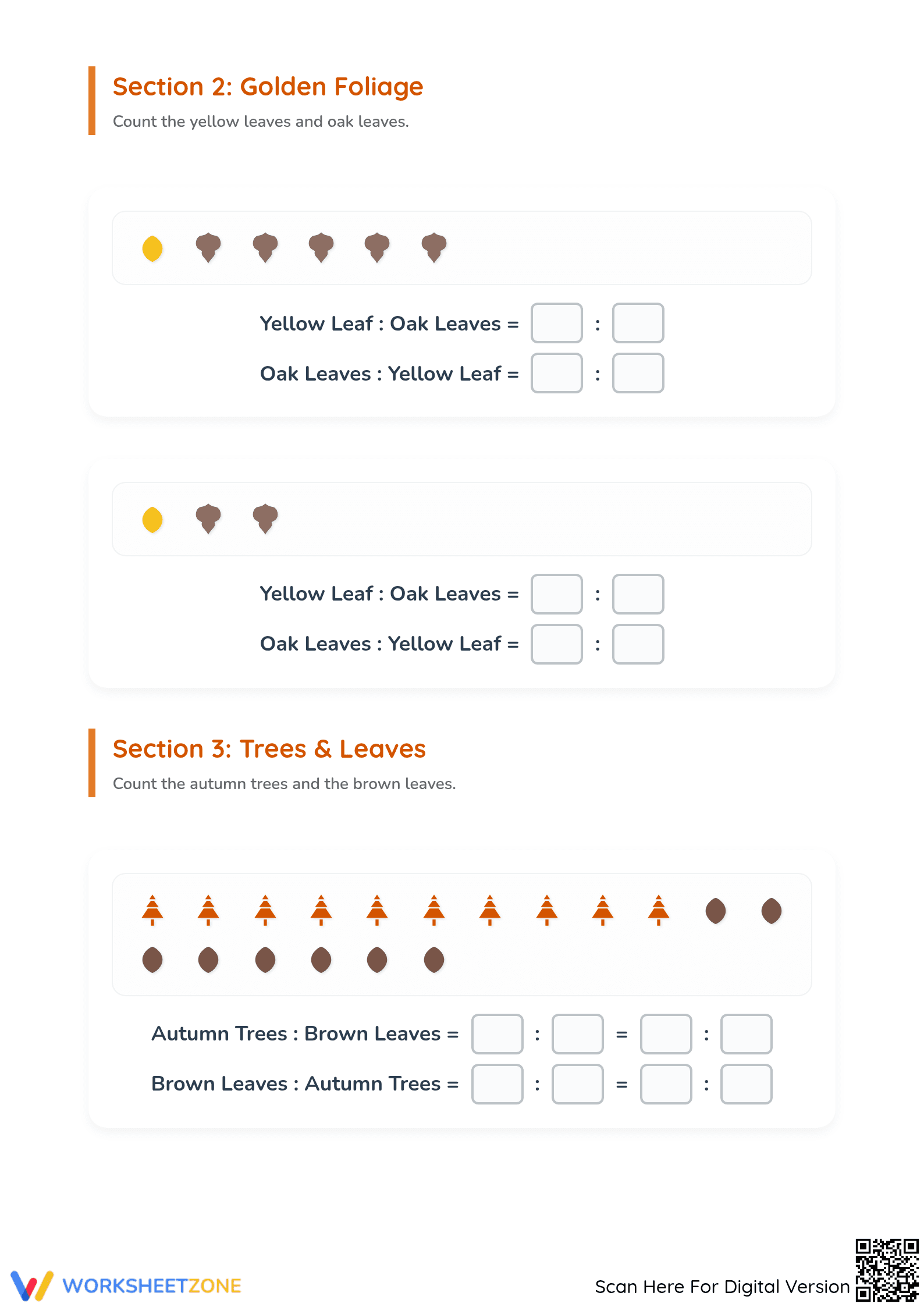
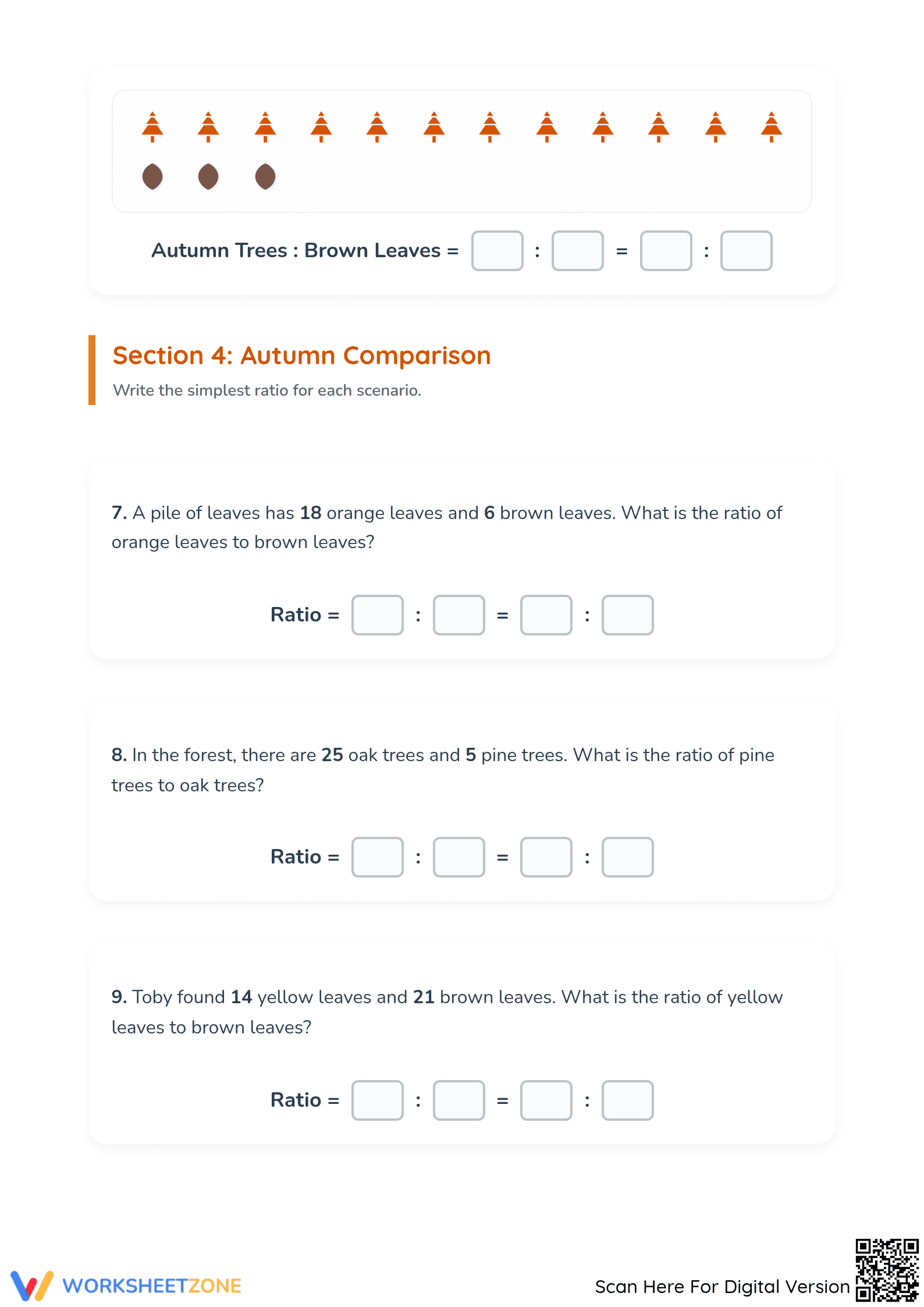
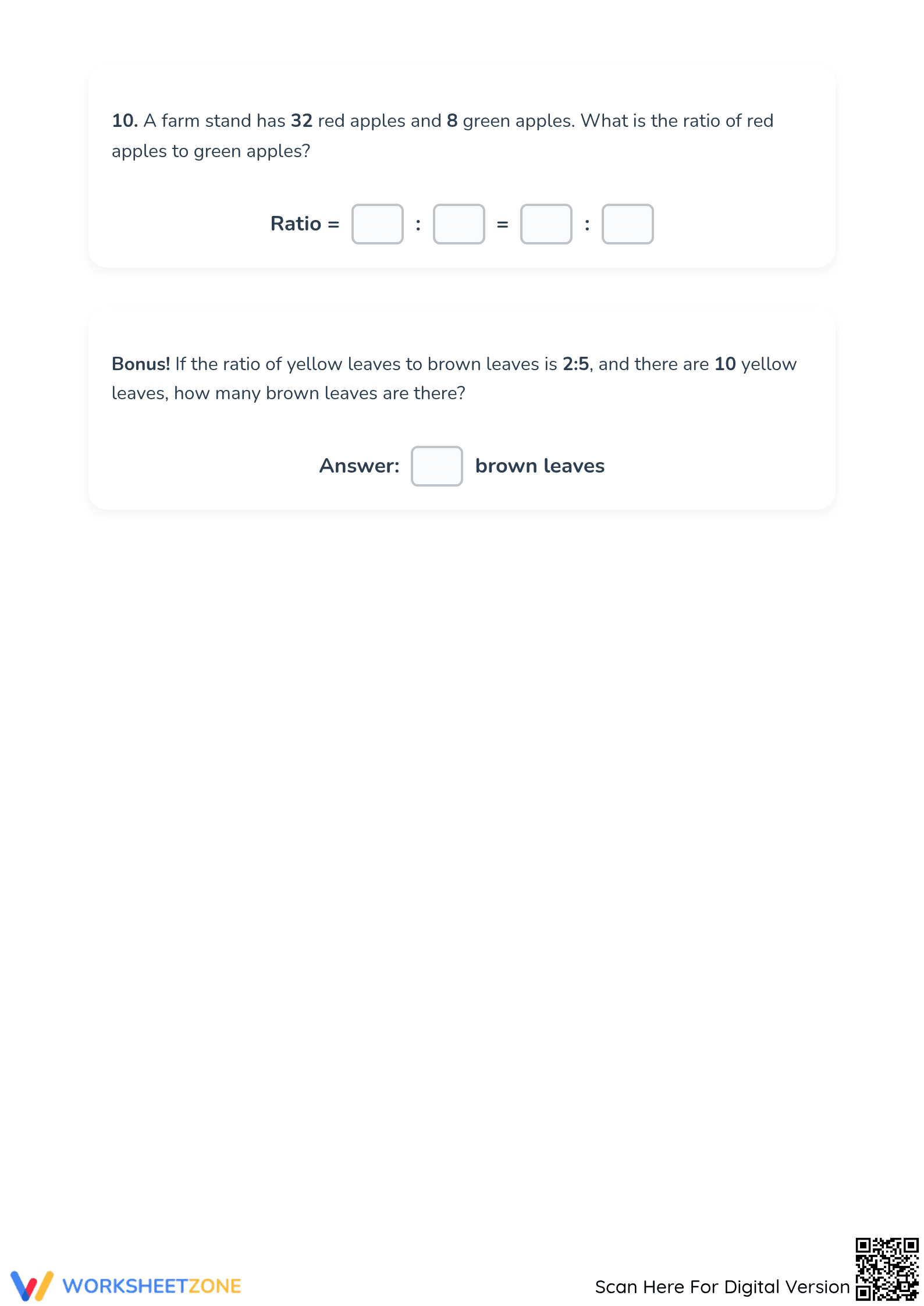
This four-page instructional packet is divided into four distinct sections, each building upon the last to reinforce mastery. The first three sections utilize high-quality clipart of brown leaves, oak leaves, golden foliage, and autumn trees to provide concrete visual scaffolds. Section 4 transitions to abstract word problems, including a bonus challenge that tests higher-order thinking. A full answer key is provided for efficient grading and student self-reflection.
Skill Progression
- Guided Practice: Students count specific autumn objects in Sections 1 and 2, establishing the consistent pattern of part-to-part comparison through visual sets.
- Supported Practice: Section 3 introduces mixed objects, requiring differentiation and introducing the concept of simplified, equivalent ratios for the first time.
- Independent Practice: The final section presents word problems and a bonus task, challenging students to apply knowledge to text-based scenarios without visual aid.
This gradual-release model ensures students move confidently from visual identification to abstract mathematical application.
Standards Alignment
The primary standard addressed is 6.RP.A.1: "Understand the concept of a ratio and use ratio language to describe a ratio relationship between two quantities." While often introduced later, these visual counting tasks serve as an essential precursor to multiplicative comparison and proportional thinking. Both standard codes can be copied directly into lesson plans, IEP goals, or district curriculum mapping tools.
How to Use It
This resource is best utilized during the 'You Do' phase of a lesson on ratios or as a comprehensive formative assessment. After direct instruction on ratio notation, assign the first two pages to check for understanding of part-to-part relationships. Use the final page as an exit ticket to observe if students can apply their knowledge to word problems. Expect completion in approximately 30 minutes, depending on the level of student independence.
Who It's For
This worksheet is designed for Grade 3 students ready for enrichment, as well as older students requiring remedial support in proportional reasoning. It pairs naturally with a math center focused on autumn themes or a direct instruction lesson on fractions and comparisons. The visual scaffolds make it accessible for English Language Learners and students with processing needs.
According to the RAND AIRS 2024 report, the use of concrete visual models is critical for bridging the gap between arithmetic and algebraic thinking. Research indicates that students who master visual ratios before abstract notation show higher proficiency in solving complex proportional problems in later grades. This worksheet aligns with the Fisher & Frey (2014) gradual release framework, providing scaffolds that are systematically removed as tasks increase in complexity. By grounding concepts in a familiar seasonal theme, the resource reduces cognitive load and increases engagement. The word problems in Section 4 ensure students are not merely counting but are interpreting mathematical language in context, a key indicator of long-term mastery. This systematic approach supports the development of fluency in ratio relationships, preparing students for success in middle school mathematics.


