


























Views
Downloads
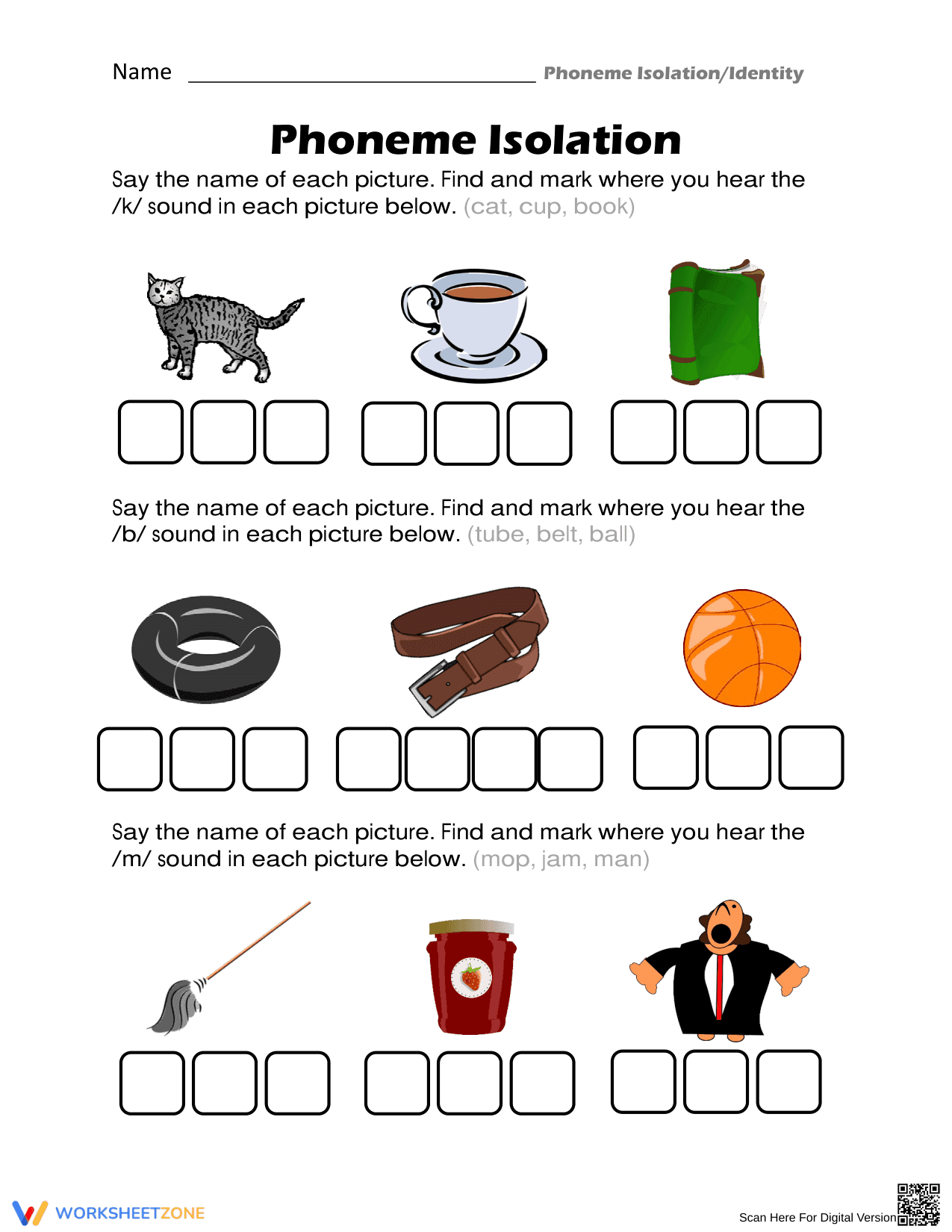

Essential Phoneme Isolation Worksheet | Grades K-2 Phonics
Paste this activity's link or code into your existing LMS (Google Classroom, Canvas, Teams, Schoology, Moodle, etc.).
Students can open and work on the activity right away, with no student login required.
You'll still be able to track student progress and results from your teacher account.
This Essential Phoneme Isolation worksheet helps students master the foundational phonics skill of identifying specific sounds within words. Students look at 9 vivid illustrations, say the name of each object, and mark the position where they hear the target phoneme. This activity strengthens auditory discrimination and prepares early readers for decoding and spelling success in the classroom.
At a Glance
- Grade: K–2 · Subject: ELA
- Standard:
CCSS.ELA-LITERACY.RF.K.2.D— Isolate and pronounce initial, medial, and final sounds in CVC words- Skill Focus: Phoneme Isolation & Identity
- Format: 1 page · 9 problems · Answer key included · PDF
- Best For: Literacy centers and independent phonics practice
- Time: 10–15 minutes
Inside this one-page PDF, you will find nine structured tasks divided into three sections, each targeting a specific sound: /k/, /b/, and /m/. Each task includes a clear picture (such as a cat, belt, or mop) and a set of boxes representing the beginning, middle, and end of the word. A full answer key is provided to ensure quick and easy grading.
This resource is designed for a zero-prep workflow in any early elementary classroom. Teachers can simply print the page in under 30 seconds and distribute it immediately to students. The clear visual cues and repetitive structure allow students to work independently, making it an ideal choice for emergency sub plans or quick bell-ringer activities.
The primary standard for this resource is `CCSS.ELA-LITERACY.RF.K.2.D`, which requires students to "Isolate and pronounce the initial, medial vowel, and final sounds (phonemes) in three-phoneme (consonant-vowel-consonant, or CVC) words." It also supports RF.1.2.C by focusing on isolating phonemes in spoken words. Both standard codes can be copied directly into lesson plans, IEP goals, or district curriculum mapping tools.
Use this worksheet during small-group instruction to provide guided practice for students struggling with auditory discrimination. Alternatively, assign it as a post-lesson formative assessment to observe how accurately students can locate sounds in different word positions. A completion time of 10 to 15 minutes is expected for most students in the K-2 range.
This activity is perfect for Kindergarten, 1st Grade, and 2nd Grade students who are developing their phonological awareness. It is particularly beneficial for English Language Learners (ELLs) who need visual support to connect spoken sounds to meaningful words. Pair this worksheet with a phonics passage or an anchor chart showing common CVC words for a complete lesson.
Research from Fisher & Frey (2014) emphasizes that explicit instruction in phoneme isolation is a critical precursor to proficient reading. By identifying the position of phonemes like /k/, /b/, and /m/ in words such as "cup" or "book," students build the phonological mapping skills necessary for later decoding tasks. This Grades K-2 worksheet directly addresses the CCSS.ELA-LITERACY.RF.K.2.D standard by providing 9 targeted opportunities for students to practice sound-to-position identification. Educational data from NAEP indicates that students who master phonemic awareness in early grades demonstrate significantly higher reading comprehension scores later in their academic careers. This printable PDF provides the structured, high-frequency practice required to achieve these milestones. The combination of visual prompts and phoneme boxes allows for immediate feedback and reinforces the student's ability to segment spoken words into individual sounds, a skill fundamental to the Science of Reading framework.


