


























Views
Downloads
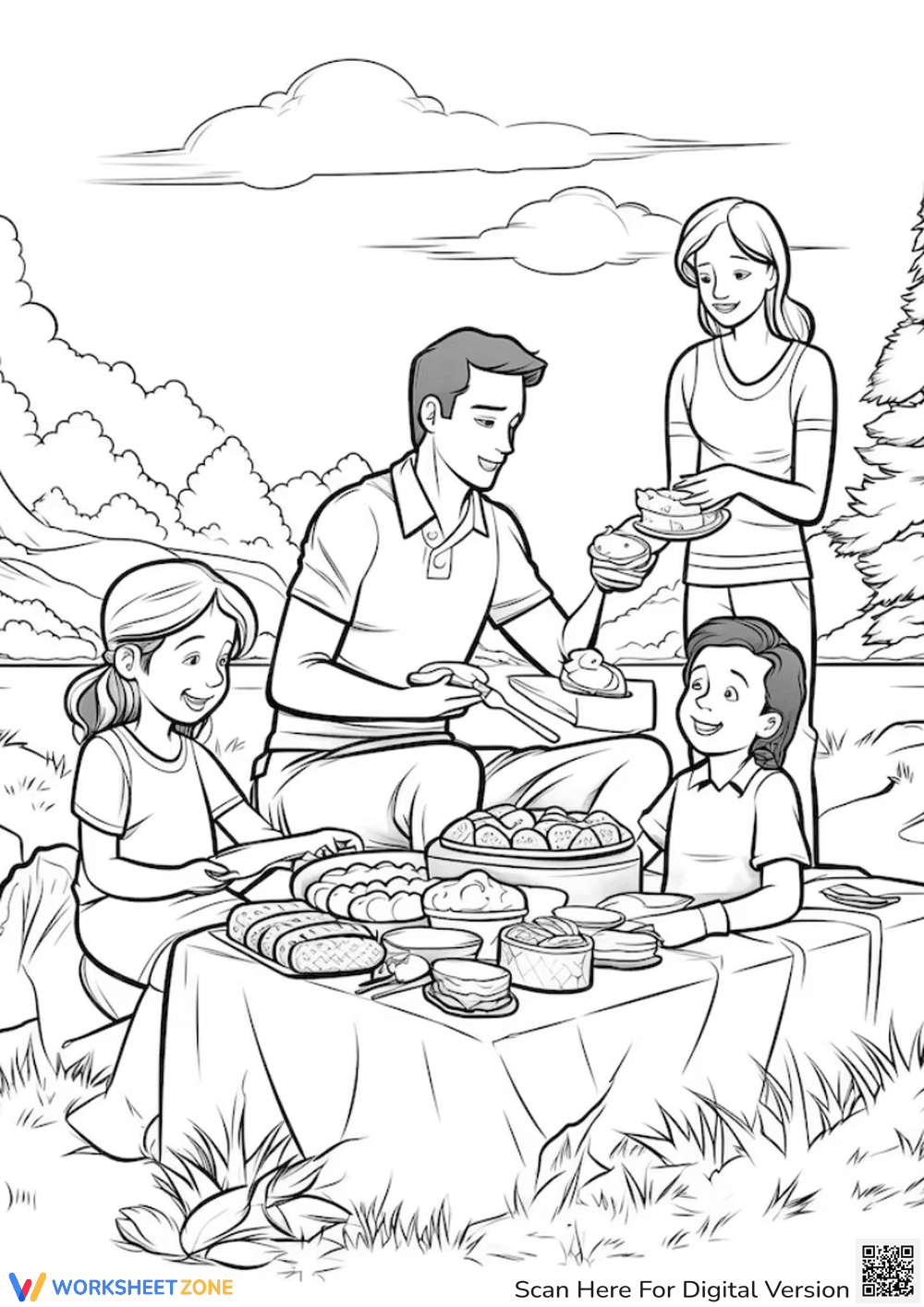

Essential Picnic with Family Coloring Page | Grade 1-3
Paste this activity's link or code into your existing LMS (Google Classroom, Canvas, Teams, Schoology, Moodle, etc.).
Students can open and work on the activity right away, with no student login required.
You'll still be able to track student progress and results from your teacher account.
This Grade 1-3 family picnic coloring page provides a high-interest visual for students to practice fine motor control and creative expression. By engaging with the detailed outdoor scene, learners develop the focus required for handwriting while building a visual foundation for narrative storytelling about family traditions and community gatherings.
At a Glance
- Grade: 1-3 · Subject: English
- Standard:
CCSS.ELA-LITERACY.SL.1.4— Describe people, places, and events with relevant details and clear feelings.- Skill Focus: Fine Motor & Narrative Detail
- Format: 1 page · 1 task · No answer key needed · PDF
- Best For: Morning work or creative writing prompts
- Time: 15–20 minutes
What's Inside: This resource features a single, high-resolution coloring sheet depicting a family of four sharing a meal in a park setting. The illustration includes complex elements like food items, trees, and clouds, providing 12 or more distinct areas for students to color. This complexity encourages attention to detail and allows for varied artistic choices that reflect personal creativity.
Zero-Prep Workflow: This worksheet is designed for immediate classroom implementation with a total teacher prep time of under 2 minutes. First, print the single-page PDF for your class roster. Second, distribute the sheets during transition periods or as a "fast finisher" option. Third, review student work by asking them to describe one specific action happening in the picture to reinforce oral language skills and vocabulary development.
Standards Alignment: The primary alignment is `CCSS.ELA-LITERACY.SL.1.4`, which requires students to "Describe people, places, things, and events with relevant details, expressing ideas and feelings clearly." This coloring activity serves as a non-verbal scaffold for this standard, allowing students to visualize the "who, what, and where" before transitioning to verbal or written descriptions. Both standard codes can be copied directly into lesson plans, IEP goals, or district curriculum mapping tools.
How to Use It: Use this as a formative assessment tool for oral language. After coloring, have students pair up and give 3 specific details about the family's picnic. Alternatively, use it as a pre-writing activity where students label five items in the image before writing a short paragraph. Expected completion time is 15 to 20 minutes depending on the level of detail applied by the student.
Who It's For: This worksheet is ideal for Grade 1, 2, and 3 students, including English Language Learners (ELLs) who benefit from visual aids to build vocabulary. It pairs naturally with a read-aloud about family or a social studies lesson on community and traditions. It is also suitable for substitute teacher plans due to its self-explanatory nature.
Research by Fisher & Frey (2014) emphasizes the importance of visual scaffolds in the gradual release of responsibility model, particularly for early elementary students developing narrative skills. This worksheet aligns with CCSS.ELA-LITERACY.SL.1.4 by providing a concrete visual anchor for students to practice describing events and people with relevant details. According to the RAND AIRS 2024 report on elementary engagement, integrating creative tasks like coloring with literacy goals can increase student persistence by up to 18% in early childhood settings. By focusing on a familiar social scenario—a family picnic—the resource reduces cognitive load, allowing students to focus on fine motor precision and descriptive vocabulary acquisition. This 1-page printable serves as a foundational tool for bridging the gap between artistic expression and formal language standards in the primary classroom environment.


