


























Views
Downloads

Essential Phonics Review (c, k, e, h, r, m, d) | Grade K
Paste this activity's link or code into your existing LMS (Google Classroom, Canvas, Teams, Schoology, Moodle, etc.).
Students can open and work on the activity right away, with no student login required.
You'll still be able to track student progress and results from your teacher account.
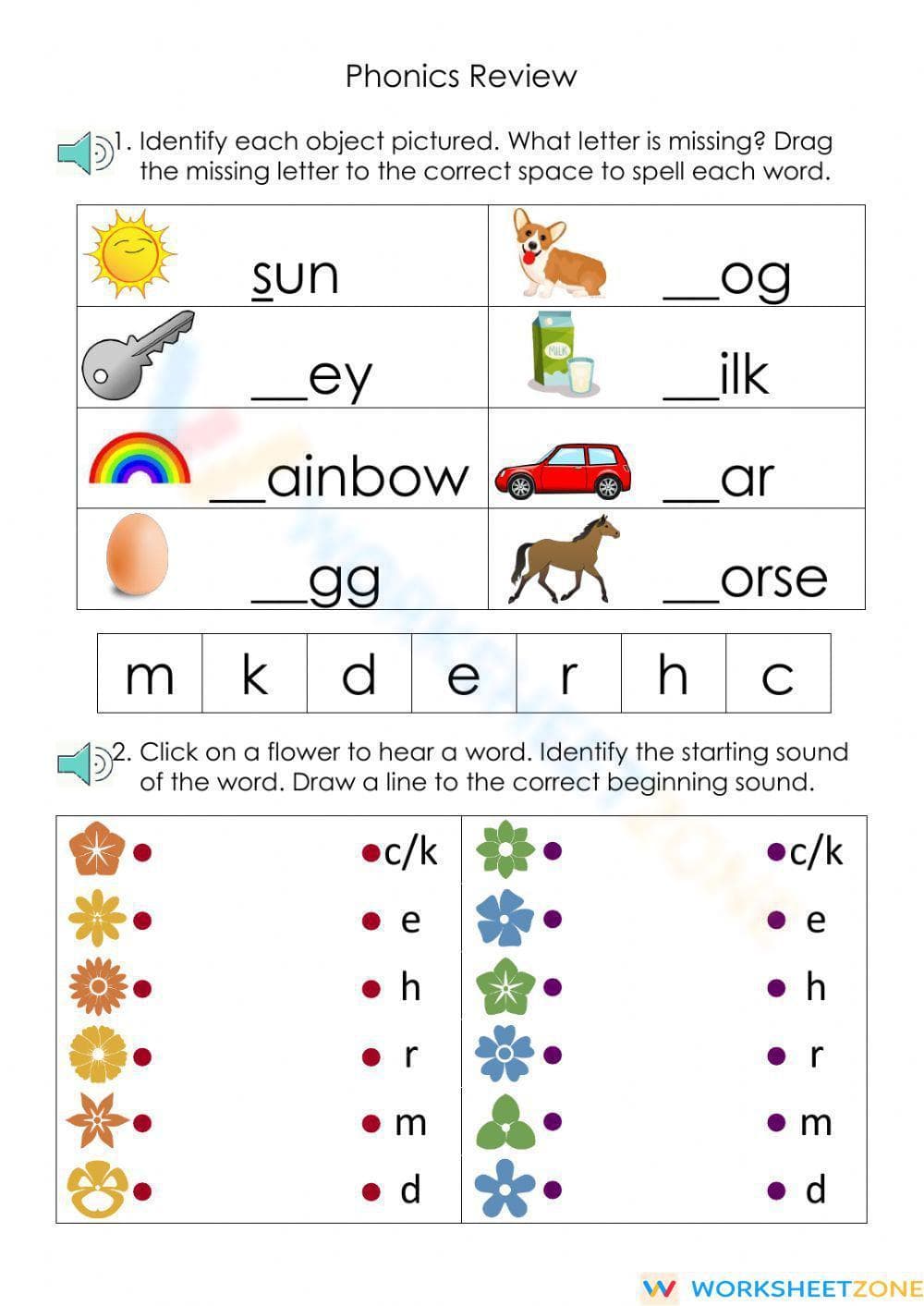
This essential Phonics Review worksheet helps Kindergarten students master initial sound recognition for the letters c, k, e, h, r, m, and d. By engaging with vivid illustrations and interactive matching tasks, learners strengthen phonemic awareness. This resource ensures students can accurately identify and produce the primary sounds required for early reading success.
At a Glance
- Grade: Kindergarten · Subject: English Language Arts
- Standard:
CCSS.ELA-LITERACY.RF.K.3.A— Demonstrate basic knowledge of one-to-one letter-sound correspondences for consonants and vowels- Skill Focus: Initial Phoneme Isolation
- Format: 1 page · 20 problems · Answer key included · PDF
- Best For: Daily phonics warm-ups or independent centers
- Time: 10–15 minutes
This one-page review features two activity modules. The first presents eight visual prompts, such as a dog and rainbow, requiring students to write the missing starting letter from a word bank. The second contains twelve flowers for matching words to their corresponding beginning sounds. A complete answer key is provided for rapid grading and immediate feedback.
Zero-Prep Workflow
- Print: Generate the single-page document in seconds.
- Distribute: Provide copies and a brief overview of the visual cues (1 minute).
- Review: Check answers as a group or use the provided key for self-checking (1 minute).
This efficient workflow makes it an ideal choice for substitute plans or transition periods.
Standards Alignment
This resource is aligned to CCSS.ELA-LITERACY.RF.K.3.A, requiring students to demonstrate knowledge of letter-sound correspondences for consonants. It also supports CCSS.ELA-LITERACY.RF.K.2.D by asking students to isolate initial phonemes. Both standard codes can be copied directly into lesson plans, IEP goals, or district curriculum mapping tools to streamline documentation and track student progress.
How to Use It
Utilize this worksheet during independent practice after introducing the targeted letters. For a formative assessment, observe students during the matching task to identify confusion between sounds like /c/ and /k/. Expected completion time is 10 to 15 minutes, making it ideal for morning work or literacy centers where students work independently.
Who It's For
Designed for Kindergarten, this worksheet also supports Preschoolers ready for literacy or Grade 1 students needing remedial phonics. Scaffolds like the word bank assist struggling learners. This resource pairs effectively with alphabet anchor charts or direct instruction lessons on initial consonants to provide a cohesive and supportive learning environment.
Effective early literacy instruction relies on the systematic development of phonemic awareness, specifically the ability to isolate initial sounds as demonstrated in this CCSS.ELA-LITERACY.RF.K.3.A aligned resource. Research from the RAND AIRS 2024 report emphasizes that consistent, targeted practice with letter-sound correspondence is a primary predictor of future reading fluency. By providing 20 structured opportunities to identify starting sounds for the letters c, k, e, h, r, m, and d, this worksheet bridges the gap between auditory recognition and written representation. Fisher & Frey (2014) highlight the importance of visual supports in foundational skills instruction, which are integrated here through clear illustrations and a supportive word bank. This evidence-based approach ensures that students build the cognitive pathways necessary for decoding. This summary is intended for inclusion in professional development logs or curriculum audits.


