


























Views
Downloads
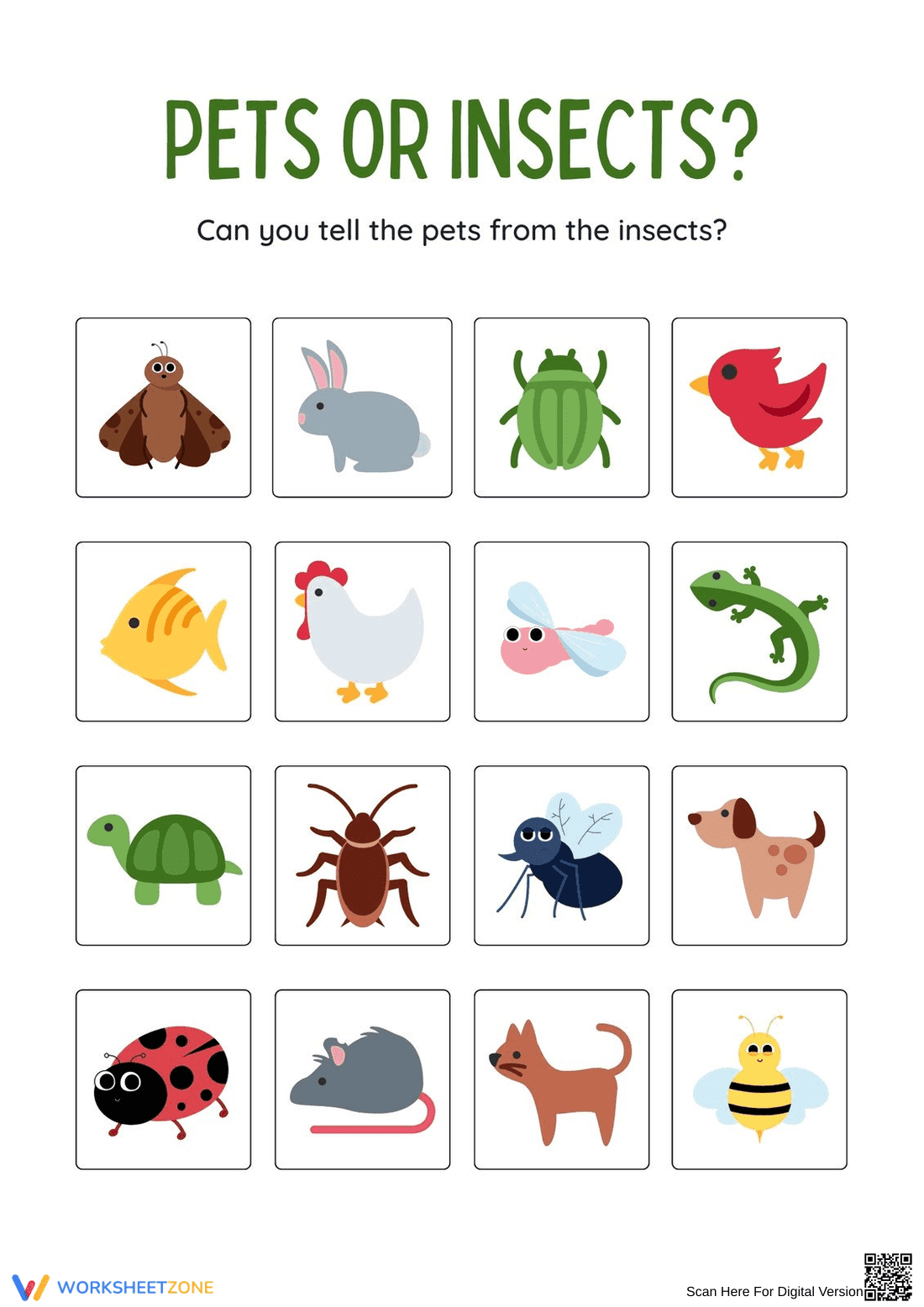

Pets or Insects Sorting Worksheet | Grade K Essential
Paste this activity's link or code into your existing LMS (Google Classroom, Canvas, Teams, Schoology, Moodle, etc.).
Students can open and work on the activity right away, with no student login required.
You'll still be able to track student progress and results from your teacher account.
This Kindergarten animal classification worksheet helps young learners distinguish between common household pets and various insects. By identifying and sorting 16 distinct visual examples, students develop critical observation skills and categorical thinking. This resource provides a clear, engaging way to introduce biological grouping and vocabulary development in early childhood science or language arts lessons.
At a Glance
- Grade: Kindergarten · Subject: Science / ELA
- Standard:
CCSS.ELA-LITERACY.L.K.5.A— Sort common objects into categories to gain a sense of the concepts the categories represent- Skill Focus: Animal classification and sorting
- Format: 1 page · 16 problems · Answer key included · PDF
- Best For: Morning work or science centers
- Time: 10–15 minutes
This single-page PDF features a clean 4x4 grid containing 16 high-quality, colorful illustrations of animals. The selection includes diverse examples such as ladybugs, dogs, fish, and beetles to challenge student recognition. The layout is designed for easy cutting and pasting or simple circling and labeling, making it accessible for students with developing fine motor skills. A full answer key is provided for quick grading.
The workflow for this resource is designed for maximum efficiency. First, print the single-page PDF (30 seconds). Second, distribute the sheets for independent sorting (1 minute). Third, review the answers as a class to reinforce vocabulary (5 minutes). Total teacher preparation time is under 2 minutes, making this ideal for sub plans or transition activities.
The primary alignment for this activity is `CCSS.ELA-LITERACY.L.K.5.A`, which requires students to sort common objects into categories to gain a sense of the concepts the categories represent. Additionally, it supports NGSS K-LS1-1 by encouraging students to observe patterns in different types of living things. Both standard codes can be copied directly into lesson plans, IEP goals, or district curriculum mapping tools.
Use this worksheet during the "Explore" phase of a life science unit on animals. After discussing what makes an animal a pet versus a wild insect, have students complete the sorting task to demonstrate their understanding. It also serves as an excellent formative assessment tool; observe if students struggle with "edge cases" like the lizard or mouse to identify needs for further direct instruction. Expected completion time is 10 to 15 minutes.
This resource is tailored for Kindergarten students, though it is highly effective for English Language Learners (ELL) and students in special education programs who benefit from visual-heavy tasks. It pairs naturally with an anchor chart showing "Pet Needs" versus "Insect Characteristics" or a read-aloud book about animal habitats.
Categorization tasks are fundamental to early cognitive development, as they require students to identify defining attributes. This worksheet aligns with the instructional recommendations found in the RAND AIRS 2024 report, which emphasizes the importance of visual scaffolding in early literacy and science integration. By engaging with 16 specific examples, students practice the "sort common objects into categories" requirement of CCSS.ELA-LITERACY.L.K.5.A. Research by Fisher & Frey (2014) suggests that such structured sorting activities facilitate the gradual release of responsibility, moving students from teacher-led identification to independent mastery of conceptual groupings. This printable resource provides the necessary repetition for students to internalize the distinctions between domestic animals and insects, ensuring they meet foundational benchmarks in both ELA and Life Science. The clear imagery reduces cognitive load, allowing learners to focus entirely on the logic of classification.


