




























Views
Downloads
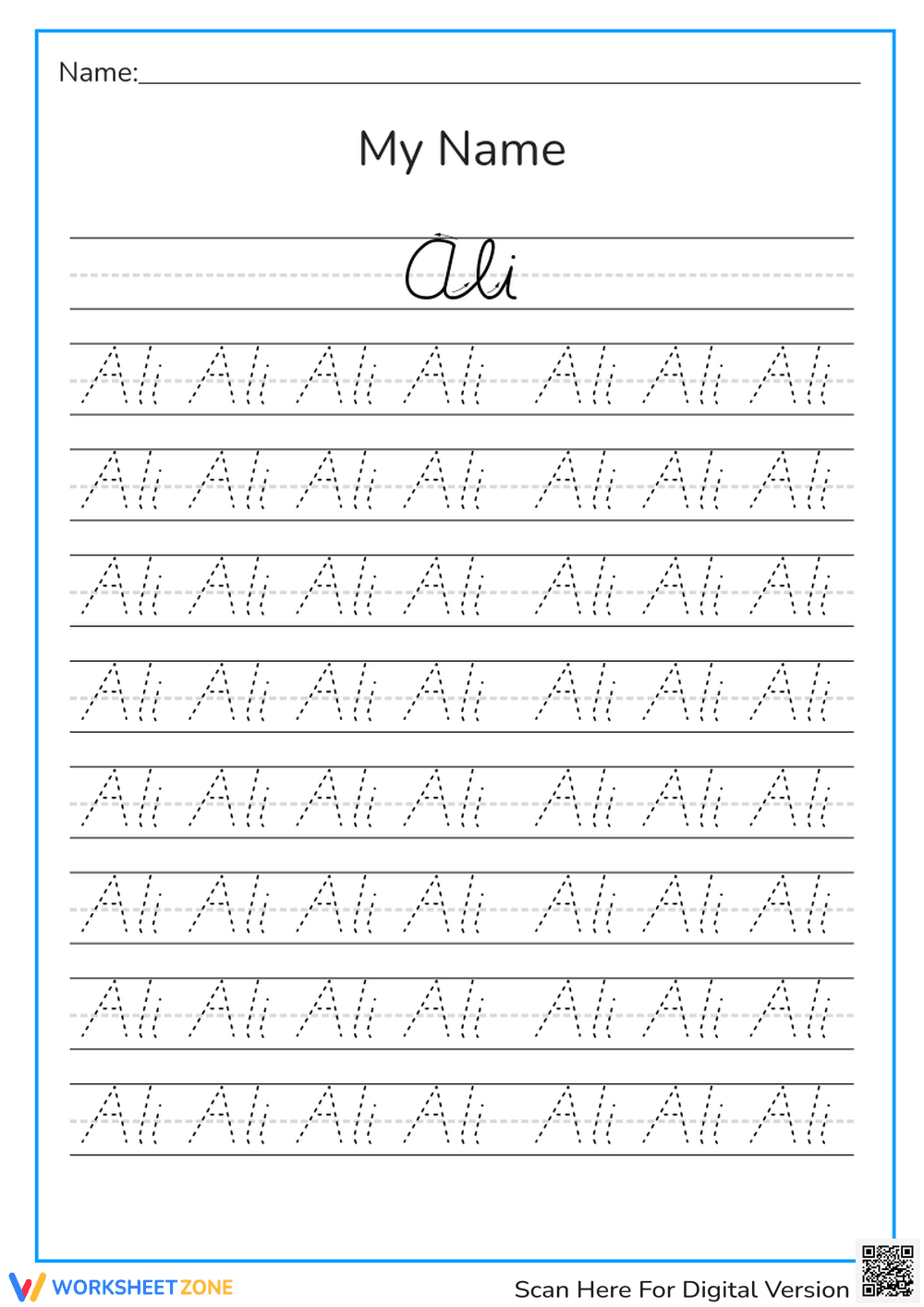

Name Tracing Worksheet: Ali | Essential Grade K-1

Paste this activity's link or code into your existing LMS (Google Classroom, Canvas, Teams, Schoology, Moodle, etc.).
Students can open and work on the activity right away, with no student login required.
You'll still be able to track student progress and results from your teacher account.
This Grade K-1 name tracing worksheet helps students master the specific letter formations for the name Ali. By providing repetitive, structured practice, students develop the muscle memory and fine motor control necessary for legible handwriting. This resource ensures early learners gain confidence in identifying and writing their own names independently.
At a Glance
- Grade: Kindergarten · Subject: Handwriting
- Standard:
CCSS.ELA-LITERACY.L.K.1.A— Print many upper- and lowercase letters accurately- Skill Focus: Name tracing and letter formation
- Format: 1 page · 64 problems · Answer key N/A · PDF
- Best For: Morning work or daily handwriting practice
- Time: 10–15 minutes
This single-page PDF features a clear, large model of the name "Ali" at the top, complete with directional arrows to guide proper stroke order. Below the model, students will find 8 rows of dotted-line text, providing 64 individual tracing opportunities. The layout is clean and distraction-free, focusing entirely on the repetitive motion required for handwriting mastery.
The workflow for this resource is designed for maximum efficiency. First, print the single-page PDF (30 seconds). Second, distribute the sheets to students during morning arrival or center rotations (1 minute). Finally, review student progress by checking for proper pencil grip and stroke direction as they work (ongoing). Total teacher preparation time is under 2 minutes, making it an ideal sub-plan or bell-ringer activity.
This worksheet aligns with `CCSS.ELA-LITERACY.L.K.1.A`, which requires students to print many upper- and lowercase letters. By focusing on a specific name, it also supports `CCSS.ELA-LITERACY.RF.K.1.B` regarding the recognition of letter sequences in written words. Both standard codes can be copied directly into lesson plans, IEP goals, or district curriculum mapping tools.
Use this worksheet as a formative assessment tool during the first weeks of school to observe student fine motor readiness. It is best assigned after a brief direct instruction session on pencil grip. Expect students to complete the full page in 10 to 15 minutes. Observe if students follow the directional arrows on the model to ensure they are not drawing letters from the bottom up.
This resource is designed for preschool, kindergarten, and first-grade students who are learning to write the name Ali. It is particularly helpful for students requiring extra fine motor support or those in English Language Development (ELD) programs. Pair this worksheet with a name-recognition anchor chart or a tactile sand-tracing activity for a multi-sensory approach.
Handwriting remains a foundational literacy skill, as research from Fisher & Frey (2014) emphasizes that the physical act of letter formation reinforces letter recognition and phonological awareness. This worksheet targets CCSS.ELA-LITERACY.L.K.1.A by providing 64 high-repetition tracing tasks for the name Ali. According to the RAND AIRS 2024 report, consistent low-stakes practice with familiar words like a student's own name significantly reduces cognitive load, allowing early learners to focus on the mechanics of grip and stroke. By utilizing dotted-line scaffolds and directional arrows, this resource bridges the gap between guided and independent writing. Educators can use this tool to document progress in fine motor development, which is a key predictor of later academic success in writing. The structured layout ensures that students receive the high-frequency exposure necessary to move from tracing to free-hand production of their personal identifier.


