


























Views
Downloads

Essential Personal Pronouns Worksheet | Grade 1-5 ELA
Paste this activity's link or code into your existing LMS (Google Classroom, Canvas, Teams, Schoology, Moodle, etc.).
Students can open and work on the activity right away, with no student login required.
You'll still be able to track student progress and results from your teacher account.
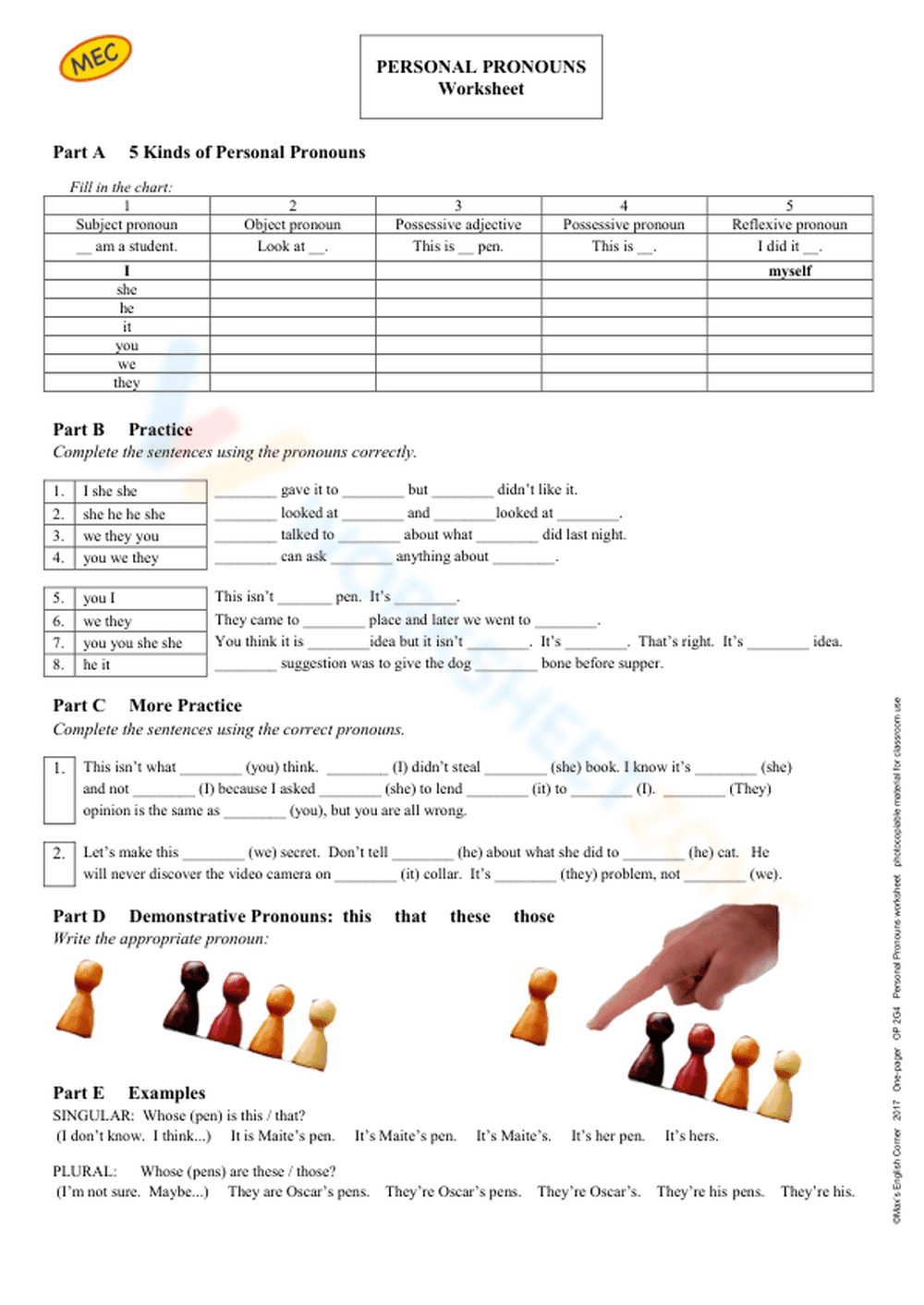
This comprehensive personal pronouns worksheet provides students with targeted practice to master five categories of pronouns and demonstrative usage. Through structured charts and contextual sentence completion, learners develop the precision required for clear communication. Students will confidently apply subject, object, possessive, and reflexive pronouns in various sentence structures.
At a Glance
- Grade: 1–5 · Subject: ELA
- Standard:
CCSS.ELA-LITERACY.L.1.1.D— Use personal and possessive pronouns like I, me, and my accurately in sentences- Skill Focus: Personal and Demonstrative Pronouns
- Format: 1 page · 60+ problems · Answer key included · PDF
- Best For: End-of-unit grammar review, morning work, or independent centers
- Time: 20–30 minutes
What's Inside:
This single-page PDF features a logical progression of exercises designed to solidify pronoun mechanics. It begins with a comprehensive reference chart for five pronoun types (Subject, Object, Possessive Adjective, Possessive Pronoun, and Reflexive), followed by sixteen sentence-completion tasks in Part B and another sixteen intensive practice items in Part C. The worksheet concludes with a visual section on demonstrative pronouns (this, that, these, those) and clear comparative examples for singular and plural possessive forms.
Zero-Prep Workflow
This resource follows a three-step efficiency model. First, print the single-page master (under 30 seconds), including the answer key. Second, distribute handouts to students as a bell-ringer or independent task (1 minute). Third, review responses using the provided key for instant formative feedback (under 2 minutes). Its self-explanatory structure makes it ideal for emergency substitute plans or literacy rotations.
Standards Alignment
The primary alignment for this resource is `CCSS.ELA-LITERACY.L.1.1.D`, which requires students to "Use personal, possessive, and indefinite pronouns." This worksheet extends this foundational skill by incorporating reflexive pronouns and demonstrative adjectives. Both standard codes can be copied directly into lesson plans, IEP goals, or district curriculum mapping tools.
How to Use It
Use this worksheet as a summative check after a direct instruction lesson on pronoun-antecedent agreement. During the "You Do" phase of a gradual release model, observe students as they complete Part B to identify common misconceptions regarding object vs. subject pronouns. Alternatively, assign it as a targeted homework task to reinforce the distinctions between possessive adjectives and possessive pronouns.
Who It's For
This resource is optimized for elementary students in Grades 1 through 5, with scaffolds like sentence frames and a reference chart for younger learners and complex paragraphs for older students. It pairs naturally with a mentor text passage that emphasizes dialogue or a direct instruction lesson using a pronoun anchor chart.
Mastering pronoun usage is a critical milestone in early literacy development, as it allows students to reduce redundancy and improve the cohesion of their written work. Research from Fisher & Frey (2014) emphasizes the importance of guided practice and explicit instruction in grammar to bridge the gap between isolated skill acquisition and applied writing proficiency. This worksheet aligns with the CCSS.ELA-LITERACY.L.1.1.D standard by providing the high-repetition practice necessary for students to internalize the complex rules governing personal and possessive pronouns. By engaging with both singular and plural forms across five distinct categories, learners build the linguistic flexibility needed for advanced text production. This instructional resource provides a structured environment for students to move from rote identification to meaningful application, ensuring they maintain clear references within their own compositions. This systematic approach supports long-term retention of grammatical structures and facilitates the transition to more complex academic writing.


