


























Views
Downloads

Grade 5 Atomic Structure — Printable No-Prep Worksheet
Paste this activity's link or code into your existing LMS (Google Classroom, Canvas, Teams, Schoology, Moodle, etc.).
Students can open and work on the activity right away, with no student login required.
You'll still be able to track student progress and results from your teacher account.
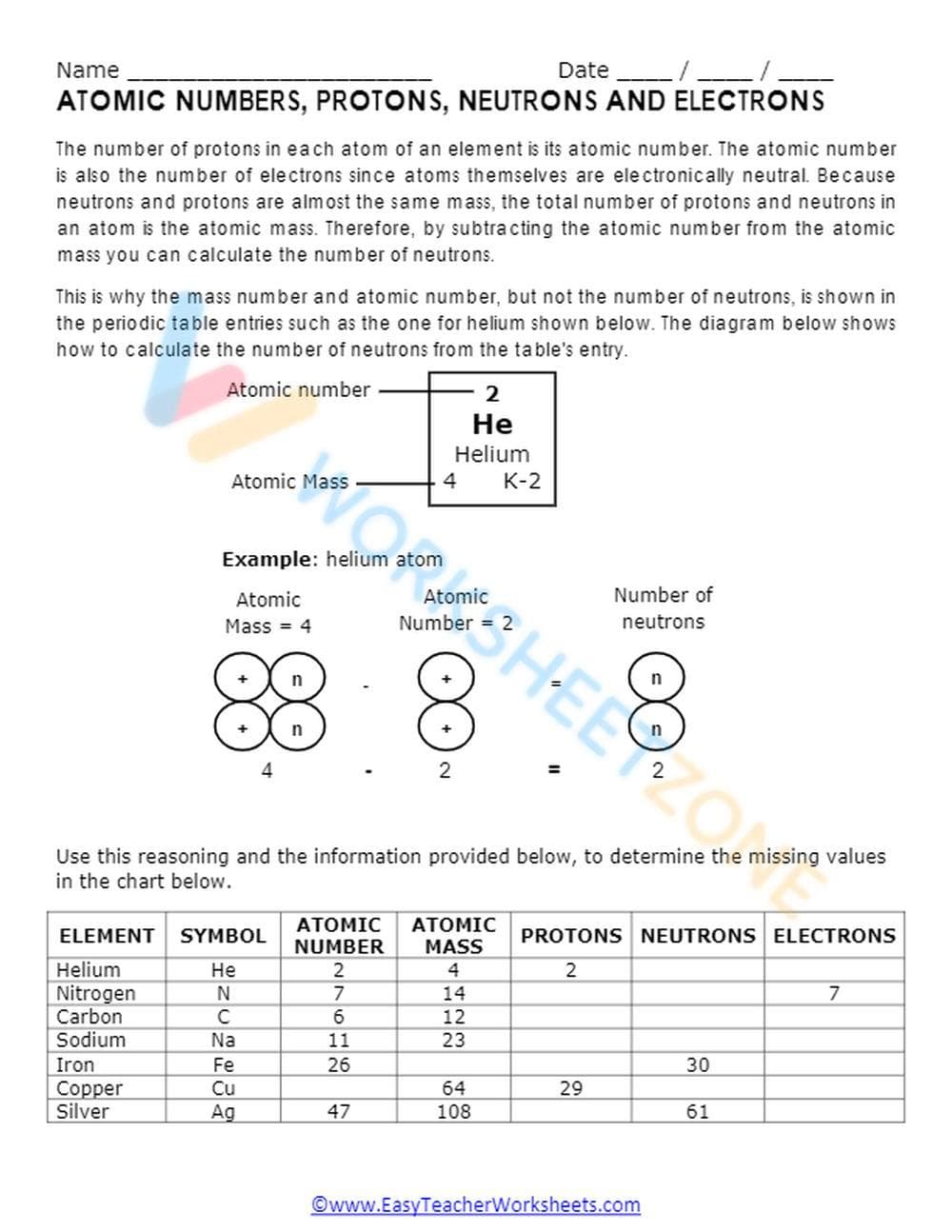
This Grade 5 science worksheet helps students calculate the number of protons, neutrons, and electrons in various atoms. By reading a short informational text and analyzing a visual model of a helium atom, learners will apply their new knowledge to complete a data chart for seven different elements.
At a Glance
- Grade: 5 · Subject: Science
- Standard:
5-PS1-1— Describe that matter is made of particles too small to be seen- Skill Focus: Calculating subatomic particles
- Format: 1 page · 24 problems · Answer key included · PDF
- Best For: Independent practice or sub plans
- Time: 15–20 minutes
Inside this single-page resource, teachers will find a comprehensive reading passage explaining atomic mass and atomic numbers, followed by a clear visual example of a helium atom. The core activity features a 24-cell fill-in-the-blank chart where students determine missing values for elements like carbon, sodium, and iron. A complete answer key is provided to make grading fast and accurate.
This resource is designed for a zero-prep workflow, making it ideal for busy educators.
- Print (1 minute): Simply print the single-page PDF and the accompanying answer key.
- Distribute (1 minute): Hand out the worksheet to students. The built-in reading passage means no prior lecture is strictly required.
- Review (3 minutes): Use the provided key to quickly check student charts or display it on a smartboard for self-grading.
Total teacher prep time is under two minutes, making this an excellent option for emergency sub plans or quick independent work stations.
This worksheet aligns with 5-PS1-1, requiring students to develop a model to describe that matter is made of particles too small to be seen. By calculating protons, neutrons, and electrons, students build a foundational understanding of atomic structure. Both standard codes can be copied directly into lesson plans, IEP goals, or district curriculum mapping tools.
Use this worksheet during direct instruction as a guided practice activity, or assign it after a lesson on the periodic table to reinforce concepts. It takes approximately 15 to 20 minutes to complete. As a formative assessment tip, watch how students calculate the number of neutrons; if they forget to subtract the atomic number from the atomic mass, pause and review the helium example provided at the top of the page.
This resource is designed for fifth-grade general education science students, though it serves as an excellent review for middle schoolers. The embedded reading passage and visual models provide natural differentiation for visual learners and students who need immediate reference material. Pair this worksheet with a large classroom periodic table or an introductory video on atoms for a complete lesson experience.
Understanding atomic structure is a critical stepping stone for advanced scientific literacy. According to a ScienceDirect TpT Analysis, providing students with integrated reading passages alongside data charts significantly improves their ability to process complex scientific concepts independently. This worksheet supports 5-PS1-1 by helping students describe that matter is made of particles too small to be seen. When learners actively calculate protons, neutrons, and electrons, they transition from abstract memorization to concrete application. The visual models and step-by-step examples embedded in this resource reduce cognitive load, allowing students to focus on mastering the mathematical relationships between atomic mass and atomic number. By integrating literacy and math skills into science practice, educators can foster deeper comprehension, build confidence in data analysis, and better prepare students for future chemistry coursework.


