


























Views
Downloads



Printable Percent Increase and Decrease Worksheet | Grade 7
Paste this activity's link or code into your existing LMS (Google Classroom, Canvas, Teams, Schoology, Moodle, etc.).
Students can open and work on the activity right away, with no student login required.
You'll still be able to track student progress and results from your teacher account.
Students often struggle with identifying which value serves as the denominator in percentage change calculations. This Grade 7 math worksheet clarifies the process by providing 15 targeted problems that require students to determine the original amount, find the difference, and calculate the final percentage. By the end of this session, learners will confidently distinguish between increase and decrease scenarios.
At a Glance
- Grade: 7 · Subject: Math
- Standard:
7.RP.A.3— Use proportional relationships to solve multi-step ratio and percent increase and decrease problems- Skill Focus: Percent Increase and Decrease Calculations
- Format: 3 pages · 15 problems · Answer key included · PDF
- Best For: Homework, formative assessment, or independent practice
- Time: 25–35 minutes
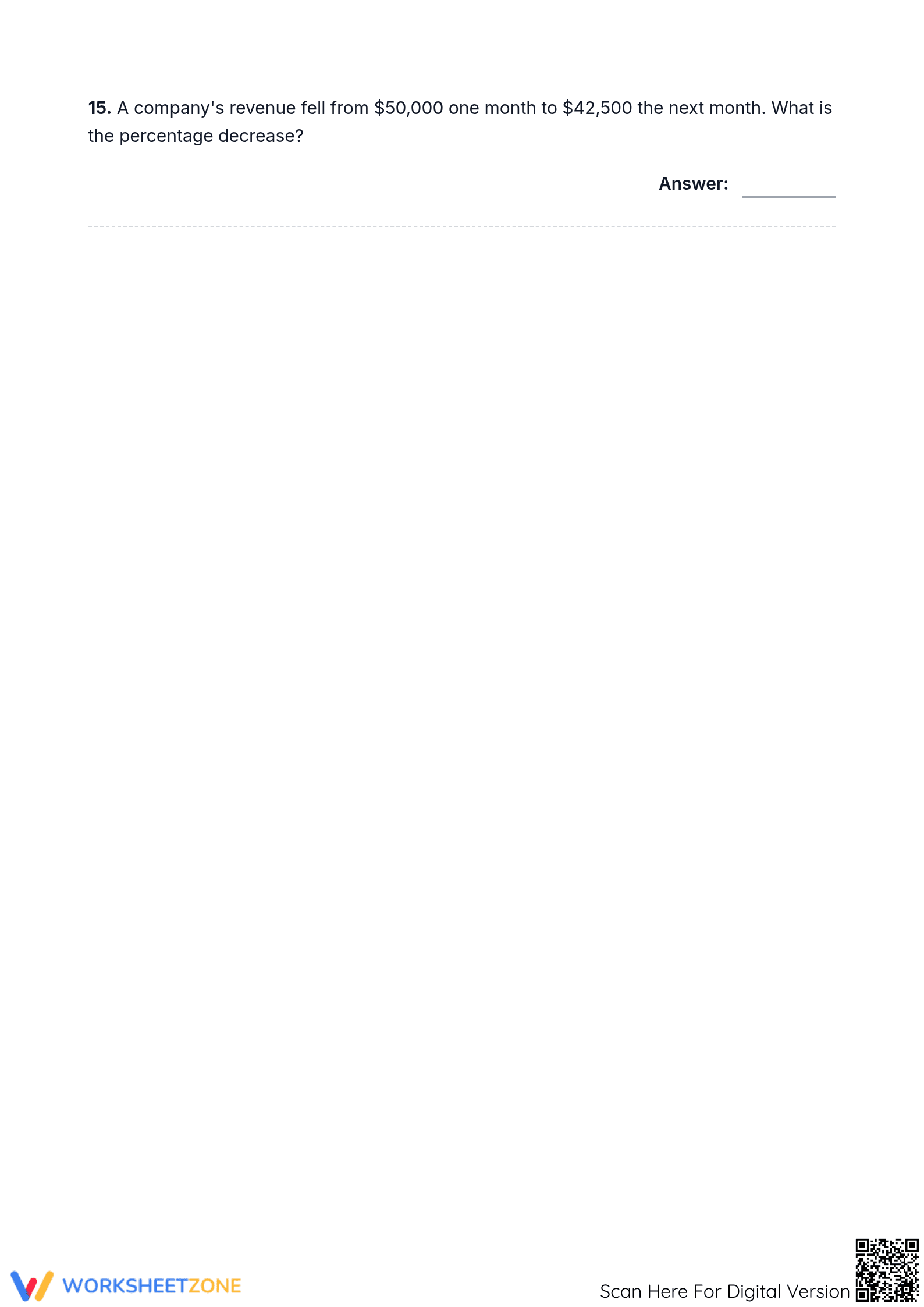
This comprehensive 3-page PDF resource contains two distinct sections designed for mathematical mastery. The first section includes 10 table-based computational problems where students track numerical shifts from an original amount to a new amount. The second section increases the challenge with 5 contextual word problems involving real-world currency and membership data. A full answer key is provided for immediate feedback.
Skill Progression
- Guided practice: The initial problems use small, manageable numbers (e.g., 100 to 81) to help students internalize the formula without computational overload.
- Supported practice: Middle-tier problems introduce larger values and require students to first determine if the change represents an increase or decrease before calculating the exact percentage.
- Independent practice: The concluding word problems remove visual scaffolds, forcing students to extract relevant data from narrative text and perform multi-step proportional reasoning.
The resource follows a gradual-release model, transitioning students from teacher-led computation to independent problem-solving.
Standards Alignment
This worksheet is directly aligned with CCSS.MATH.CONTENT.7.RP.A.3, which mandates that students use proportional relationships to solve multi-step ratio and percent problems. Specifically, it targets the "percent increase and decrease" component of the standard. This standard code can be copied directly into lesson plans, IEP goals, or district curriculum mapping tools.
How to Use It
Use this worksheet as a mid-lesson formative assessment after introducing the percentage change formula. During the independent practice phase, observe students to see if they are incorrectly using the "new amount" as the divisor—a common misconception. This resource is also ideal for a 30-minute homework assignment or a structured review session prior to a summative unit test on ratios.
Who It's For
This resource is designed for seventh-grade students but serves as an excellent remedial tool for eighth graders or an enrichment activity for advanced sixth graders. It naturally pairs with a visual anchor chart demonstrating the "change over original" ratio or a brief direct instruction lesson on retail markups and discounts.
The CCSS.MATH.CONTENT.7.RP.A.3 standard requires Grade 7 students to use proportional relationships to solve multi-step ratio and percent problems, specifically focusing on percent increase and decrease calculations. Research from Fisher & Frey (2014) emphasizes the importance of gradual release of responsibility in mathematical fluency, moving from scaffolded computation to independent application in word problems. This resource aligns with that methodology by pairing 10 computational fluency drills with 5 real-world scenarios, ensuring students can transition from the mechanics of the "change over original" formula to conceptual understanding in contexts like retail pricing and population shifts. According to the RAND AIRS 2024 report on mathematical instructional materials, high-quality practice sets that bridge the gap between abstract number sets and contextualized word problems lead to significantly higher retention rates in middle school learners. This worksheet provides a critical bridge, allowing educators to assess procedural skill and higher-order application of proportional reasoning.


