


























Views
Downloads

Essential Ratios and Proportions Worksheet | Grade 8 Math
Paste this activity's link or code into your existing LMS (Google Classroom, Canvas, Teams, Schoology, Moodle, etc.).
Students can open and work on the activity right away, with no student login required.
You'll still be able to track student progress and results from your teacher account.
This essential Grade 8 math worksheet provides a comprehensive review of ratios and proportional relationships, focusing on both direct and inverse proportions. Students will solve real-world problems, interpret tables, and analyze graphs to demonstrate mastery of core mathematical concepts. This resource ensures students can calculate values across different units and understand varying rate relationships through structured practice.
At a Glance
- Grade: 8 · Subject: Math
- Standard:
CCSS.MATH.CONTENT.7.RP.A.3— Use proportional relationships to solve multi-step ratio and percent problems accurately.- Skill Focus: Direct and Inverse Proportions
- Format: 5 pages · 20 problems · Answer key included · PDF
- Best For: Homework, independent practice, or test preparation
- Time: 40–50 minutes
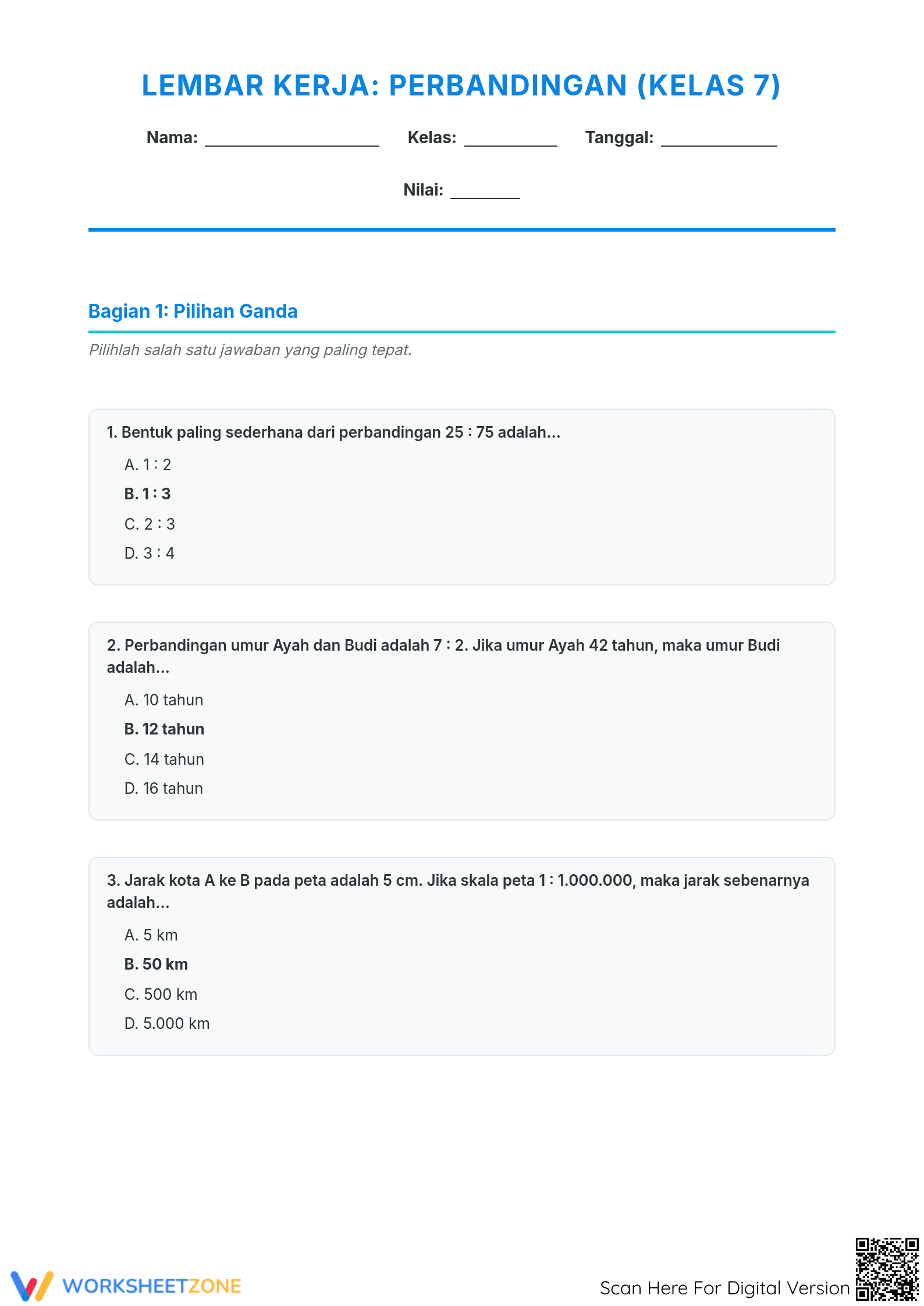
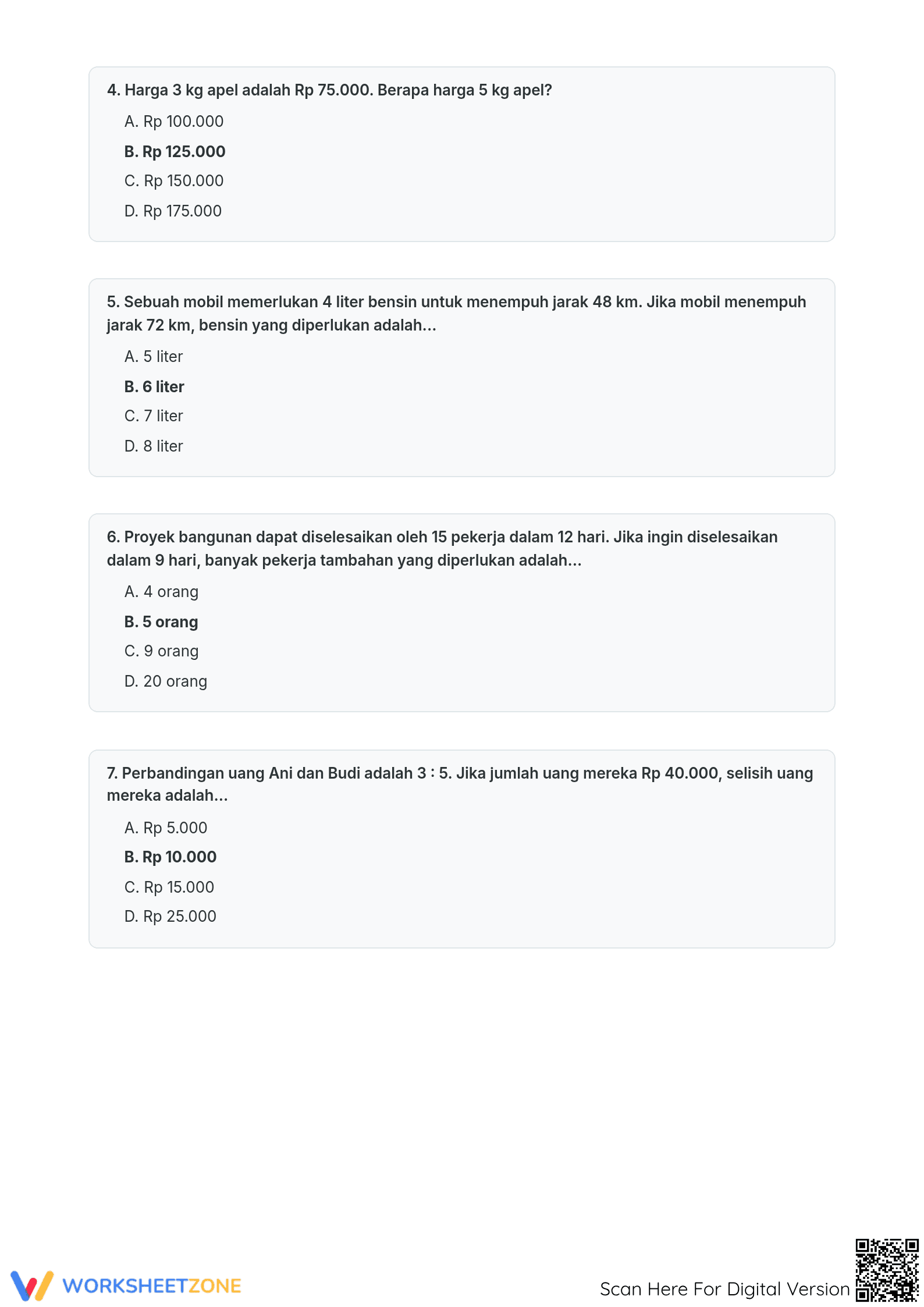
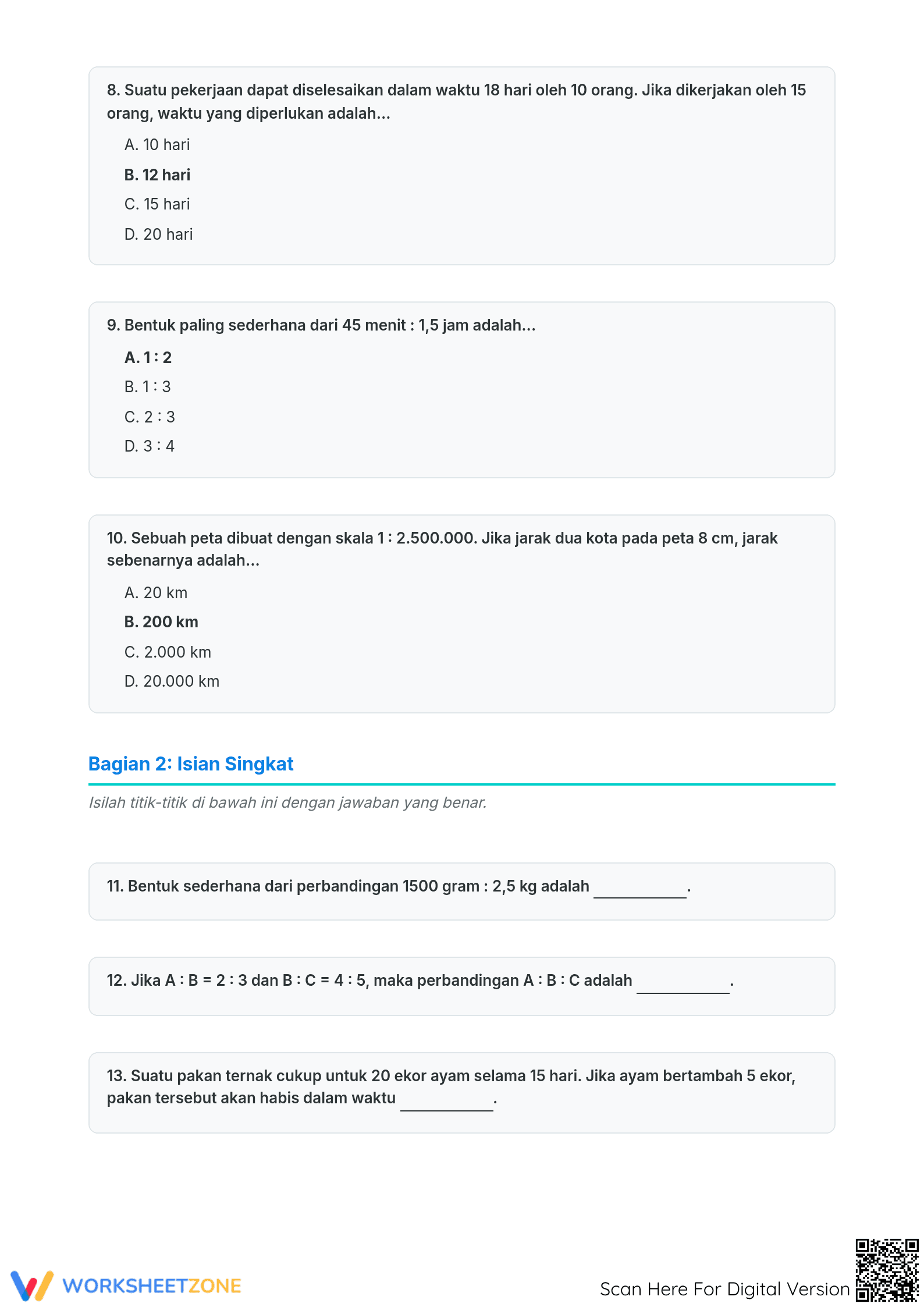
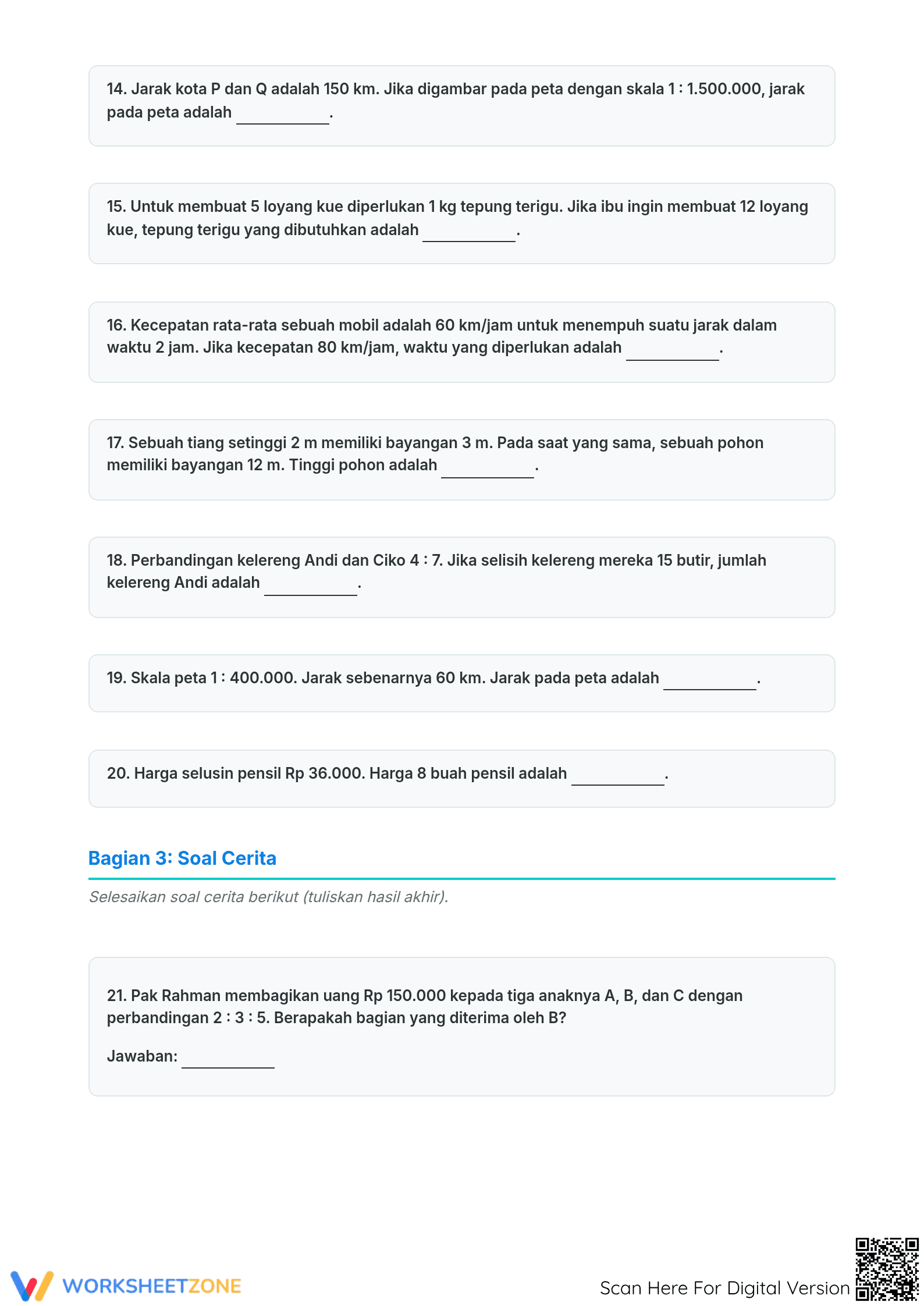
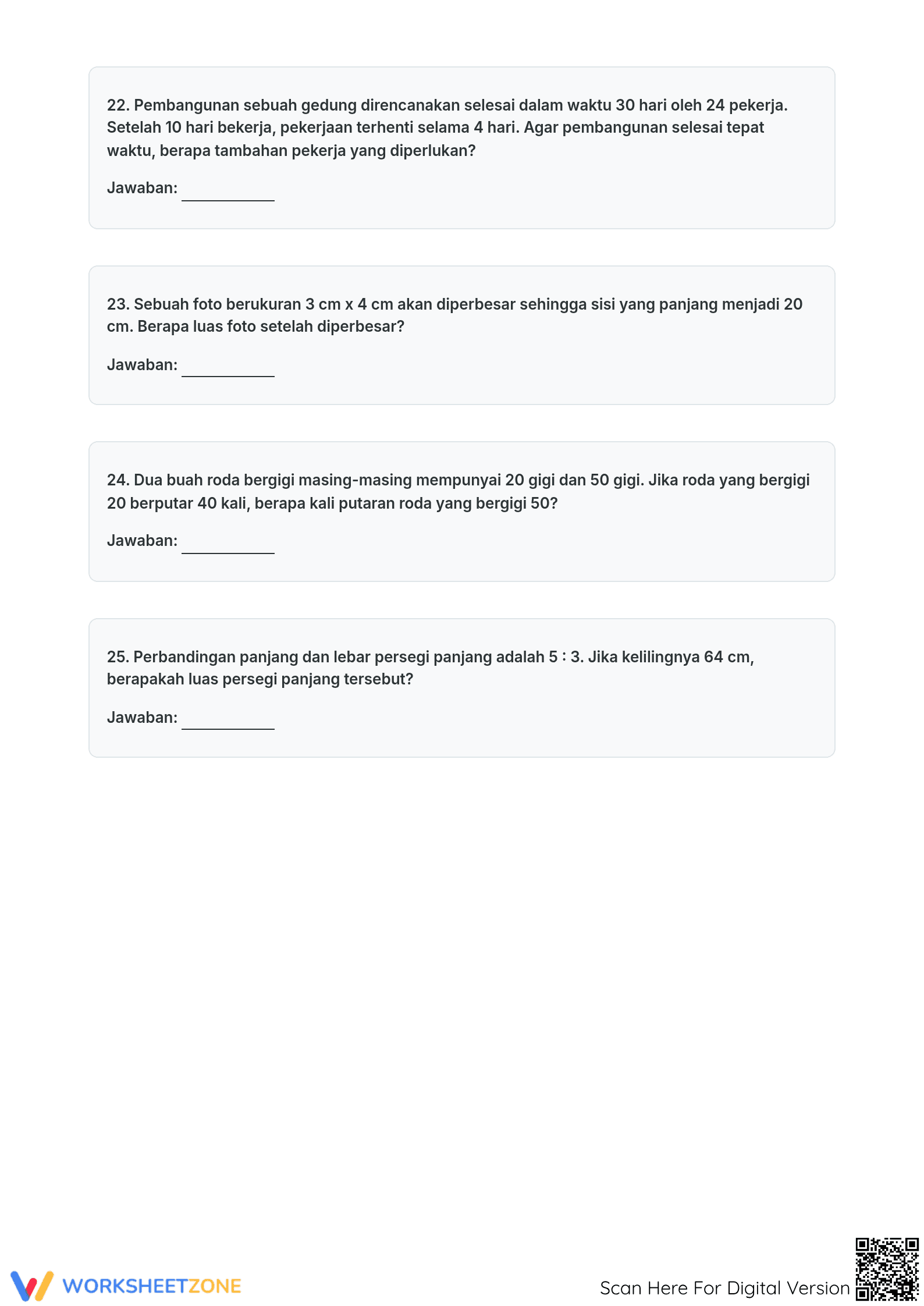
What's Inside: This packet contains 5 pages of focused practice, including multiple-choice questions and extended response items. The first two pages present 10 multiple-choice problems covering unit conversions and direct proportions. Page 3 provides 5 essay-style questions for deeper application, while the final pages include table-based and graphical representations. A full answer key is provided to facilitate self-grading or quick teacher review.
Skill Progression
- Guided Practice: The initial 5 problems offer structured scenarios with clear units, allowing students to identify basic ratio relationships with minimal scaffolding.
- Supported Practice: Questions 6-10 introduce inverse proportions and unit conversions (e.g., kg to grams), requiring students to apply multi-step reasoning.
- Independent Practice: The final section requires students to construct their own tables and interpret graphical data without prompts.
This gradual release approach ensures that students build confidence before tackling complex, abstract proportional relationships autonomously.
Standards Alignment
The primary focus is CCSS.MATH.CONTENT.7.RP.A.3, which requires students to "use proportional relationships to solve multistep ratio and percent problems." Additionally, the inclusion of coordinate planes and rate tables supports CCSS.MATH.CONTENT.8.EE.B.5 regarding the graphing of proportional relationships. Both standard codes can be copied directly into lesson plans, IEP goals, or district curriculum mapping tools.
How to Use It
This resource is ideal for use during the independent practice phase of a lesson on rates and proportions. Teachers can assign the multiple-choice section as a formative exit ticket to check for understanding of direct versus inverse relationships. Alternatively, use the graphing section as a collaborative small-group activity to help students visualize how constant rates of change appear on a coordinate plane during instruction.
Who It's For
This worksheet is designed for Grade 8 and Grade 9 students who are mastering middle school algebraic concepts. It is particularly effective for students requiring extra practice with unit consistency and word problem translation. It pairs naturally with a ratio anchor chart or a short instructional video on identifying inverse scenarios in real-world contexts to support diverse learners.
According to the RAND AIRS 2024 report on mathematical literacy, consistent practice with proportional reasoning is the strongest predictor of success in high school Algebra I. This worksheet addresses that need by focusing on CCSS.MATH.CONTENT.7.RP.A.3. By solving 20 distinct problems ranging from unit-rate identification to graphical analysis, learners develop the "mental flexibility" required to distinguish between direct and inverse relationships. Research from the NAEP highlights that students who navigate the transition from arithmetic ratios to algebraic proportions show significantly higher retention in STEM subjects. This resource provides the necessary volume of practice to solidify these foundational skills, ensuring Grade 8 students are prepared for linear functions. It bridges the gap between basic division and functional modeling through rigorous application.


