


























Views
Downloads
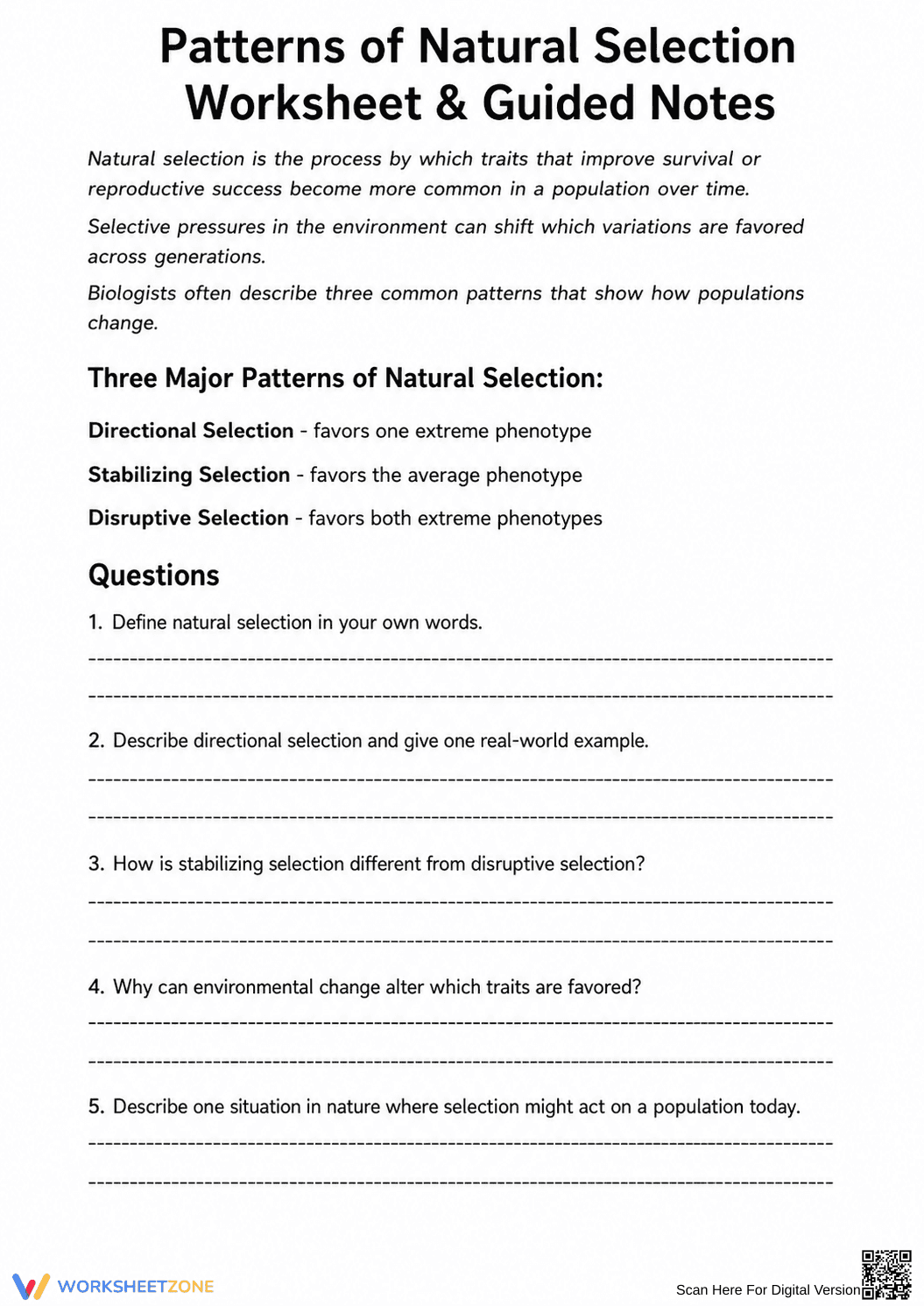

Essential Natural Selection Patterns Worksheet | Grade 10
Paste this activity's link or code into your existing LMS (Google Classroom, Canvas, Teams, Schoology, Moodle, etc.).
Students can open and work on the activity right away, with no student login required.
You'll still be able to track student progress and results from your teacher account.
This comprehensive biology resource helps students master the three primary modes of natural selection by connecting theoretical definitions to real-world biological outcomes. Students will define core evolutionary mechanisms and distinguish between directional, stabilizing, and disruptive selection patterns. By the end of this activity, learners can accurately predict how specific environmental pressures shift phenotype distributions within a population.
At a Glance
- Grade: 10 · Subject: Biology
- Standard:
HS-LS4-3— Explain how organisms with advantageous heritable traits increase in proportion over time- Skill Focus: Patterns of Selection
- Format: 1 page · 5 problems · Answer key included · PDF
- Best For: Quick reinforcement of evolutionary biology concepts
- Time: 15–20 minutes
What's Inside
The worksheet features a guided notes section providing clear definitions for directional, stabilizing, and disruptive selection. Following the text, students engage with five targeted short-answer questions. These tasks require students to synthesize information, provide real-world examples, and compare selective pressures. A full answer key facilitates rapid grading or student self-correction.
Zero-Prep Workflow
- Print (1 minute): Generate enough copies for your class; the single-page layout keeps printing costs low and organization simple.
- Distribute (30 seconds): Hand out the sheets as a transition from direct instruction to independent practice or as a focused warm-up.
- Review (5 minutes): Use the included answer key to conduct a whole-class check, addressing misconceptions about phenotype shifts immediately.
This streamlined process ensures that teacher preparation time remains under two minutes, making it an ideal choice for emergency sub plans or high-impact bell-ringers.
Standards Alignment
This resource aligns with `HS-LS4-3`: "Apply concepts of statistics and probability to support explanations that organisms with an advantageous heritable trait tend to increase in proportion to organisms lacking this trait." It also supports middle school life science standards regarding the role of environment in natural selection. Both standard codes can be copied directly into lesson plans, IEP goals, or district curriculum mapping tools.
How to Use It
Deploy this worksheet during the "Explain" or "Elaborate" phase of a 5E lesson cycle. It serves as an excellent formative assessment tool immediately following a lecture on evolutionary mechanisms. Teachers should observe student responses to question three to ensure they can articulate the specific differences between stabilizing and disruptive selection, which are frequently confused. Expect students to complete the full page in approximately 15 to 20 minutes.
Who It's For
This resource is designed for high school biology students and advanced middle school life science learners. It is particularly effective for students who benefit from structured guided notes and clear definitions. Pair this worksheet with a visual slide deck or a population simulation lab to provide a multi-modal learning experience that reinforces the statistical nature of evolutionary change.
The Patterns of Natural Selection Worksheet provides a rigorous framework for understanding how selective pressures modify population genetics. By focusing on HS-LS4-3, the resource ensures students move beyond simple definitions toward a functional understanding of how advantageous traits proliferate. According to Fisher & Frey (2014), guided notes and structured independent practice facilitate the gradual release of responsibility, allowing students to internalize complex concepts effectively. This worksheet utilizes that approach by providing necessary definitions before challenging students to apply them to novel scenarios. The five distinct tasks ensure students engage with the material multiple times, increasing retention of the differences between directional, stabilizing, and disruptive selection. This evidence-based design supports diverse learners in achieving mastery of core evolutionary principles within a standard class period. This summary is based on the HS-LS4-3 standard and Fisher & Frey (2014) research.


